
MVP List — A Collaborated Weekend Planner Powered by GBrain and GStack
Two tired parents, a one-year-old, and a thousand bookmarked places we keep meaning to visit. Here is the small planning agent we built so that every Saturday no longer starts with the same question: 'so... where are we going today?'

On this page
Built by Victor Zhou and Mia Jia at the YC GBrain & GStack Hackathon, May 16, 2026. Mail us at mvp@zzn.im.
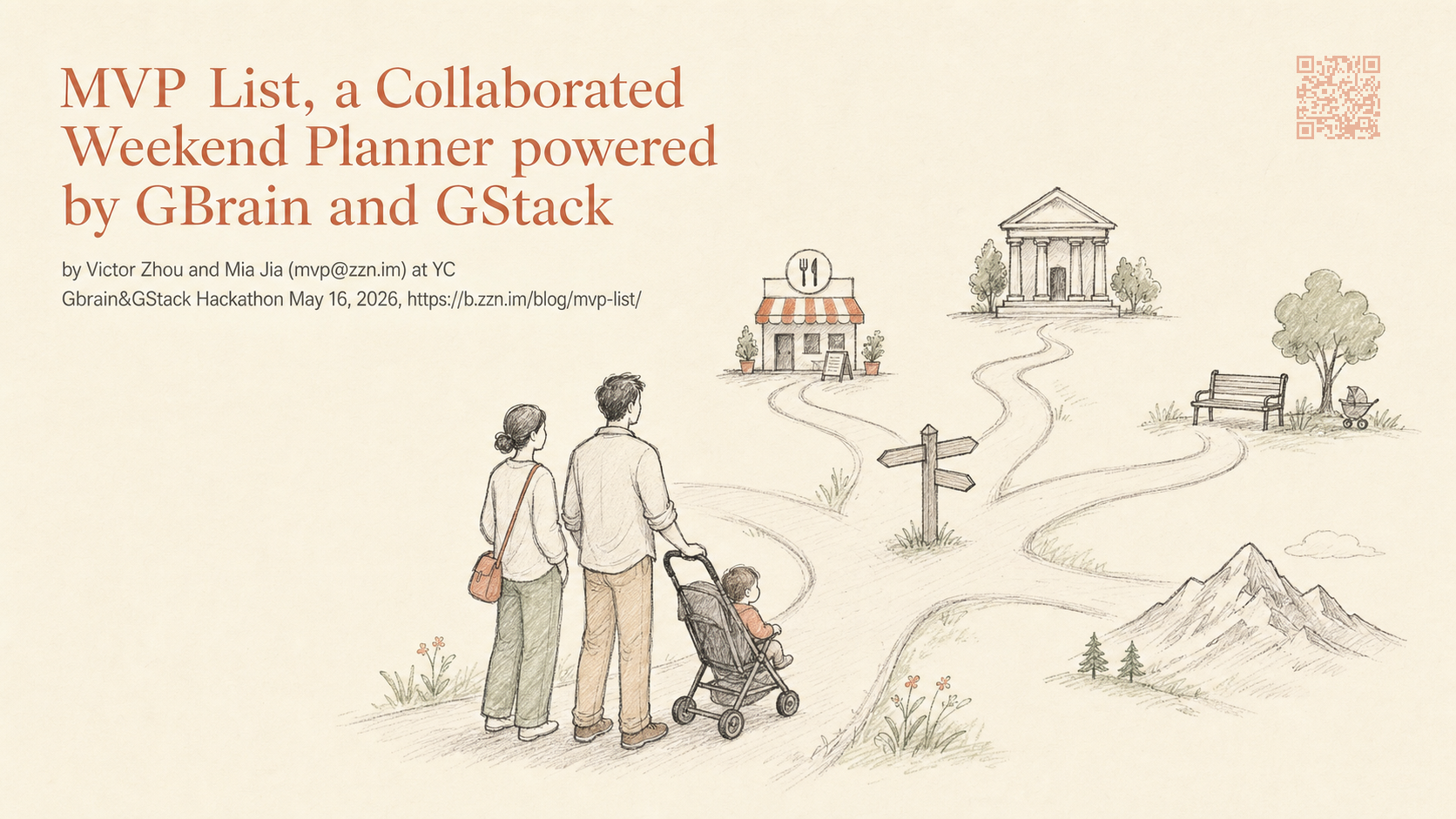
We have a one-year-old. We also have a long, slowly accumulating list of places we’d love to take her — a bakery a friend mentioned, a museum somebody tagged on Instagram, a national park we keep “saving for later.”
By Friday night the list is intimidating instead of inviting. By Saturday morning we are tired, the toddler is louder than the algorithm, and we end up at the same playground we went to last week.
MVP List is the small planning agent we built to fix this. It is not a travel app. It is a personal pipeline that runs quietly in the background, remembers everything we ever bookmarked, and proposes one or two concrete getaway options for the coming weekend — automatically, every Wednesday.
This post walks through how it works.
1. Curate — gather the long tail
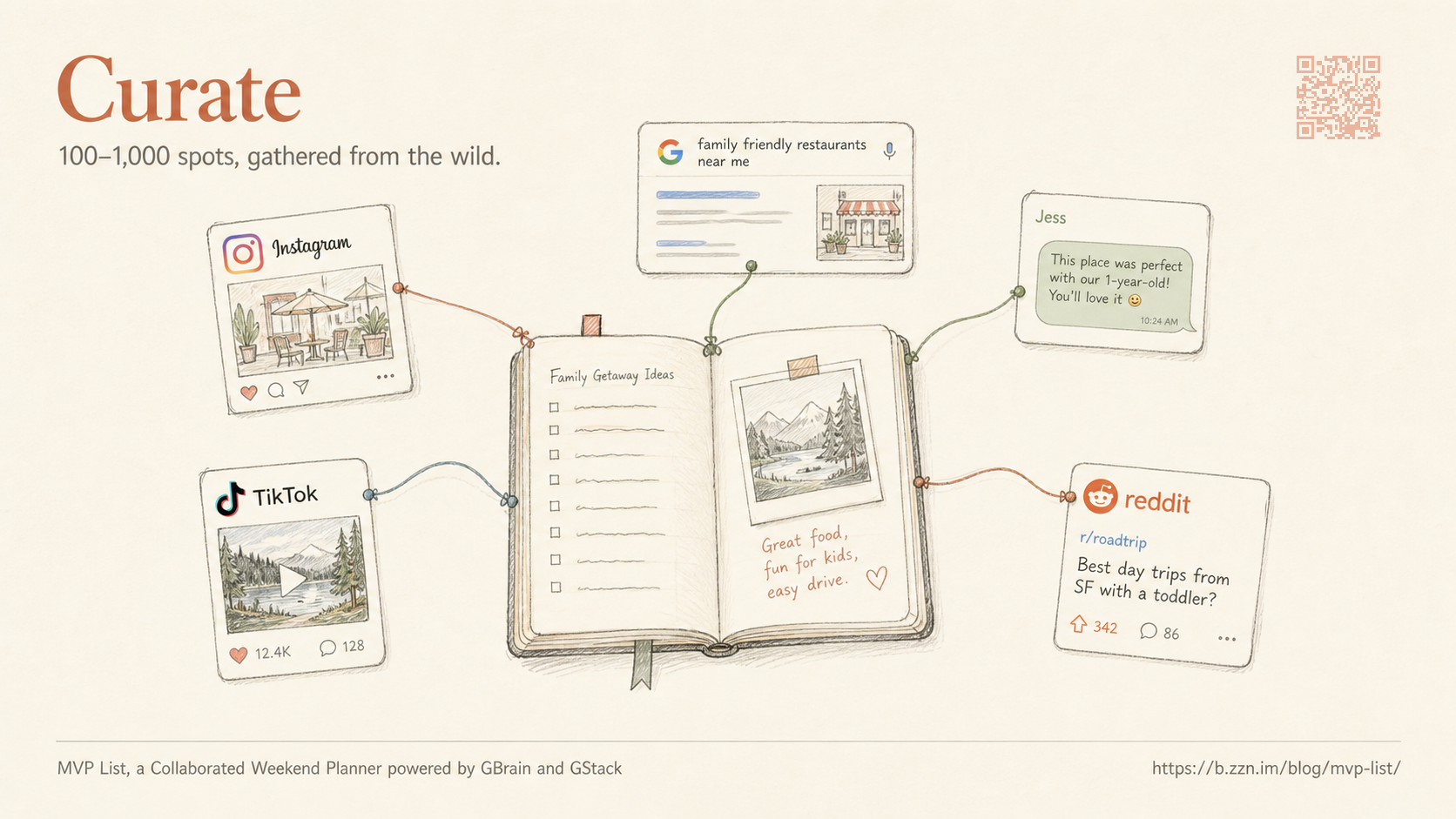
The first step is the most human one. We don’t pretend to discover places algorithmically; we keep doing what we already do — saving an Instagram reel, screenshotting a TikTok, forwarding a Reddit thread, copying a friend’s recommendation.
Realistically, a family like ours accumulates somewhere between 100 and 1,000 candidate spots before it ever becomes useful. The pipeline is designed for that volume from day one. The hard part is not finding places; the hard part is not losing them.
2. Index — structure it with GBrain
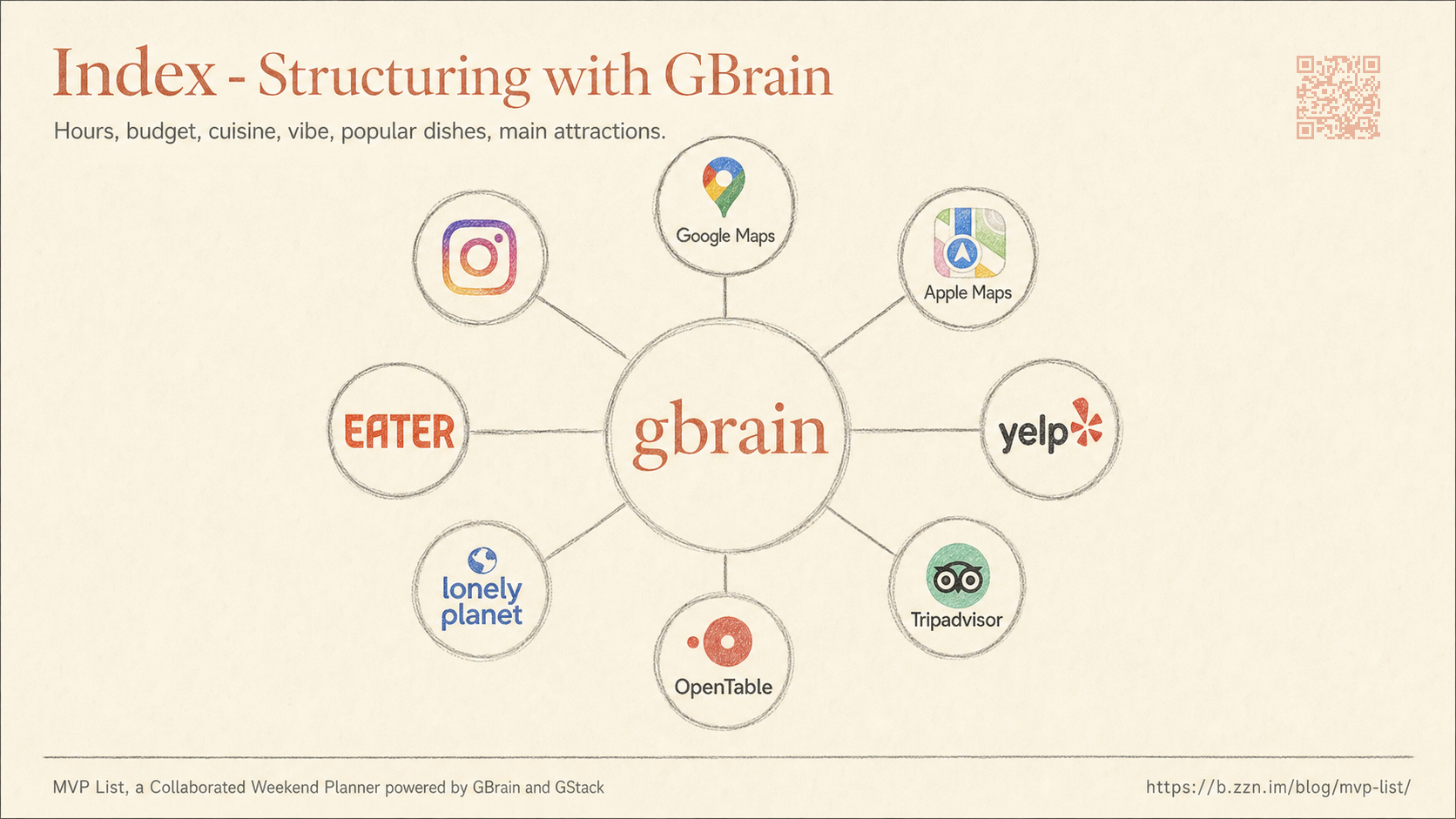
A bookmark is a name. A trip needs a shape. So each candidate gets pulled into GBrain and enriched until it has enough structure to be ranked against the others:
- General — Google Maps and Apple Maps IDs, lat/long, hours of operation, rough budget.
- Restaurants — popular dishes, cuisine type, vibe (date-night-quiet vs. stroller-friendly-loud).
- Attractions — for museums and parks, the main exhibit or trail, plus a short background blurb a parent can read in thirty seconds.
The illustration above shows the eight sources we lean on most: Google Maps, Apple Maps, Yelp, TripAdvisor, Lonely Planet, OpenTable, Instagram, and Eater. GBrain sits in the middle because the value isn’t any single source — it’s having one durable, searchable place where all of them resolve to the same canonical record.
3. Trigger & Ranking — every Wednesday, a funnel from 1,000 to 2
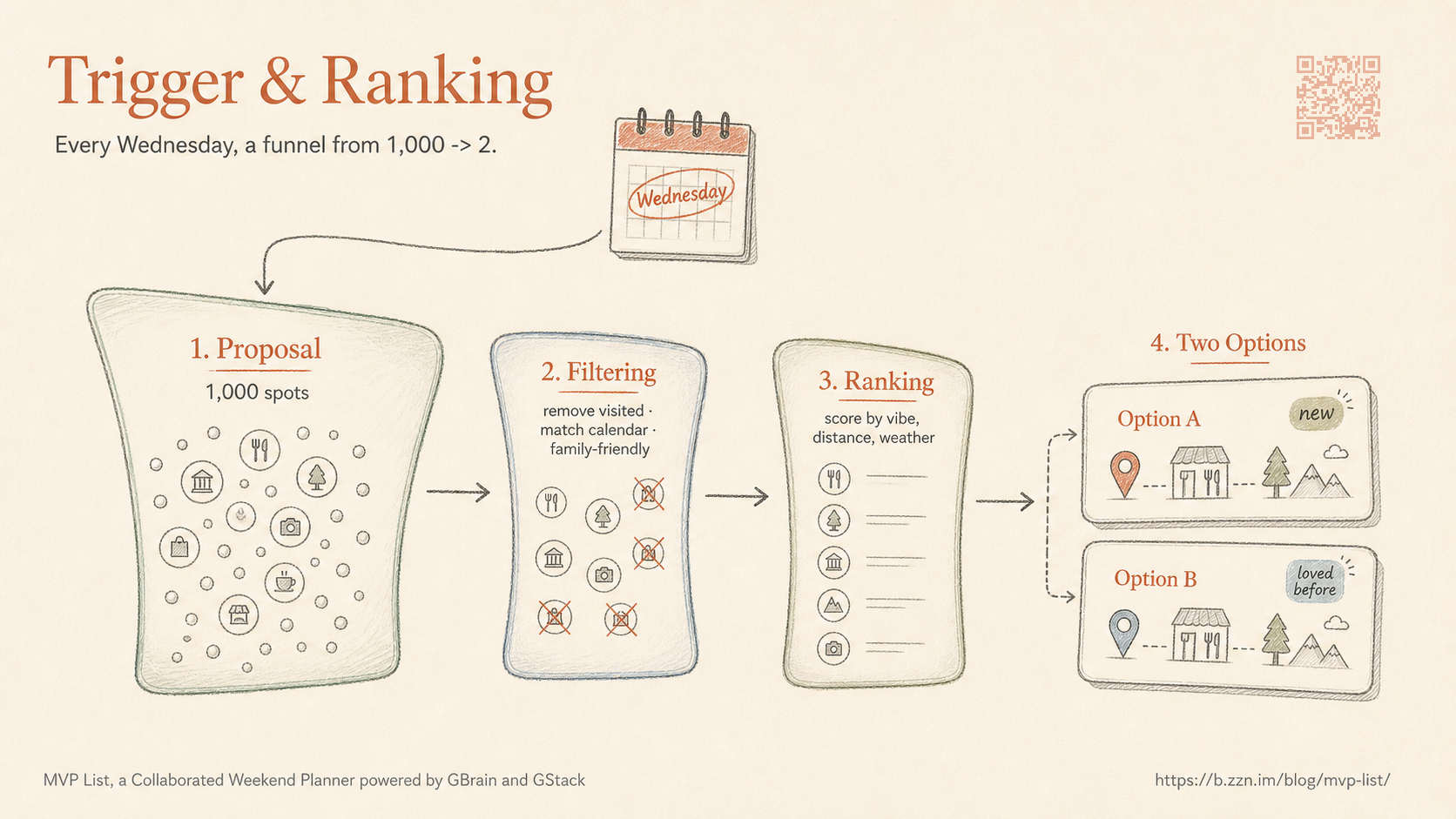
Every Wednesday morning, the planner wakes up on its own.
It does four things in order:
- Proposal. Pull the full candidate pool — a thousand spots is fine.
- Filtering. Remove anywhere we’ve already been, anywhere that’s closed this weekend, anywhere that doesn’t match the week’s calendar (a packed Friday means we want a calmer Saturday).
- Ranking. Score what remains by vibe fit, distance from home, weather, and toddler-friendliness.
- Two options. Funnel down to two concrete trip options, side by side. Each option leads with two new places we’ve never been; the rest of the slots are filled either with another new spot or a revisit to somewhere we already love.
The “two options” shape is on purpose. One option feels like an order. Three options is back to decision fatigue. Two is a conversation we can have over coffee.
4. Output — an agenda, and a picture of the day
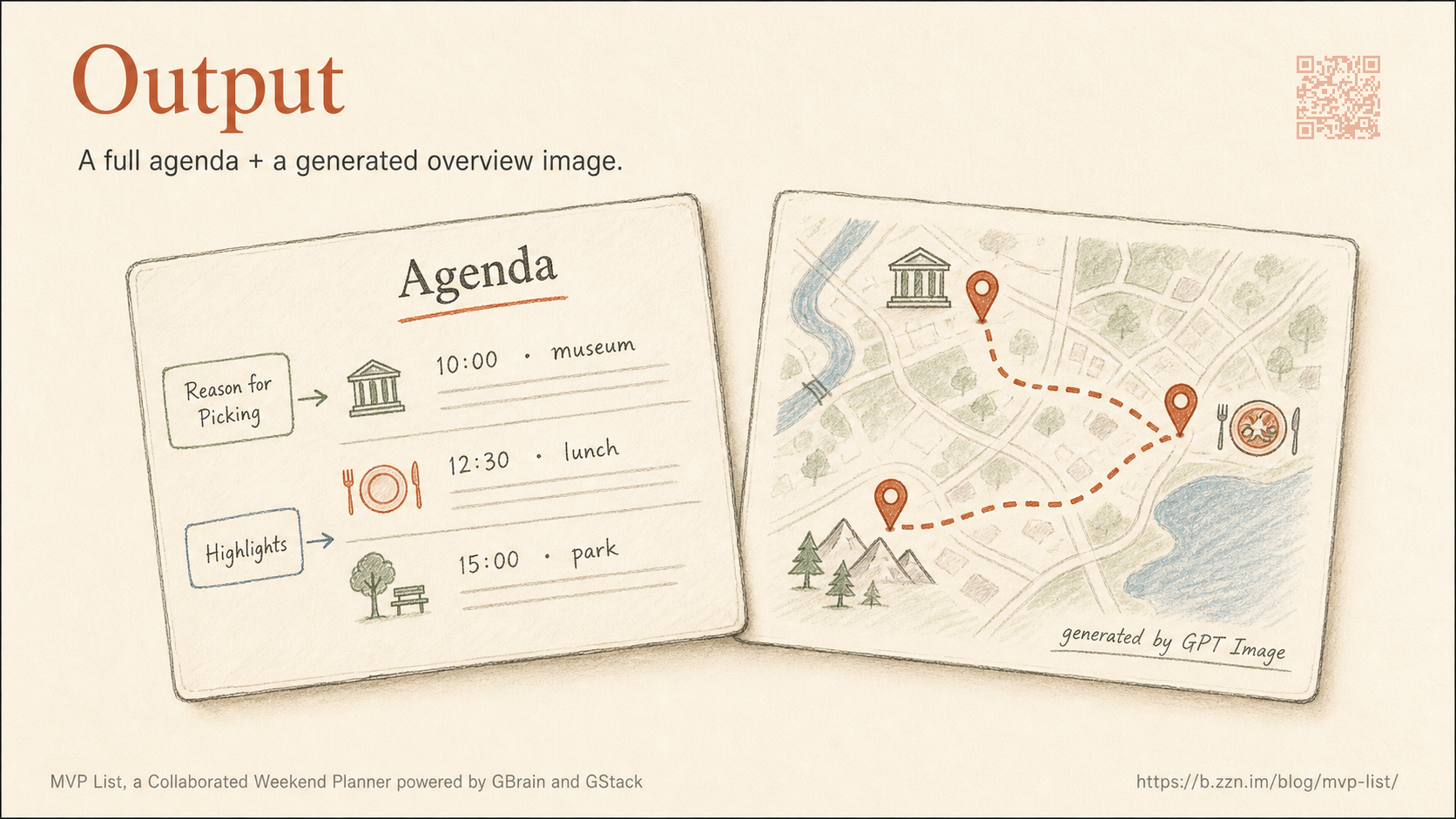
Each option ships as a tiny package:
- An agenda with time blocks (10:00 museum, 12:30 lunch, 15:00 park), plus a short “Reason for picking” and “Highlights” so the non-planning partner can skim it in thirty seconds and say yes.
- An overview image, generated with GPT Image, showing a top-down map of the route, the restaurant’s signature dish, and the main attraction’s main view — basically a postcard of Saturday before Saturday happens.
The agenda is the useful artifact. The image is the one that actually gets us out the door.
Why GBrain
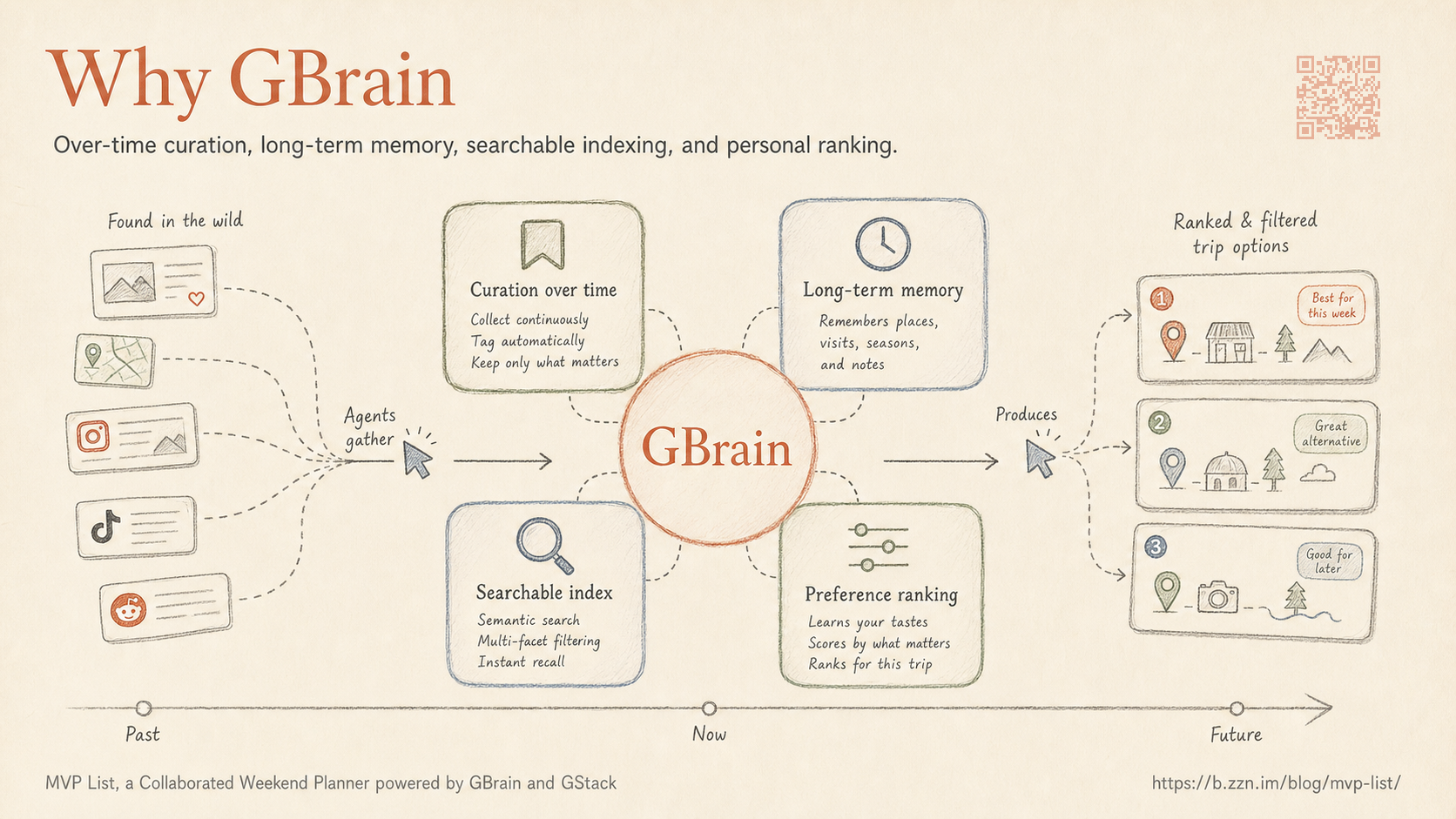
A weekend planner sounds like a one-shot LLM prompt. It isn’t.
It’s a system that has to remember, for years, every place we’ve ever bookmarked; what we thought of each one after we went; which ones we’ve already exhausted; and what our taste actually is, as opposed to what we say it is. That is four things in a trench coat: over-time curation, long-term memory, a searchable index, and a personal ranker.
GBrain gives us all four in one place. Without it, the whole pipeline collapses back into a Notes app with good intentions.
Why TheHog
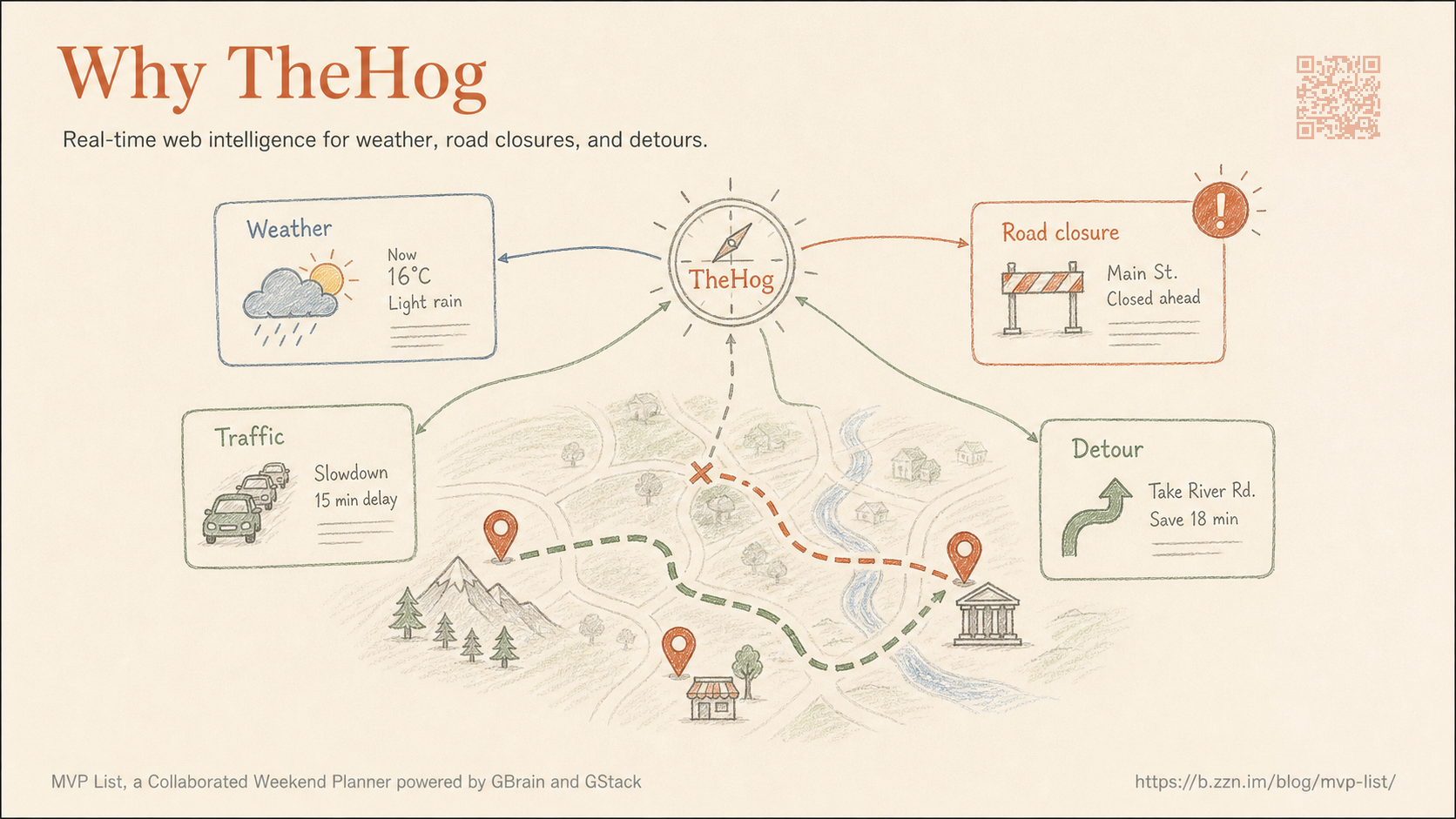
The other half of a real weekend is what the planner can’t know in advance.
A wildfire closes a road. The bakery shut down two months ago and nobody updated the listing. Rain shows up on Saturday afternoon and the hike turns into a hot-chocolate cafe. TheHog is the live-web layer: it checks weather, traffic, road closures, and recent reviews right before the plan is finalized, and rewrites the agenda if reality has moved.
GBrain remembers. TheHog notices. Together they cover the two failure modes of every previous version of this we tried.
How the whole thing looks, in motion
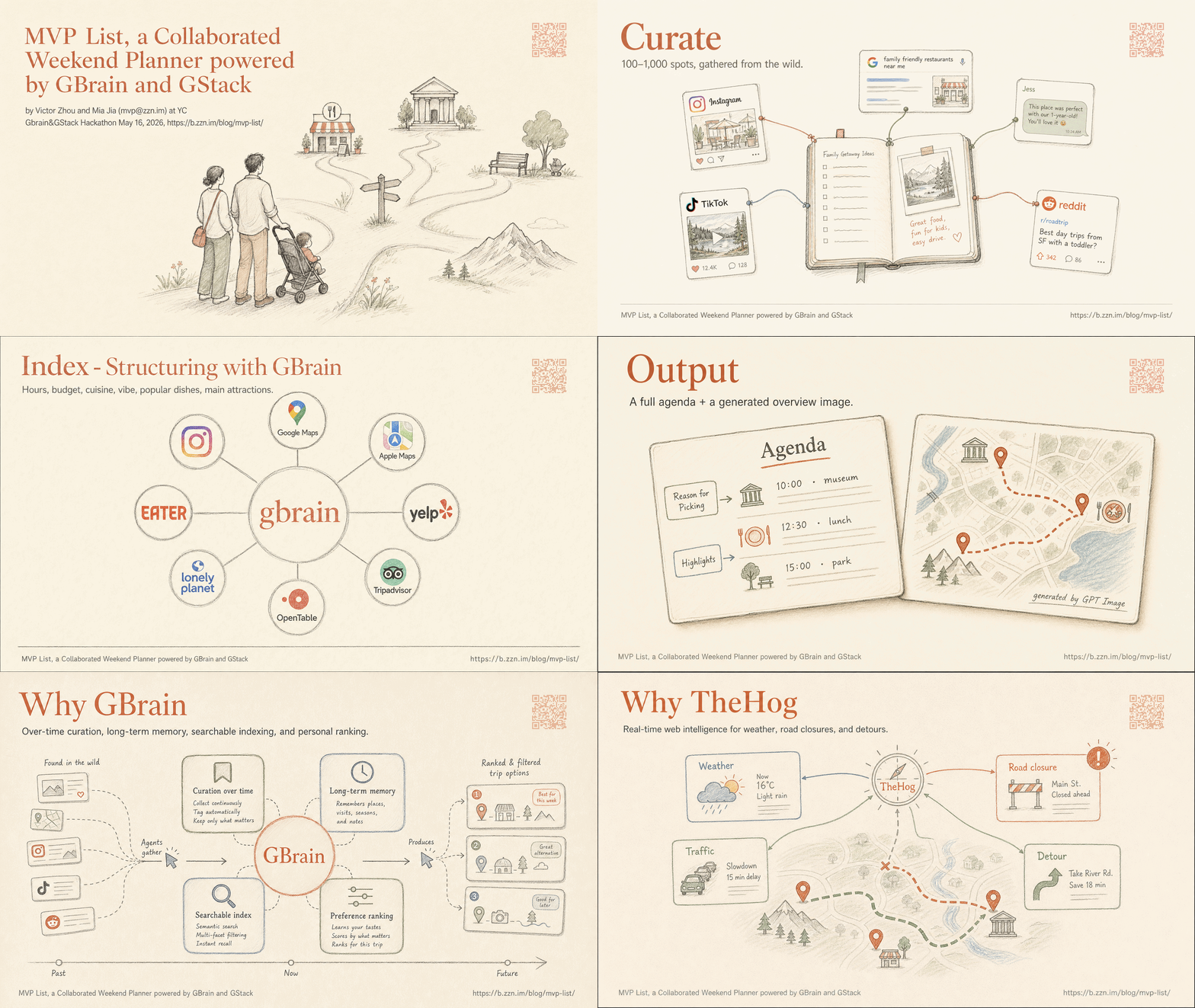
That’s the whole MVP. A pipeline, not a product. Curate → Index → Trigger & Rank → Output, running on a quiet Wednesday cron, powered by GBrain for memory and TheHog for the live world.
If you’re a parent of a small kid and any of this sounds familiar — or if you just want the deck — write to us at mvp@zzn.im. We’re keeping a short list of families who want to try the next version.
— Victor & Mia