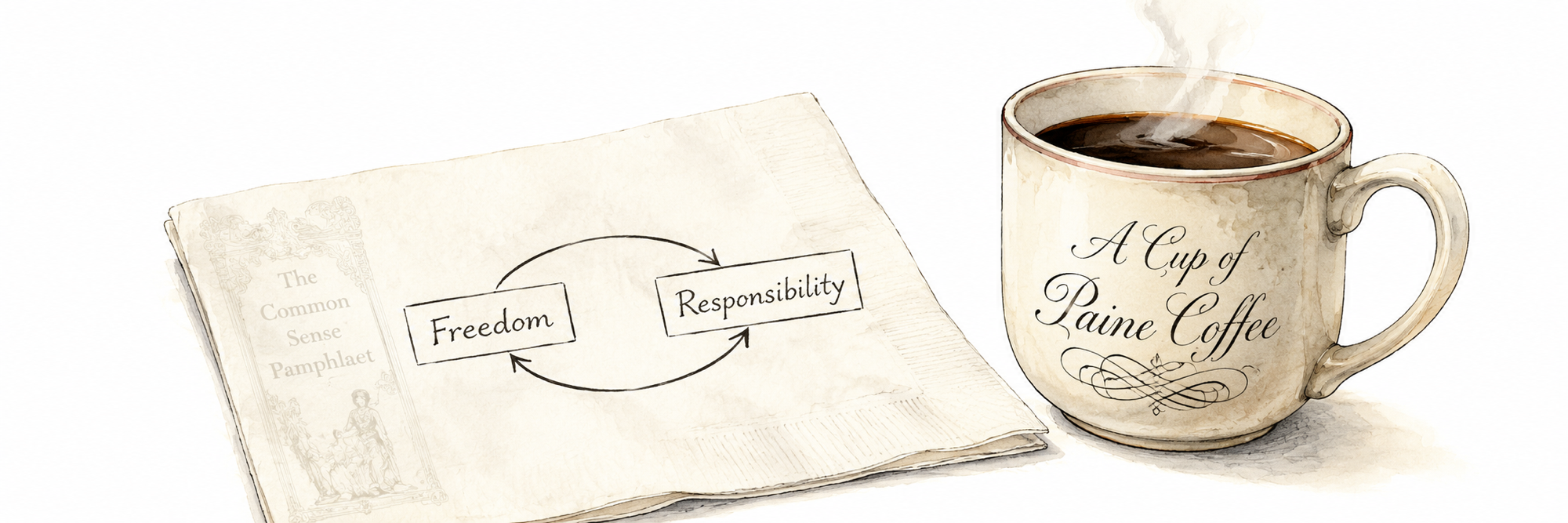

For thirty years we have argued about twenty-six words.
“No provider or user of an interactive computer service shall be treated as the publisher or speaker of any information provided by another information content provider.”
That is the heart of Section 230. Depending on whom you ask, it is either the law that created the internet or the law that broke it. One camp wants it repealed: platforms, they say, hide behind it to silence the people they dislike. The other camp wants it kept: without it, they say, every website would be sued into the ground for what strangers post. Both camps are right about something. Both have been stuck in the same trench for a generation.
They are stuck because they are arguing about the wrong noun. They argue about platforms — whether a company, taken as a whole, should be shielded or exposed. But responsibility has never worked that way anywhere else in life, and we all know it. It does not attach to a building, a business, or a brand. It attaches to a decision.
So the question was never “should platforms be liable or immune?” The question is, and always was: for which decisions?
This is a proposal to answer that question with common sense. I call the principle Reciprocal Choice.
The whole of it, in one line
Here is the entire argument, and you could fit it on a napkin:
Your decision, your responsibility. Not your responsibility, not your decision to make.
Everything that follows is just commentary.
If you choose, you answer for the choice. If you do not get to choose, no one may hang the outcome around your neck. This is not a clever new doctrine invented for the internet. It is the oldest fairness there is — the kind a child grasps before they can read. We are not reinventing the law. We are reminding it of something it already knew. Call it, if you like, the renaissance of common sense: principles that never expire, dragged back into daylight and asked to do their job again.
And the principle does not care how large you are. It falls on a trillion-dollar platform, a corner startup, a government, and a single person in precisely the same way, because it begins from a premise none of them can escape: you are free, and freedom is a thing you have to answer for.
The living room and the coffee shop
Picture two rooms.
The first is your living room. It is yours. You decide who comes in. You may invite a guest and you may show one the door, for a good reason or for no reason at all, and that is entirely your right. But the moment you choose your guests — the moment you decide who stays — you take on a sliver of responsibility for what they do under your roof. You picked them. That was a decision, and decisions have owners.
The second room is a coffee shop you have opened to the public. You did not handpick the customers; you opened the door and the street walked in. As long as you serve everyone evenhandedly and keep your thumb off the scale, you should not be on the hook for every rude thing a stranger mutters at a corner table. You did not choose him, so his words are not yours.
But the coffee shop comes with its own bargain, and it is a strict one. Because you claimed the privilege of not choosing, you owe the public the other half of the deal. Everyone who walks in is entitled to the same coffee, the same seat, the same respect. You cannot quietly run a public coffee shop while secretly seating the people you like and turning away the ones you don’t. Neutrality is not a slogan to print on the window. It is a duty you actually have to keep.
That is Reciprocal Choice in physical form. Choose, and you carry the weight. Decline to choose, and you carry the obligation to be fair. You may take either bargain. You may not have the upside of both and the cost of neither.
And the upside of both with the cost of neither is exactly what Section 230 accidentally handed to the largest platforms on earth. They moderate like a publisher when it suits them and disclaim like a passive pipe when it doesn’t. The fix is not to take the choice away. The fix is to make them pick a room.
Responsibility follows the decision, not the entity
Here is where most reform proposals go wrong. They try to sort whole companies into boxes — this one is a publisher, that one is a platform — as if a company were a single thing that performs a single act. No real institution has ever worked like that, and we have known it for centuries.
Walk into a coffee shop with a stage (say, the “Central Perk” in Friends). The coffee shop books the act. It chose who stands at the microphone, so if the performer slanders someone from the stage, the coffee shop shares the blame — it exercised editorial judgment, and judgment is a decision with an owner. Now look at the same coffee shop’s seating area, open to anyone who walks in. If a customer at table six says something ugly, the coffee shop is not liable. It did not choose him; it chose to be open. Same building. Two different decision boundaries. Two different answers. No one finds this confusing in a coffee shop.
Open a magazine and you find the same line drawn with a ruler. The editors are fully responsible for the articles — they commissioned and edited every word. They are not responsible, in the same way, for the advertisements, which run under a different and disclosed set of rules. One publication, two decision boundaries, and the law has handled this comfortably for a hundred years.
A modern internet platform is not one room. It is a building full of rooms, and it should be allowed — and required — to declare, room by room, which ones it is editing and which ones it is merely hosting. In particular, three decision boundaries must be pried apart and judged each on its own terms:
- Whether an account lives or dies — the decision to admit a user, or to remove one.
- Whether a post is kept and shown — the decision to store and display what someone has said.
- Whether something is recommended and spread — the decision to amplify it and push it into other people’s view.
These are three separate acts. A platform might run the first on neutral, published rules and claim immunity there; edit the third heavily and accept full responsibility for what it chooses to promote; and do something in between with the second. Today the law treats all three as one undifferentiated lump, which is why the argument never ends. Split them, and each boundary receives the only thing that was ever fair: the responsibility that matches the choice actually made.
These three are the boundaries that matter now. As new feature sets appear, the same principle simply extends to them — the framework needs no rewriting each time the technology shifts, because it was never about the technology. It was about who decided and what’s being decided.
Objective rules, and the wager of disclosure
“Neutral” needs a definition that can survive a courtroom, not just a press release. So here is the test.
If a platform’s rules are genuinely objective — applied to everyone alike, by a process anyone could in principle run — then the platform does not answer for what those rules produce. Early PageRank is the clean example: a mathematical formula ranking pages by their links, indifferent to who you were. Run an honest, mechanical rule and you are not editorializing. You are sorting.
But the devil hides in one word: seed. PageRank, in practice, began from a chosen set of trusted pages — a human-picked seed set. The moment a human hand selects the starting point, a subjective decision has entered the machine, however objective the math downstream. And a subjective decision, wherever it sits, has an owner. You do not get to launder a choice through an algorithm and call the output neutral.
So platforms remain free to gate and to rank by objective means. They may charge a flat fee to register or to be promoted — the same price for everyone. They may require verified ID. They may use a transparent credit score. None of this is forbidden, any more than a bar is forbidden from saying you must be twenty-one to come in. Or seventy, for that matter. An age limit is not discrimination, because it falls on everyone equally. The rule is permitted precisely because it is blind.
And now the mechanism that makes the whole thing enforceable. Call it disclose to immunize:
A rule that is publicly disclosed — so that outsiders, journalists, and independent scholars can replicate and validate it — earns the benefit of the doubt. Disclose it, and it is presumed neutral, and you are immune for its results.
A rule kept in a black box gets no such presumption. Keep the steering wheel hidden and you own everything it produces.
This is a wager, freely offered. Show your work and you are protected. Hide it and you own everything it produces. No platform can complain about the terms, because each one picks which side of the bet to take.
Two clean ways to set the weight down
It follows that a platform has two honest routes to immunity, and both are open to anyone.
The first is to hand the decision away entirely. Give content judgments to a genuinely independent arbitrator, an outside enforcement body, or a third-party vendor with real autonomy. Once the decision truly leaves your hands, the responsibility leaves with it. You cannot be blamed for a choice you no longer make. Those who made the decisions on the platform’s behalf now bear the consequence of their decisions too.
The second is to automate on rules that are objective and public. Set them out in the open, apply them without exception, and let them run. You answer for the rules — they are yours, and they had better be fair — but you do not answer for each particular result the rules grind out, any more than a thermostat is blamed for the weather.
Either path works. What no longer works is the third path, the one we have lived under: keep the steering wheel, hide the steering, and disclaim the crash.
The same rule, scaled to fit
A fair principle still needs a fair procedure, and a procedure that is fair to Google could crush a four-person startup. So the principle stays identical for everyone, while the paperwork scales.
First, a word on posture. This proposal assumes good faith from everyone — the giants included. It does not begin from the premise that big is bad. Large and small alike carry responsibility here, and large and small alike are owed the matching freedom. Reciprocal Choice is for all of them, or it is for none of them.
The large platform — the big coffee shop. It has lawyers, engineers, and resources to spare. With that capacity comes a simple, upfront duty: at the moment it begins serving users, it must declare, plainly and in public, which functions it claims as objective — and therefore immune — and which it owns as subjective, and therefore answerable. No one with that much power gets to leave the public guessing which room they are standing in.
The small platform — the coffee stand, e.g. startup. The law should lay no bureaucratic burden on a team that is still trying to survive. No filings, no forms, no compliance theater. A startup says nothing in advance. Only if it is one day challenged — sued, hauled into a real dispute — does it step up and make its declaration, there in the courtroom, and accept the matching consequences from that point forward. It is the same choice the giant makes. It simply comes due when it actually matters, and not a day before.
Same principle. Same fairness. Different weight, because the shoulders are different sizes.
A first cup
I do not offer this as a finished statute. I offer it as a way of thinking — that we should walk up to our laws, one at a time, and ask the plain question a reasonable person would ask across a kitchen table: who decided, and did the responsibility land where the decision was made? Section 230 is simply where I have chosen to begin. It is the first of what I hope will be many attempts to re-examine our legislation through common sense, and to push that common sense back into the law, where it belongs.
The principle has a name — Reciprocal Choice — and so does the larger effort it opens. Thomas Paine wrote Common Sense not for the lawyers but for the people who would have to live under the result, and he wrote it so plainly that anyone could understand it and argue it over a drink. That is the spirit worth keeping.
So consider this an invitation. Pull up a chair.
Let’s have a cup of Paine Coffee.