A comparison of what you can actually use for speech-to-text in August 2026, covering both hosted APIs and models you can run on your own hardware. Prices come from vendor pricing pages I read on 2026-08-27; leaderboard figures are from the 28 August 2026 update. Both move fast. I have named the publisher next to every number, for reasons that become obvious about halfway down.
The bug that sent me looking

An 87-minute two-person phone call, recorded through a meeting bot, came back as a clean transcript: 777 sentences, correct words, good punctuation. Every single sentence was attributed to one speaker.
The transcription was fine. The diarization, the part that decides who spoke when, had collapsed on the phone leg and merged both people into one. The usual escape hatch is to split the stereo channels and transcribe each separately, but that failed too: the file was dual-mono, with the left-minus-right difference sitting around −84 dB. Two identical channels wearing a stereo container.
A headline word error rate tells you nothing about this. The words were right. What broke was everything downstream that needs to know who said them.
So I went looking for a replacement, and ended up comparing the whole field: the hosted APIs, and the open models you can run yourself, which in 2026 are much closer together than I expected.
The decision that comes first
Before comparing anything, work out which side of this line you are on, because it eliminates most of the options for you.
Reach for a hosted API when you have bursty or low volume, you want diarization and streaming without building them, you need a long tail of languages, or you do not want to own GPU capacity.
Run a model yourself when audio cannot leave your infrastructure, you have steady high volume, you want a fixed cost instead of a per-hour meter, or you need to pin a model version that nobody can deprecate under you.
The cost crossover is sharper than most people assume, and I work through it below. The short version: at full GPU utilisation, self-hosting is roughly thirty times cheaper per audio-hour than the cheapest hosted API, and at low utilisation it is far more expensive.
What the neutral leaderboard says
The Hugging Face Open ASR Leaderboard is the only ranking here not published by a company selling one of the entries. Models are submitted by pull request, the evaluation scripts are public, and part of the average comes from private datasets held by Appen, DataoceanAI and Voice Arena, which matters because nobody can train on a test set they cannot download.
The top of the table as of its 28 August 2026 update, average WER across the default dataset mix, lower is better:
| Rank | Model | Avg WER | Licence |
|---|---|---|---|
| 1 | reson8/resonant-1 | 4.77 | Proprietary |
| 2 | modulate/vfast | 4.78 | Proprietary |
| 4 | elevenlabs/scribe_v2 | 4.84 | Proprietary |
| 6 | microsoft/azure-speech-06-2026 | 4.91 | Proprietary |
| 7 | Qwen/Qwen3-ASR-1.7B | 4.95 | apache-2.0 |
| 8 | assemblyai/universal-3-5-pro | 5.02 | Proprietary |
| 11 | gladia/solaria-3 | 5.22 | Proprietary |
| 12 | nvidia/canary-qwen-2.5b | 5.23 | cc-by-4.0 |
Two things worth taking away. The spread across the top twelve is under half a percentage point, so whatever separates these products in practice, it is not headline English accuracy. And the best open model sits seventh, ahead of AssemblyAI’s flagship. A 2 GB file you can download beats a commercial API on a benchmark neither of them controls.
The other surprise is where Whisper landed. The only Whisper-family entry in the top 40 is distil-whisper/distil-large-v3.5 at rank 37, 6.2 WER. If you last looked at this in 2024 and still reach for Whisper by reflex, that reflex is now expensive.
One limitation matters more than the rest: the leaderboard covers English and European languages only. No Chinese, no Japanese, no Arabic, no Hindi.
Models you can run yourself
Thirty of the forty models on that leaderboard carry an open licence. These are the ones worth knowing, with throughput and size, which is what actually decides whether you can deploy them:
| Model | Avg WER | RTFx | Licence | Params | Languages |
|---|---|---|---|---|---|
| Qwen3-ASR-1.7B | 4.95 | 820 | apache-2.0 | 2.04B | 52 |
| AutoArk ARK-ASR-3B | 5.18 | 482 | apache-2.0 | 3.75B | 19 |
| NVIDIA canary-qwen-2.5b | 5.23 | 867 | cc-by-4.0 | 2.5B | 1 |
| MOSS-Transcribe-Diarize | 5.52 | 381 | apache-2.0 | 0.91B | 50+ |
| NVIDIA parakeet-tdt-0.6b-v2 | 5.48 | 6025 | cc-by-4.0 | 0.6B | 1 |
| NVIDIA parakeet-tdt-0.6b-v3 | 5.66 | 6076 | cc-by-4.0 | 0.6B | 26 |
| IBM granite-speech-4.1-2b | 5.43 | 546 | apache-2.0 | 2B | 6 |
| Mistral Voxtral-Small-24B | 5.79 | 101 | apache-2.0 | 24B | 8 |
| Microsoft Phi-4-multimodal | 5.72 | 163 | mit | 6B | 8 |
| IBM granite-5.0-470m-turboctc | 5.78 | 12946 | apache-2.0 | 0.47B | 1 |
RTFx is how many seconds of audio the model transcribes per second of wall clock, so it is throughput per GPU. The range here is enormous: parakeet is roughly seven times faster than Qwen3-ASR for about 0.7 points of WER, and granite-470m is faster still.
Check the licence column before you get attached to a model. Several families ship a fast variant and a nearly identical non-commercial one, and the names barely differ:
granite-speech-5.0-470m-turboctcis apache-2.0;granite-speech-5.0-470m-turboctc-ncis cc-by-nc-sa-4.0.canary-1b-flashis cc-by-4.0; plaincanary-1bis cc-by-nc-4.0.Zipformer-cr-ctc-transducer-XL-290Mis cc-by-nc-4.0.
If your product is commercial, three of the fastest-looking options on the board are unusable, and nothing in the WER column tells you that.
The other thing local models mostly do not do is diarization, with one exception I come back to below.
The hosted APIs
| Provider / model | Languages | Diarization | Streaming |
|---|---|---|---|
| AssemblyAI Universal-3.5 Pro | 18, native code-switching | Add-on | Yes |
| AssemblyAI Universal-2 | 99 | Add-on | — |
| Deepgram Nova-3 | 45+ | Free on batch, paid on streaming | Yes |
| ElevenLabs Scribe v2 | 90+ | Bundled | Yes (Realtime) |
| Gladia Solaria-1 / -3 | 100+ / 5 | Bundled, pyannoteAI Precision-2 | Yes |
| Google Chirp 3 | 29 GA + 82 preview | BatchRecognize only | Yes |
| Gemini 3.5 Transcribe | 85+ | Up to 8 speakers | Yes (Live) |
Google is really three products and people conflate them. Chirp 3 covers 111 languages but only diarizes in BatchRecognize, and its word-level timestamps are documented contradictorily — they appear in a table headed “Chirp 3 doesn’t support the following features” while that row’s own description says they can be enabled in Speech.Recognize and Speech.BatchRecognize with “some transcription degradation” expected. Gemini 3.5 Transcribe entered public preview on 2026-08-26, one day before I wrote this, so there are no third-party numbers for it yet. And plain Gemini multimodal prompting will transcribe too, in whatever shape your prompt implies.
Gemini 3.5 Transcribe has one catch worth knowing before you design around it. Its smart mode does the filler-word removal and self-correction cleanup, and the documentation is blunt about the cost:
Note: Smart transcription (“smart”) is incompatible with
timestamp_granularitiesanddiarization_mode. If you need word timestamps or speaker diarization, configure mode with{"type": "verbatim", ...}.
So clean readable text, or knowing who spoke when, but not both in the same call. A meeting-notes product wants exactly both.
What it costs, on both sides
Hosted, in US dollars per hour of audio, read from each vendor’s pricing page on 2026-08-27:
| Provider / model | Batch $/hr | Realtime $/hr | Diarization |
|---|---|---|---|
| AssemblyAI Universal-2 | $0.15 | — | Add-on, +$0.02/hr |
| AssemblyAI Universal-3.5 Pro | $0.21 | $0.45 | Add-on, +$0.02/hr |
| Deepgram Nova-3 mono | $0.26 | $0.29 promo, $0.46 list | Free on batch; +$0.12/hr streaming |
| ElevenLabs Scribe v2 | $0.22 | $0.39 | Bundled (no add-on line) |
| Gladia, Starter | $0.61 | $0.75 | Bundled |
| Gladia, Growth commit | from $0.20 | from $0.25 | Bundled |
| Google Cloud STT v2 standard | $0.96 | — | No separate line |
| Google Cloud STT v2 dynamic batch | $0.18 | — | No separate line |
| Gemini 3.5 Transcribe | ~$0.30 | ~$0.54 (Live) | Bundled, verbatim mode only |
Diarization bundling is inconsistent in both directions, and it is where people misprice. Deepgram includes it free on pre-recorded audio but charges $0.0020/min on streaming, while AssemblyAI charges $0.02/hr in both modes. Gladia’s $0.61/hr is the highest batch rate here, roughly triple Deepgram’s, and only reaches $0.20/hr on a committed-volume plan. Google Cloud’s dynamic batch at $0.18/hr is the lowest hosted price in the table, in exchange for processing “at a lower level of urgency.” Gemini’s figure is Google’s own estimate — billing is per token, and the page converts it to “an effective blended rate of ~$0.005 per min for Transcribe”.
Self-hosting can be priced the same way, because the leaderboard publishes both throughput and the hardware it was measured on. Those RTFx figures come from runs on a single NVIDIA H200, billed by Hugging Face Jobs at $5.00/hour. Since RTFx is audio-hours processed per wall-clock hour, the cost per audio-hour is $5.00 ÷ RTFx:
| Model | RTFx | $/audio-hour on a rented H200 |
|---|---|---|
| IBM granite-5.0-470m-turboctc | 12946 | $0.0004 |
| NVIDIA parakeet-tdt-0.6b-v3 | 6076 | $0.0008 |
| NVIDIA canary-qwen-2.5b | 867 | $0.006 |
| Qwen3-ASR-1.7B | 820 | $0.006 |
| MOSS-Transcribe-Diarize | 381 | $0.013 |
| Mistral Voxtral-Small-24B | 101 | $0.049 |
Against $0.18/hr for the cheapest hosted option, Qwen3-ASR self-hosted is about thirty times cheaper, and parakeet is over two hundred times cheaper. The leaderboard maintainers publish their own observed run costs, which are in the same territory: $2.92 for a full English short-form evaluation of parakeet-tdt-0.6b-v3, $5.58 for Qwen3-ASR-1.7B.
The catch is utilisation, and it is the whole ballgame. Those numbers assume the GPU never idles. Rent an H200 for a month at $5.00/hour and you have spent $3,600 whether you fed it 3,000 audio-hours or three. The break-even against Google’s $0.18/hr batch tier lands around 20,000 audio-hours a month for Qwen3-ASR; below that, a hosted API is cheaper and you also skip the ops work. Add engineer time, and the honest threshold is higher still.
Diarization is the part that breaks
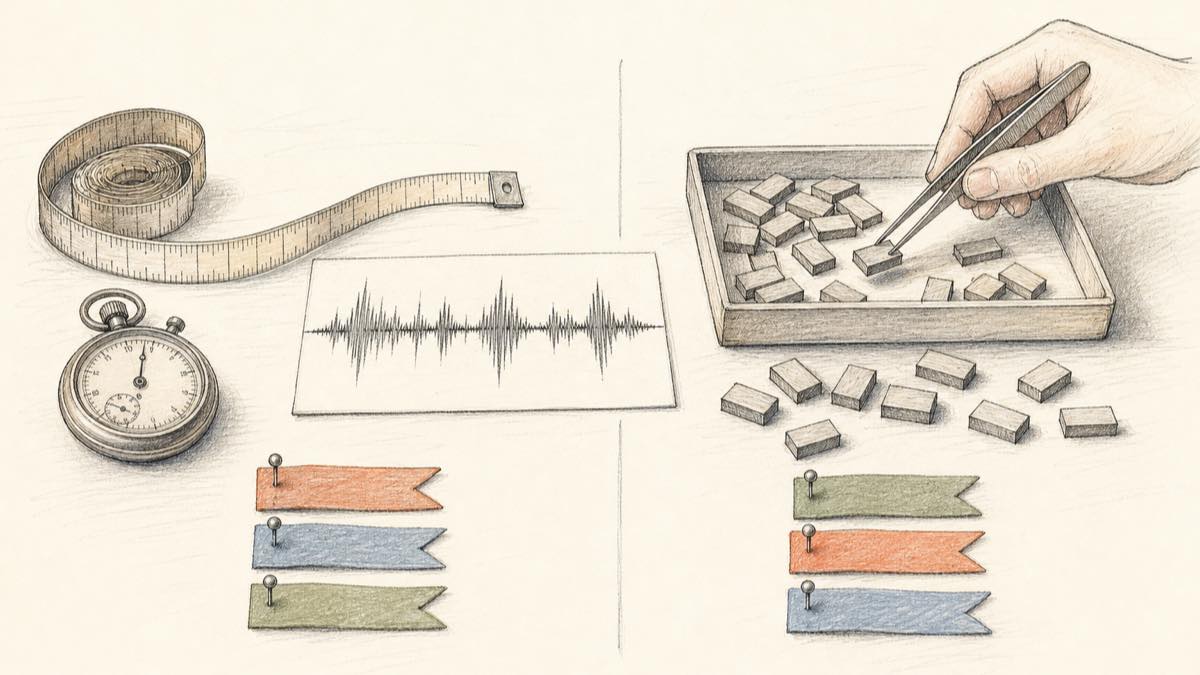
Everything above is about getting the words right, which is the solved part. Knowing who said them is not.
Two metrics get quoted and they disagree, so it is worth knowing which one you are being shown. DER (diarization error rate) is measured in time: add up every second that was missed, falsely detected as speech, or attributed to the wrong speaker, divide by total speech time. It scores the segmentation and says nothing about the words. cpWER (concatenated minimum-permutation word error rate) is measured in words: concatenate everything each speaker said, try every mapping of your labels onto the true speakers, keep the best, then compute WER. It charges you for transcription and attribution mistakes together.
AssemblyAI explains the difference more clearly than anyone else I read:
DER is a fine academic metric, but it measures diarization in isolation from the transcript. In production what you care about is whether the right speaker label lands on the right words—which is what cpWER measures. Keep that distinction in mind, because it changes how the leaderboard looks.
Which is true, and also convenient, since AssemblyAI ranks first on the cpWER table it published. The metric tends to follow the product: pyannoteAI sells diarization alone and produces no transcript, so DER is the only thing its product can be scored on at all.
The more useful number is how bad everyone is. On pyannoteAI’s own streaming benchmark, a chart built by the eventual winner, that winner scores 19.8% DER, or roughly one speech-second in five still wrong. It gets worse on hard audio: 54.4% DER on restaurant audio, 44.6% on meetings, 44.9% on web video, with competitors between 51% and 76% across those three.
Nobody has solved this. Plan for the labels to be wrong some of the time.
For local deployments the options are narrower but real. pyannote’s open Community-1 is the standard pairing for any ASR model that has no diarizer of its own, and on pyannoteAI’s own DIHARD Broadcast chart it scores 10.5% DER against 9.4% for their paid Precision-2 — close enough that the free model is a reasonable default. The more interesting option is MOSS-Transcribe-Diarize, an Apache-2.0 0.9B model that does transcription and diarization end to end in a single pass, across 50+ languages, on recordings up to 90 minutes, emitting [S01]/[S02] labels with timestamps. It won first place in the 2nd MLC-SLM Challenge at INTERSPEECH 2026.
That last one is a direct answer to the call I opened with: 87 minutes, two speakers, and a 0.9B model you can run on your own box would have handled it in one pass.
Chinese and multilingual
The neutral leaderboard has no Chinese column at all, so this is the part where you are most on your own — and where the vendor pages are least reliable.
ElevenLabs’ Mandarin page is the clearest example. Its marketing copy claims Scribe achieves “a word error rate of just 3.1% on the FLEURS benchmark and 5.5% on Common Voice”, while the benchmark table a few hundred pixels below lists Scribe v1 at 7.2% WER on FLEURS. The page contradicts itself by more than a factor of two. The same table credits Deepgram Nova 2 with “98.2% WER,” which would mean near-total failure and much more likely means the language was unsupported. The table is also still labelled v1 while the shipping product is v2.
The strongest option here is local. Qwen3-ASR is Alibaba’s Apache-2.0 release from 2026-01-29, in 0.6B and 1.7B sizes plus a forced aligner for timestamps, covering 52 languages and dialects including 22 Chinese dialects — Cantonese, Wu and Minnan among them, which essentially nothing else here addresses. Alibaba’s own numbers, and they are Alibaba’s: 2.71 on AISHELL-2 against Whisper large-v3’s 5.06, and 3.98 on Cantonese Fleurs-yue against Whisper’s 9.18.
Two things stop me filing that with the rest of the vendor claims. On the Open ASR Leaderboard it sits seventh overall on English at 4.95, ahead of AssemblyAI’s flagship, and takes the best score in the field on the private conversational set, which it cannot have trained on. And Brown University’s research computing center, which sells nothing here, recommends Qwen3-ASR for noisy environments and non-English dialects in its own transcription service.
Code-switching
For audio that mixes languages inside a sentence, the marketing is ahead of the evidence. Gladia advertises Solaria-1 as covering 100+ languages with native code-switching, including 42 it says are unavailable elsewhere. AssemblyAI describes Universal-3.5 Pro as working “across 18 languages, with native code switching”. Gemini 3.5 Transcribe auto-detects across 85+ locales.
I could not find a single neutral benchmark scoring any of them on code-switched audio. The public research resource that exists is CS-Dialogue, 104 hours of spontaneous Mandarin-English conversation from 200 speakers, released for academic use; its authors note that pre-trained models like Whisper still have room to improve on it. There is also a 2025 systematic literature review of code-switching in end-to-end ASR, useful for framing.
If you need this, no published number is going to decide it for you. Run CS-Dialogue, or a sample of your own audio, against two or three candidates.
How I would choose
There is no single winner here, so this is by use case.
Steady high volume, English. Self-host parakeet-tdt-0.6b-v2 at roughly $0.0008 per audio-hour. It is English-only and cc-by-4.0, and at RTFx 6025 one GPU covers an enormous workload. Use -v3 if you need its 26 languages, for about 0.2 WER.
Steady high volume, multilingual. Qwen3-ASR-1.7B, Apache-2.0, 52 languages, seventh on a neutral board, about $0.006 per audio-hour self-hosted.
Bursty or low volume. Stay hosted; the GPU idle time will eat any modelling advantage. Deepgram at $0.26/hr with diarization included on batch is the least surprising default, and AssemblyAI Universal-2 at $0.15 + $0.02 is cheaper if you can live with its older model.
Multi-speaker audio where attribution matters. Diarization quality is the binding constraint, not WER. Hosted, route it to pyannoteAI or use Gladia, which bundles Precision-2. Local, use MOSS-Transcribe-Diarize, or pair any ASR model with pyannote Community-1. Budget for failure on overlapping speech either way: 19.8% DER is the best published streaming number.
Many speakers talking over each other. Brown’s CCV documentation points at Microsoft Azure, the only non-vendor recommendation I found on the question; Azure’s June 2026 model sits sixth on the leaderboard.
Chinese-heavy. Qwen3-ASR-1.7B, self-hosted, plus a diarizer. It is the only option here with real Chinese dialect coverage. Do not choose from the vendor Mandarin pages.
Audio that cannot leave your network. Any Apache-2.0 or MIT row in the local table. This is also the only case where your bill stops scaling with audio hours.
Lowest possible cost, no constraints. Google Cloud STT v2 dynamic batch at $0.18/hr if you stay hosted; granite-5.0-470m-turboctc at $0.0004 per audio-hour if you do not — checking that you took the apache-2.0 variant and not the -nc one.
And on the original bug: if you control the recording, capture a separate channel per participant rather than asking a diarizer to recover something the capture pipeline could have kept.
Reading these numbers with suspicion

One thing to carry away from all the tables above: almost every “best speech-to-text API in 2026” article is published by a company in the comparison, and four of the five I checked rank their own publisher first. AssemblyAI’s roundup puts AssemblyAI first on cpWER. pyannoteAI’s benchmark puts pyannoteAI first on DER, and puts AssemblyAI’s Universal-3 last of twelve, at 31.1% DER against pyannoteAI’s own 9.4%. Deepgram’s guide ranks Deepgram first of ten. Gladia’s ranks Gladia first.
The same disagreement shows up inside a single benchmark name. Gladia reports Solaria-3 first on Earnings22 at 6.4% WER, ahead of AssemblyAI at 6.9% and ElevenLabs at 7.7%. On the neutral leaderboard’s Earnings22 column, ElevenLabs scores 4.8, Gladia 5.94 and AssemblyAI 6.05. The ordering inverts and the absolute numbers do not match, because the two evaluation harnesses are not the same.
There were two exceptions. Coval’s provider guide is written by a company that sells evaluation tooling rather than a model, and it declines to name a winner at all, reporting that the top providers sit “within 1-2 percentage points of each other.” The other was Picovoice, which sells Falcon, benchmarks it against pyannote, and then declines to pick a winner: “Our goal was not to crown a single ‘winner’, but to understand tradeoffs between research accuracy and production efficiency.” Its own numbers put pyannote ahead of Falcon on DER, 9.0% against 10.3%. It is the only case here of a vendor publishing a benchmark its own product loses.
So: find the publisher before you read the chart, check which metric was chosen, and ask whether the dataset can be named at all — “our internal benchmark across a mix of real-world datasets” is not a result anyone can check.
Several of the leads I started from fell apart once I opened the sources: a cpWER table attributed to the wrong publisher, an “included” diarization that is really a paid add-on, a price off by a factor of three, a leaderboard whose #1 had quietly dropped to #12, and a “55% WER reduction” that appears nowhere in the paper it was credited to. All of them read perfectly plausibly. That is the problem with this genre — plausible is cheap, and the only thing that separates a real number from an invented one is whether you went and looked.
References and source passages
Vendor-published benchmarks and roundups
- AssemblyAI (vendor in the comparison) — Original source: “8 Best Speaker Diarization Solutions & APIs in 2026”, by Kelsey Foster, dated August 4, 2026. Supporting passages: “DER is a fine academic metric, but it measures diarization in isolation from the transcript. In production what you care about is whether the right speaker label lands on the right words—which is what cpWER measures. Keep that distinction in mind, because it changes how the leaderboard looks.” The comparison table lists AssemblyAI 30.17, ElevenLabs Scribe v2 35.26, Gladia 36.87, Deepgram Nova-3 EN 37.92, with PyAnnote, NVIDIA NeMo and Kaldi/SpeechBrain marked “DER-reported only.” Dataset disclosure: “The cpWER numbers come from our internal diarization benchmark, run across a mix of real-world datasets.” Author disclosure: “I run Voice AI at AssemblyAI.” — fetched 2026-08-27
- pyannoteAI (vendor in the comparison) — Original source: Speaker Diarization DER performance comparison. Reports DER only, across ten DIHARD domains, 259 recordings and roughly 67 hours. The per-domain results are published as chart images without text alternatives; values below were read from those images. DIHARD Broadcast (12 conversations, 3 or 4 speakers): pyannoteAI Precision-2 9.4%, pyannoteAI OSS Community-1 10.5%, NVIDIA 10.3%, AWS 16.5%, Speechmatics Enhanced 16.8%, Gladia Solaria 22.0%, Mistral Voxtral Mini 22.7%, Speechmatics Standard 24.5%, Soniox 25.2%, ElevenLabs Scribe-v2 26.4%, Deepgram Nova-3 26.9%, AssemblyAI Universal-3 31.1%. DIHARD Clinical (51 conversations, 2 or 3 speakers): Precision-2 13.3%, AssemblyAI Universal-3 48.1%. Methodology note: “We did not provide the number of speakers for any of them.” — fetched 2026-08-27
- pyannoteAI (vendor in the comparison) — Original source: “How accurate is streaming speaker diarization?”. Undated on the page. DER on DIHARD III across all languages: pyannote API 19.8% (false alarm 4.8, missed 7.7, confusion 7.3); Speechmatics real-time v2 31.3% (6.2 / 19.7 / 5.5); Deepgram Nova 3 39.1% (4.6 / 25.3 / 9.3); AssemblyAI Universal Streaming v3 39.2% (6.9 / 20.4 / 11.8). Supporting passage: “pyannote leaves 7.71% of speech unattributed, while the other systems miss between 19.70% and 25.26%, roughly 2.5 to 3 times more.” Hard-domain figures for pyannote Live-1: restaurant 54.4%, webvideo 44.9%, meeting 44.6%. Methodology caveat: “measured on DIHARD without special scoring for overlapped speech.” — fetched 2026-08-27
- Deepgram (vendor in the comparison) — Original source: “Best Speech-to-Text APIs 2026”. The deck says the article compares the leading APIs, “ranking them based on accuracy, features, and real-world performance”. The order is carried by the numbered section headings, which sit in the page markup but do not appear in the rendered body text, so the linked fragment lands on the deck instead: 1. Deepgram, 2. OpenAI Whisper, 3. Microsoft Azure, 4. Google Cloud, 5. AssemblyAI, 6. Amazon Transcribe, 7. Rev AI, 8. Speechmatics, 9. IBM Watson, 10. Kaldi. By Jose Nicholas Francisco, Product Marketing Manager, marked “UPDATED Feb 19, 2026”. The ranking is presented as based on “accuracy, features, and real-world performance”; I could not find a per-provider WER figure anywhere on the page to support the ordering — fetched 2026-08-27
- Gladia (vendor in the comparison) — Original source: “Introducing Solaria-3”, by Ani Ghazaryan, dated June 10, 2026. Claims Solaria-3 ranks first on Earnings22 at 6.4% WER, ahead of AssemblyAI 6.9%, ElevenLabs 7.7%, Speechmatics 7.8%, Mistral 7.9% and Deepgram 12.0%; 9.6% WER on Gladia’s internal English production dataset, a 26% improvement over Solaria-1’s 12.9%. The Solaria-1 language and code-switching claim quoted in this article comes from Gladia’s separate roundup post, not from this one. — fetched 2026-08-27
- Gladia (vendor in the comparison) — Original source: “Best speech-to-text APIs in 2026”, by Ani Ghazaryan, “Published on Jul 9, 2026”. The post opens: “Every speech-to-text vendor claims the lowest word error rate, the lowest lat[ency]…” and then ranks Gladia first. Supporting passages: “Solaria-1 is our breadth model, the most multilingual in the lineup, with 100+ languages and native code-switching across all of them, including 42 languages unavailable elsewhere”; Solaria-3 “ranks #1 across English and core European languages (EN, FR, DE, ES, IT), ahead of AssemblyAI, ElevenLabs, Deepgram, Mistral, and Speechmatics”; Solaria-1 “leads outright on speaker diarization accuracy: 3x more accurate diarization error rate (DER) than alternatives”; and “Gladia’s audio intelligence features are bundled into base pricing, covering code switching, speaker diarization…” — fetched 2026-08-27
- Picovoice (vendor in the comparison; sells Falcon) — Original source: “State of Speaker Diarization”, published December 18, 2023 and updated March 11, 2026. On VoxConverse: pyannote 9.0% DER against Falcon 10.3%; Falcon 19.9% JER against pyannote 27.4%. Supporting passage: “Our goal was not to crown a single “winner”, but to understand tradeoffs between research accuracy and production efficiency.” Picovoice is the one vendor here that publishes a benchmark its own product loses on the headline metric — fetched 2026-08-27
- ElevenLabs (vendor) — Original source: Mandarin Chinese speech-to-text page. The prose claims “a word error rate of just 3.1% on the FLEURS benchmark and 5.5% on Common Voice.” The “Mandarin Chinese Transcription Benchmark” table on the same page lists Scribe v1 at 7.2% WER on FLEURS, Gemini Flash 2 at 17.6%, Whisper Large v3 at 23.6%, and Deepgram Nova 2 at 98.2%. Cited here as evidence of an internally inconsistent vendor benchmark, not as a Chinese accuracy figure — fetched 2026-08-27; nearest archive snapshot 2026-07-25
Independent and non-vendor sources
- Hugging Face — Original source: Open ASR Leaderboard, “Last updated on 28 August 2026”. Standings read from the live Gradio app with the License, Size (B) and # Languages columns enabled: reson8/resonant-1 4.77, modulate/vfast 4.78, reson8/resonant-1-flash 4.79, elevenlabs/scribe_v2 4.84, zoom/scribe_v1 4.90, microsoft/azure-speech-06-2026 4.91, Qwen/Qwen3-ASR-1.7B-hf 4.95 (apache-2.0, 2.04B, 52 languages, RTFx 819.96), assemblyai/universal-3-5-pro 5.02, AutoArk-AI/ARK-ASR-3B 5.18, HojoAI/Hojo-ASR-V1 5.21, gladia/solaria-3 5.22, nvidia/canary-qwen-2.5b 5.23. Further down: ibm-granite/granite-speech-4.1-2b 5.43 (RTFx 545.65), nvidia/parakeet-tdt-0.6b-v2 5.48 (RTFx 6024.67, cc-by-4.0, 0.6B, 1 language), OpenMOSS-Team/MOSS-Transcribe-Diarize 5.52 (RTFx 381.16, apache-2.0, 0.91B, 50 languages), ibm-granite/granite-speech-5.0-470m-turboctc-nc 5.55 (cc-by-nc-sa-4.0), nvidia/parakeet-tdt-0.6b-v3 5.66 (RTFx 6076.07, 26 languages), Qwen/Qwen3-ASR-0.6B-hf 5.70, nvidia/canary-1b-flash 5.71 (cc-by-4.0), microsoft/Phi-4-multimodal-instruct 5.72 (mit), nvidia/canary-1b 5.76 (cc-by-nc-4.0), ibm-granite/granite-speech-5.0-470m-turboctc 5.78 (apache-2.0, RTFx 12945.54), mistralai/Voxtral-Small-24B-2507 5.79 (RTFx 101.27), and distil-whisper/distil-large-v3.5 6.20 at rank 37, the only Whisper-family entry in the table. Of 40 rows, 30 carry a non-proprietary licence. Scope statement: “evaluates open-source and proprietary speech recognition models on English and multiple European languages.” Private datasets are credited to Appen Inc., DataoceanAI and Voice Arena — fetched 2026-08-31
- Coval — Original source: “Best Speech-to-Text Providers in 2026”, dated June 4, 2026. Coval sells voice-agent simulation and evaluation tooling, not a speech-to-text model, so it does not compete in its own comparison — though it does benefit from readers concluding they should evaluate more. Notably, it declines to name a single winner, reporting that top providers cluster “within 1-2 percentage points of each other” — fetched 2026-08-27
- Brown University Center for Computation and Visualization — Original source: Comparing Speech-to-text Models. A university research-computing service that sells no speech-to-text product. Supporting passage: “if the accuracy of speaker diarization is a priority and/or the audio includes many speakers talking over each other, please choose the Microsoft Azure model for better performance.” The page also recommends Qwen3-ASR for noisy environments and non-English dialects. Note one internal inconsistency: Azure is recommended in the text but does not appear in the page’s own model table — fetched 2026-08-27
Pricing pages
- AssemblyAI — Original source: Pricing. Pre-recorded: Universal-3.5 Pro $0.21/hr, Universal-2 $0.15/hr. Streaming: Universal-3.5 Pro Realtime $0.45/hr, Universal-Streaming $0.15/hr. Under the “Add-On Features” tab, Speaker Diarization is priced at $0.02/hr on both Universal-3.5 Pro and Universal-2; keyterms prompting is $0.05/hr on Universal-3.5 Pro and included on Universal-2. Universal-3.5 Pro “works across 18 languages, with native code switching”; Universal-2 “supports 99 languages.” Free tier: 185 hours pre-recorded and 333 hours streaming — fetched 2026-08-27
- Deepgram — Original source: Pricing. Pre-Recorded tab: Nova-3 Monolingual $0.0043/min ($0.258/hr), Nova-3 Multilingual $0.0052/min, and Speaker Diarization listed as “Included.” Streaming tab: Nova-3 Monolingual $0.0048/min promotional against a $0.0077/min regular price, with Speaker Diarization at $0.0020/min ($0.12/hr). The page states “Limited-time promotional rates on streaming.” — fetched 2026-08-27
- Gladia — Original source: Pricing. Starter: “Async at $0.61/hr”, “Real-time at $0.75/hr”, with “50€ in free credits”. Growth: “Async as low as $0.20/hr”, “Real-time as low as $0.25/hr”. Speaker diarization, 100+ languages and word-level timestamps are listed as included on every tier. The FAQ describes the free credits as “a one-time grant with no monthly reset. That’s roughly 80+ hours of pre-recorded transcription” — fetched 2026-08-27
- ElevenLabs — Original source: API pricing. Scribe v2 $0.22/hr, Scribe v2 Realtime $0.39/hr. Add-ons listed are entity detection at $0.070/hr and keyterm prompting at $0.050/hr; no separate speaker-diarization charge appears — fetched 2026-08-27
- Google Cloud — Original source: Speech-to-Text pricing. Speech-to-Text V2 standard recognition: $0.016/min for the first 500,000 minutes per month ($0.96/hr), falling to $0.010, $0.008 and $0.004/min at higher volume tiers. Standard dynamic batch recognition: $0.003/min ($0.18/hr), described as processing “audio at a lower level of urgency.” Chirp is listed among the “Standard” models. No separate diarization charge appears on the page — fetched 2026-08-27; Archive.org’s save endpoint declined this URL, nearest existing snapshot 2026-08-25
- Google — Original source: Gemini API pricing. Speech-to-text billing is per token, not per minute; the page states only effective blended rates. Supporting passages: “Estimated pricing is based on 25 audio tokens per second for input and 175 text tokens per minute for output, for an effective blended rate of
$0.005 per min for Transcribe” and, for$0.009 per min for Live Transcribe”. The $/hour figures in this article are those blended rates multiplied by 60; the page publishes no per-minute input/output split for either transcribe model, so none is quoted here — fetched 2026-08-27gemini-3.5-transcribe-live, “
Google product documentation
- Google — Original source: Gemini 3.5 Transcribe announcement, posted August 26, 2026. Announces
gemini-3.5-transcribeandgemini-3.5-transcribe-livein public preview, “over 85 languages,” and, “As measured by Artificial Analysis”, an average WER of 4.0% streaming and 2.6% non-streaming plus 5.50%/5.04% on FLEURS — figures Google attributes to a third-party evaluator rather than to its own harness — and a 70% latency improvement over Chirp 3. The post describes multi-speaker identification for up to three speakers with 3+ experimental, which is narrower than the API documentation’s figure — fetched 2026-08-27; archive snapshot 2026-08-27 - Google — Original source: Gemini API audio transcription documentation. Supporting passages, verbatim: “Note: Smart transcription (“smart”) is incompatible with timestamp_granularities and diarization_mode. If you need word timestamps or speaker diarization, configure mode with {“type”: “verbatim”, …}.”; “Up to 8 speakers are supported (attribution for 3 or more speakers is experimental).”; “Supply up to 1,000 terms in the custom_vocabulary array (best results are typically achieved with up to 100 terms)”; “Note: Enabling word-level timestamps may degrade overall transcription accuracy.” — fetched 2026-08-27
- Google — Original source: Chirp 3 model documentation. The language table has 111 rows: 29 marked GA and 82 marked Preview (counted directly from the table). Diarization is marked “Available only in Speech.BatchRecognize” at GA; utterance-level timestamps are “Available only in Speech.StreamingRecognize”. Word-level timestamps appear in a table introduced by “Chirp 3 doesn’t support the following features”, but the row itself reads “Automatically generated by the model and can be optionally enabled, which some transcription degradation is expected. Available only in Speech.Recognize and Speech.BatchRecognize” — the page contradicts itself, and this article reports both halves rather than resolving it — fetched 2026-08-27
Open models and research
- Alibaba / Qwen team (vendor for its own model) — Original source: Qwen3-ASR repository. Apache-2.0. Released January 29, 2026 in 0.6B and 1.7B sizes, with Qwen3-ForcedAligner-0.6B for timestamps; native Transformers support added June 26, 2026. Covers 52 languages and dialects, including 22 Chinese dialects (Mandarin, Cantonese, Wu, Minnan). Qwen’s own reported results for Qwen3-ASR-1.7B against Whisper large-v3: AISHELL-2 2.71 vs 5.06; Fleurs-yue 3.98 vs 9.18; LibriSpeech clean 1.63 vs 1.51. Against GPT-4o-Transcribe on M4Singer: 5.98 vs 16.77. No speaker diarization is documented — fetched 2026-08-27; Archive.org’s save endpoint declined this URL, nearest existing snapshot 2026-07-29
- Gladia — Original source: “Gladia x pyannoteAI: Speaker diarization and the future of voice AI”, dated March 11, 2025. Supporting passage: “Our speaker diarization pipeline is now powered by pyannoteAI’s Precision-2, their most accurate model to date.” The post does not address whether diarization is bundled or metered; the bundling in this article’s cost table comes from Gladia’s pricing page — fetched 2026-08-27; Archive.org’s save endpoint declined this URL, nearest existing snapshot 2025-06-17
- Jiaming Zhou et al. — Original source: “CS-Dialogue: A 104-Hour Dataset of Spontaneous Mandarin-English Code-Switching Dialogues for Speech Recognition”, arXiv, submitted February 26, 2025 and revised March 12, 2025. 104 hours of spontaneous conversation from 200 speakers, with full-length dialogue recordings and complete transcriptions, to be made freely available for academic purposes. The abstract notes that “existing pre-trained models such as Whisper still have the space to improve” — fetched 2026-08-27
- Maha Tufail Agro, Atharva Kulkarni, Karima Kadaoui, Zeerak Talat and Hanan Aldarmaki — Original source: “Code-Switching in End-to-End Automatic Speech Recognition: A Systematic Literature Review”, arXiv, submitted July 10, 2025. A systematic review covering languages, datasets, metrics, model choices and open challenges. Cited here for framing only: the abstract reports no single headline WER-reduction figure — fetched 2026-08-27
- Hugging Face — Original source: open_asr_leaderboard repository. Supporting passages, under “Evaluate a model (as of 24 July 2026)”: English and multilingual short-form evaluations “use Hugging Face Jobs to guarantee reproducibility: every run executes a Docker image on the same hardware”. The hardware table lists a single flavor — “h200 | Nvidia H200 | 23 vCPU | 256 GB | 3000 GB | 1x H200 (141 GB) | $0.0833 [per min] | $5.00 [per hour]”. Example full-run costs given for English short-form: “$2.92 for nvidia/parakeet-tdt-0.6b-v3”, “$4.75 for openai/whisper-large-v3-turbo”, “$5.58 for Qwen/Qwen3-ASR-1.7B”. The $/audio-hour figures for self-hosting in this article are $5.00 divided by each model’s published RTFx, and assume continuous GPU utilisation — fetched 2026-08-31; Archive.org’s save endpoint declines github.com, so no snapshot is linked
- OpenMOSS Team — Original source: MOSS-Transcribe-Diarize model card. Licence apache-2.0. Supporting passages: “MOSS-Transcribe-Diarize 0.9B is an end-to-end audio understanding model for long-form multi-speaker transcription, diarization, timestamps, and acoustic event awareness”; “It supports transcription and diarization across 50+ languages, single-pass inference on audio recordings up to 90 minutes long, and custom hotword prompting for domain-specific terms”; the model “generates a compact speaker-aware transcript in one pass, including timestamps and anonymous speaker labels such as [S01], [S02], and beyond”. The card records that it “won first place in the 2nd MLC-SLM Challenge at INTERSPEECH 2026” — fetched 2026-08-31