
Founders Before VC: Zhang Jian Paid for a Cotton Mill With Rusting Government Machines
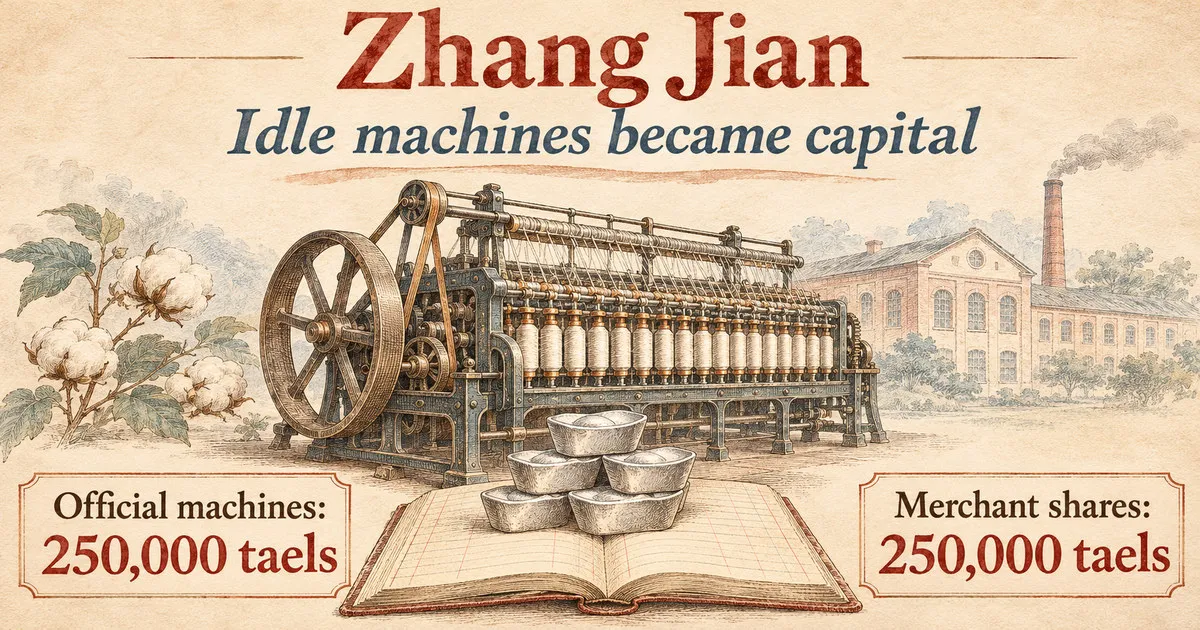
In 1895 a top imperial scholar set out to build a cotton mill in Nantong. He could not raise the cash, so he took idle official spinning machines as half of his capital and kept control of the company himself.

On this page
This post is part of the series “Founders Before VC”. Each post looks at one founder who built a company before modern venture capital, which is usually dated to the founding of ARD in 1946. The question is the same every time: in an age with no venture funds, whose methods look most like a startup founder’s today?
Zhang Jian (张謇, 1853–1926) is an unusual candidate. He was not a merchant. In 1894 he passed the top level of the imperial civil service examination, and he finished first, as zhuangyuan (状元), in the 1894 examination. A year later he started to build a cotton mill. Most of his problems in the next four years were problems that a founder today would recognize: no money, partners who walked away, and a government that wanted a say.
The market opened in 1895, and the money did not follow
Before 1895, a Chinese subject could not simply open a factory. Goetzmann and Köll describe a policy that did not allow Chinese nationals to open private industrial enterprises independently. Large industrial projects ran under the patronage of powerful officials such as Li Hongzhang.
The war with Japan changed this. The Treaty of Shimonoseki let foreigners build factories in Chinese treaty ports, so the court could no longer keep its own subjects out of industry. Cotton spinning shows the shift. Between 1890 and 1894 only five spinning mills were set up, and all but one had government involvement. By 1916, thirty new mills were running, all under private merchant management.
So the market was open. What was missing was capital, and a way for private money to trust an industrial company. China had no company law with required registration before 1904. A large shareholder at Dasheng later said that the mill had been “untouched by any law” in its early years.
Zhang Jian failed to raise the money twice
According to the Jiangsu Provincial Archives, the founding records of the Dasheng mill cover the whole process from planning and share raising in 1895 to start of production in 1899. The governor-general Zhang Zhidong lent his support as patron and initiated the mill in 1895 as a joint official-merchant venture. Goetzmann and Köll add that he gave little else: he was unable to offer Dasheng crucial financial support.
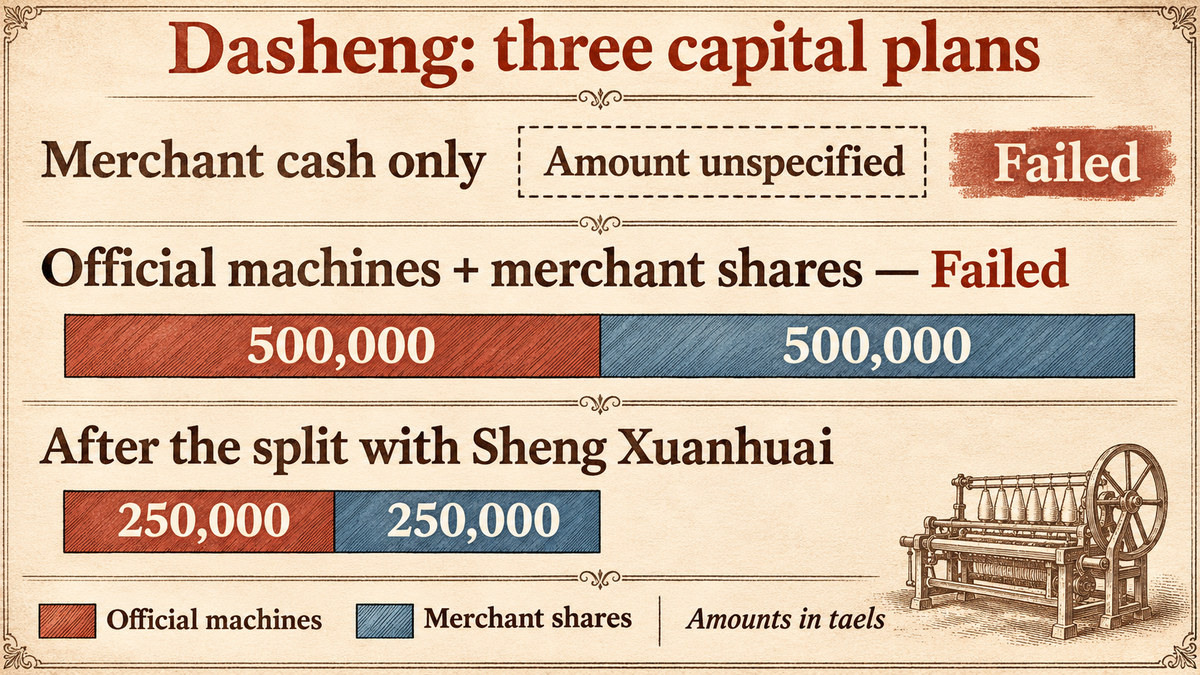
The first plan was a merchant company with six directors, three from Nantong and three from Shanghai. Yao Zhenyu and He Xinyi reconstruct the sequence from Zhang’s own chronicle and correspondence. By the autumn of Guangxu 22 (1896), two of the six directors had already left. The Shanghai partners kept reporting that they could not raise their share.
Then Zhang heard about a pile of idle machines. Officials told him that Zhang Zhidong had bought a 40,000-spindle set of spinning machines that lay stored in Shanghai, close to ruin, and that the government would hand them to merchants at a valuation of 500,000 taels. Zhang proposed to use the official machines to hold the partners together. The new plan was 500,000 taels of machines from the state plus 500,000 taels in merchant shares.
It failed again. The Shanghai partners later said that 160,000 yuan of share money was fully raised but refused to hand it over, and there was talk of the shareholders breaking their agreement. The solution was to cut the project in half. Zhang Jian and Sheng Xuanhuai each took half of the official machines, valued at 250,000 taels, and each would raise 250,000 taels in merchant shares for a separate mill. The contract said that the two gentlemen would take the official machines jointly and each run one mill. Yao and He call the resulting form shen ling shang ban (绅领商办): gentry receive the official assets, merchants run the business.
Zhang Jian later told shareholders about these years himself, at the mill’s first shareholder meeting in 1907. Li Yu reports that during the five years of preparation Zhang never spent one coin of company money on himself and lived on his salary as an academy teacher.
The move: take an idle asset as equity, and keep control
In today’s terms, Zhang Jian did three things.
He turned a stranded asset into equity. The machines were a sunk cost for the government. For Zhang they were half of his capital, with no cash needed. A founder today does something similar when a company contributes unused hardware, a dormant codebase, or a license in exchange for shares. The price was a government shareholder. The contract that Zhang signed with the provincial treasurer at the end of 1896 said that hiring and finance were entirely in the hands of the merchant directors, with one official director who could check the accounts.
He sold a fixed return, not upside. Like other companies founded after 1895, Dasheng paid guaranteed interest at a fixed rate of 8 percent on shares. Goetzmann and Köll compare these shares to modern preferred shares. Zhang paid this interest even before the mill earned money. In the Chongming branch mill, by his own account, the money for interest came from the share capital before production started, and it came from borrowing after production started. Investors received predictable income. The company lost cash it needed for growth.
He kept control without a majority. In 1907 the capital stock of the No. 1 mill was 630,000 taels, held by 553 shareholders. Accounts that can be linked to Zhang’s family held 40,300 taels, about 6.4 percent. Zhang wrote the company charter himself in 1897, and the authors describe it as highly autocratic and paternalistic. The head of the central accounts office in Shanghai answered to Zhang alone.
The modern name for this package is a founder-controlled company with a strategic investor and preferred-style shares. The closest modern parallel is not a startup with a venture round. It is a public-private project in which a founder brings the operating plan, the state brings an idle asset, and small investors bring cash.
The mill grew into a group, and the group bent under the founder’s other goals
The mill started production and made a profit in 1899. Its first shareholder meeting took place in 1907, when Dasheng became a limited-liability stock company. According to Zhang’s 1907 report, the mill paid its fixed interest every year, and dividends above the interest from 1900.
Zhang then built outward. In 1901 he issued the share prospectus for the Tonghai Land Reclamation Company, which grew cotton for the mill. He explained the chain himself: the mill needs cotton, cotton needs farming, so he set up the reclamation company, and an oil mill to use the cottonseed. In 1905 he funded the Nantong Museum with Dasheng profits, next to the normal school that he had also paid for.
Shareholders noticed. At the 1907 meeting, a prominent shareholder said that subsidies to the normal school have nothing to do with the company. He had no majority, and nothing changed.
The end of the story is debt. Goetzmann and Köll name several causes: transfers of company money to private accounts, risky loans to weak subsidiaries, falling yarn prices after the First World War, and too much debt from expansion. Together these brought Dasheng close to bankruptcy in 1922. A bank consortium took over in 1924, ordered the first external audit, and removed Zhang Jian as director. The historian Meng Sen, writing about the same period, put the cause in one sentence: Zhang held both the company and the local government, so spending on Nantong became losses for the company.
Three popular claims fail the source check
“Zhang Jian was a purely private entrepreneur.” The sources do not support this. Half of the mill’s starting capital was government machinery, and the share certificates from 1897 and 1903 said the mills were to be jointly managed by officials and gentry. Goetzmann and Köll found no document that formally ended this status.
“Dasheng was the only private mill in China that made a profit.” Britannica says that the mill became the only private mill in China operating at a profit. Britannica cites no data for this, and I did not find a primary source that compares the profits of all Chinese mills. I treat the claim as unverified.
“The banks took over in 1925.” Many Chinese accounts give 1925 for the creditor takeover. The chapter by Goetzmann and Köll, which uses the Nantong archives, gives 1924. I could not check the archive myself, so this post uses the 1924 date and notes the difference.
Two more items I could not verify and therefore left out: the exact amount of merchant cash that was in the bank when the mill started in 1899, and the claim that the Nantong Museum was “China’s first public museum”. The museum claim appears in the Study Times article that I cite for the founding year, but I found no primary source that settles it.
One number needs care. Goetzmann and Köll give the No. 1 mill’s capital as 1.13 million taels between 1903 and 1914, and its capital stock in 1907 as 630,000 taels. The difference is 500,000 taels, the same as the value of the official machines. The authors do not make this connection. It is my own reconciliation, and it needs the archive to confirm it.
What a founder today can take from Zhang Jian
An idle asset can be your seed round. Zhang could not raise 500,000 taels in cash. He could take 250,000 taels of rusting machines. Look for assets that someone else has written off: hardware, data, a domain name that nobody uses, an abandoned open-source project. The owner may value a working company more than the asset.
A fixed payout buys trust and costs flexibility. The 8 percent interest made outside money comfortable in a country with no company law. It also forced Dasheng to borrow to pay investors. A revenue share or a guaranteed return can close a round today. Model what it costs in a bad year before you sign it.
Control without accountability works until it does not. Zhang ran the group with 6.4 percent of the shares. That control let him build schools and a museum. It also let money move between companies with no check. The shareholders could not stop it. The creditors finally did.
Scope creep has a balance sheet. Each new company had a reason: cotton, oil, shipping, education. Each reason was sound. The sum was a group that one person could not watch.
Zhang Jian looks like a founder because he worked with the market and the money that existed, not the ones he wanted. His story is also a warning. The structure that let him start later made the end hard.
References
- Jiangsu Provincial Archives (江苏档案信息网) — 珍档赏析:大生纱厂创办初期档案, from 江苏省档案局、江苏省档案馆合编《江苏珍贵档案图鉴》. Supporting passage: “从1895年筹办、集股,1899年开车、盈利,到1907年召开第一次股东会议成立大生纺织公司的全过程”. Primary records described; the page is an archive catalogue entry. — fetched 2026-11-11
- Encyclopaedia Britannica — Zhang Jian, paragraph 2. Supporting passages: “in 1894 he passed the top level of the civil service examination”; “became the only private mill in China operating at a profit”. Secondary (encyclopedia). — fetched 2026-11-11
- William N. Goetzmann and Elisabeth Köll, “The History of Corporate Ownership in China: State Patronage, Company Legislation, and the Issue of Control”, in Randall K. Morck, ed., A History of Corporate Governance around the World (University of Chicago Press, 2005), p. 159. Supporting passages: “the government policy that did not allow Chinese nationals to open private industrial enterprises independently”; the Treaty of Shimonoseki let foreigners “engage in manufacturing operations in Chinese treaty ports”. Secondary. — fetched 2026-11-11
- Goetzmann and Köll (2005), p. 160. Supporting passage: “Between 1890 and 1894 only a total of five cotton-spinning mills had been successfully established (all but one with government involvement), while by 1916 thirty new mills were in operation”. Secondary. — fetched 2026-11-11
- Goetzmann and Köll (2005), p. 165. Supporting passages: Zhang Zhidong “lent his support as the patron in the beginning and officially initiated the Dasheng cotton mills as an operation under joint government-merchant management in 1895”; he “was unable to offer Dasheng crucial financial support”; share certificates of 1897 and 1903 said the mills were “by contract set up for perpetuity to be jointly managed by officials and gentry.” Secondary, based on the Nantong Textile Museum and Nantong Municipal Archives. — fetched 2026-11-11
- Goetzmann and Köll (2005), p. 166. Supporting passages: Zheng Xiaoxu at the 1907 meeting: “Formerly all the organization of this mill was unlimited and untouched by any law”; the mill “had now taken on the form of a stockholding company with limited liability”. Secondary. — fetched 2026-11-11
- Goetzmann and Köll (2005), p. 168. Supporting passage: shareholders “received guaranteed interest payments at a fixed rate of 8 percent on their share investment” (the authors cite Köll 2003, p. 130); “the common shares resembled what we now think of as preferred shares”. Secondary. — fetched 2026-11-11
- Goetzmann and Köll (2005), p. 169. Supporting passage: “The capital of the Dasheng No. 1 Cotton Mill remained unchanged at 1.13 million taels between 1903 and 1914”. Secondary. — fetched 2026-11-11
- Goetzmann and Köll (2005), p. 173. Supporting passages: “the capital stock of 630,000 taels was subscribed by altogether 553 shareholders”; Zhang family accounts held “40,300 taels or altogether 6.4 percent”; Zheng Xiaoxu: subsidies for the Normal School “have nothing to do with the company”. Secondary, from Nantong Municipal Archives B 402-111-2 and B 402-111-445. — fetched 2026-11-11
- Goetzmann and Köll (2005), p. 174. Supporting passage: “Dasheng’s corporate charter, a lengthy document written by Zhang Jian in a highly autocratic and paternalistic fashion in 1897”; the head accountant “was accountable only to Zhang Jian and not to the shareholders”. Secondary. — fetched 2026-11-11
- Goetzmann and Köll (2005), p. 175. Supporting passage: these practices “led Dasheng close to bankruptcy in 1922”; banks “imposed various financial and managerial reforms, including the first external audit ever and Zhang Jian’s removal as director, after taking over Dasheng in a bank consortium in 1924.” Secondary. — fetched 2026-11-11
- 姚震宇、何新易 (Yao Zhenyu and He Xinyi), 《清末企业官商关系实例考证及启示》, 《商业时代》2007 年第 33 期, p. 25. Supporting passages (the authors quote Zhang’s chronicle): “沪方樊芬与通方陈维镛退出六董”; “所购四万锭纱机庋沪久将废,作价五十万,招商承领”; “謇始议用官机以束合之”; contract with 桂嵩庆, 十一月初二 of the same year: “厂中用人、理财各事,全归商董经理”. Secondary. The article converts 光绪二十二年 to 1898; 光绪二十二年 corresponds to 1896, and this post uses 1896. — fetched 2026-11-11 (no archive snapshot available)
- 姚震宇、何新易 (2007), p. 26. Supporting passages: “称十六万元股款已全,不愿交出”; “复有股散悔约之言”; “由张绅、盛绅出名订约,合领官机,各主一厂”. Secondary. — fetched 2026-11-11 (no archive snapshot available)
- 李玉 (Li Yu), 《论张謇的实业诚信观》, 《安徽史学》2017 年第 2 期, p. 47. Supporting passages: “张謇甲午之后新科夺魁,状元及第”; the mill’s early hardships “由他自己在该厂 1907 年第一次召开股东大会时做了详细说明”. Secondary. — fetched 2026-11-11
- 李玉 (2017), p. 48. Supporting passage (Zhang’s own words): “嗣因纱厂必需棉花,棉花必待农业,于是设垦牧公司。又因棉子制油为副业而设油厂”. Secondary. — fetched 2026-11-11
- 李玉 (2017), p. 49, note citing 《通海垦牧公司集股章程启》, dated 清光绪二十七年五月初一日 (1901), 《张謇全集》第 5 册, p. 25. Secondary. — fetched 2026-11-11
- 李玉 (2017), p. 50. Supporting passage: “在大生纱厂筹建的五年期间,他没有花过公司一文钱,生计全赖自己担任书院讲席所得微薄俸金”. Secondary. — fetched 2026-11-11
- 李玉 (2017), p. 52. Supporting passages: from the 1907 report (《张謇全集》第 4 册, p. 131): “无年不付,余利自庚子始”; from 《大生崇明分厂十年事述》 (1913): “未开车前……即以股本给官利” and “开车以后……乃借本以给官利”; Meng Sen, 《吴君寄尘墓志》: “啬翁一手握公司、地方两任,遂以填入地方之赀为亏公司之累”. Secondary. — fetched 2026-11-11
- 邓田田 (Deng Tiantian), 学习时报, republished by 中国社会科学网 — 《南通博物苑》. Supporting passage: “1905年,他以大生集团的赢利为后盾,在他所出资创办的南通师范学校之西,修建了……南通博物苑”. Secondary (newspaper). — fetched 2026-11-11 (no archive snapshot available)
Further reading
- Elisabeth Köll, From Cotton Mill to Business Empire: The Emergence of Regional Enterprises in Modern China (Harvard University Asia Center, 2003). The standard English study of Dasheng. I could not open the full text for this post, so no claim here rests on it directly.
- 《张謇全集》 (江苏古籍出版社, 1994; new edition 2012). The Chinese quotations above come from this collection through the articles by Li Yu and by Yao and He.