
Thou shalt commit adultery.
In 1631, an edition of the English Bible printed in London left a single three-letter word—not—out of the Seventh Commandment. Without it, “Thou shalt not commit adultery” became “Thou shalt commit adultery.” The edition later became known as the Wicked Bible. Robert Barker and Martin Lucas, the King’s Printers who produced it, were fined £300, and the books were seized.
The press could reproduce words in bulk. It could reproduce mistakes in bulk, too.
Centuries Later, an Argument About AI Reminded Me of Printing History
A few days ago, an argument about AI brought this story back to mind. I wasn’t especially happy about the comparison.
I had written an article on English Wikipedia called “Easy-to-cancel mandate,” about laws that require businesses to make canceling a subscription as easy as signing up. It eventually landed on Wikipedia’s AI noticeboard. The editors thought I had used AI to help draft it. They weren’t wrong.
One editor checked the sources and found a sentence that could mislead readers. The source appeared to treat a two-step cancellation rule as a requirement of German law; I had written it as though the researchers had devised the test themselves.
I wasn’t trying to hide my use of AI. By 2026, I had come to assume that using AI to help with writing was normal. As a software engineer, I had started small, with autocomplete. Over time, I began using AI to fix grammar and spelling, refactor code, and generate files and tests. Between 2023 and 2025, AI was involved in most of the code I wrote, and I also relied on it when planning new projects.
On the noticeboard, I even gave a blunt estimate: AI generated “almost 90–95%” of my new lines of code. But I did not explain how I had arrived at that number.
The 90–95 percent was not a character count. I was roughly comparing how much time I spent with how long the AI ran. I might spend a minute writing a prompt, after which the AI might run for ten or twenty minutes. By that rough measure, the machine was running much longer than I was writing. If I counted characters in the finished prose or code instead, I would estimate that more than 99 percent was AI-generated. It produces text far faster than I can.
I produced the Wikipedia article in much the same way. I gave Claude Code and Codex prompts to research the subject, add citations, and check facts. When I found a problem, I usually changed the prompt and asked them to revise the draft again instead of rewriting their output myself.
I kept the article in draft space and asked editors from the relevant WikiProjects to review it and give feedback. I moved it into mainspace only after they responded. Even the text on the draft’s talk page was written with help from an LLM. The issue was not that I had hidden the AI. I simply had not realized that the community had already set new rules for this kind of writing.
At the time, I did not know that in March 2026 English Wikipedia had adopted a content guideline that, with a few exceptions, barred LLM generation and rewriting in articles. I explained my process, apologized, withdrew the article’s Did You Know nomination, and put my editing on hold.
I am not writing this to complain about Wikipedia. The editors were careful, measured, and reasonable. They were worried that AI could generate a large amount of plausible-looking text very quickly, while volunteer editors still had to verify the sources one by one. The writer saved time, but the reviewers ended up with more work. Restricting AI-generated content was also a way to protect the limited time those volunteers had.
From my side, AI had already become an everyday tool. I thought what mattered was whether I disclosed the AI, cited the evidence for each claim, and accepted review—not which tool I had used. We also differed over who should do the checking, and what record of the writing and revision process should remain so that, when something went wrong, responsibility was clear.
Hacker News has a similar rule. Its guidelines prohibit generated text and even text edited by AI, because “HN is for conversation between humans.” The rule is about how the text was made, not how good the finished text is. It leaves no exception for generated writing that happens to be good.
Other platforms draw the line elsewhere. TikTok requires labels on AI-generated content containing realistic images, audio, or video, and encourages labels on other content that is wholly generated or substantially edited with AI. It may remove material that breaks its community rules, causes harmful confusion, or lacks a required label. Some forms of impersonation are prohibited even when labeled. Xiaohongshu says it welcomes the use of AI to improve quality and informational value, but treats automated accounts, fabrication, infringement, and the mass production of repetitive low-quality material as violations. Its responses can include distribution limits and account bans.
Once the embarrassment had passed, I kept thinking about two claims I had seen in my feeds that same week. They seemed to contradict each other. One was that AI was too dangerous. The International AI Safety Report 2026 says general-purpose AI can help find software vulnerabilities and write malicious code, and may provide technical information relevant to biological or chemical weapons. The report also repeatedly warns that there is still substantial uncertainty about how much these capabilities increase real-world risk. The other claim was that AI content was slop: cheap, bad, unreliable, and costly for everyone else to sort through and check.
Dangerous enough to guard against, yet stupid enough not to be worth reading. How can both be true?
The history of printing does not prove that AI will follow the same path. But the comparison gives us a way to ask a few useful questions: when a new tool appears, who feels threatened, who benefits, and what kinds of rules do institutions try to impose?
An Early Debate over Printing in Venice
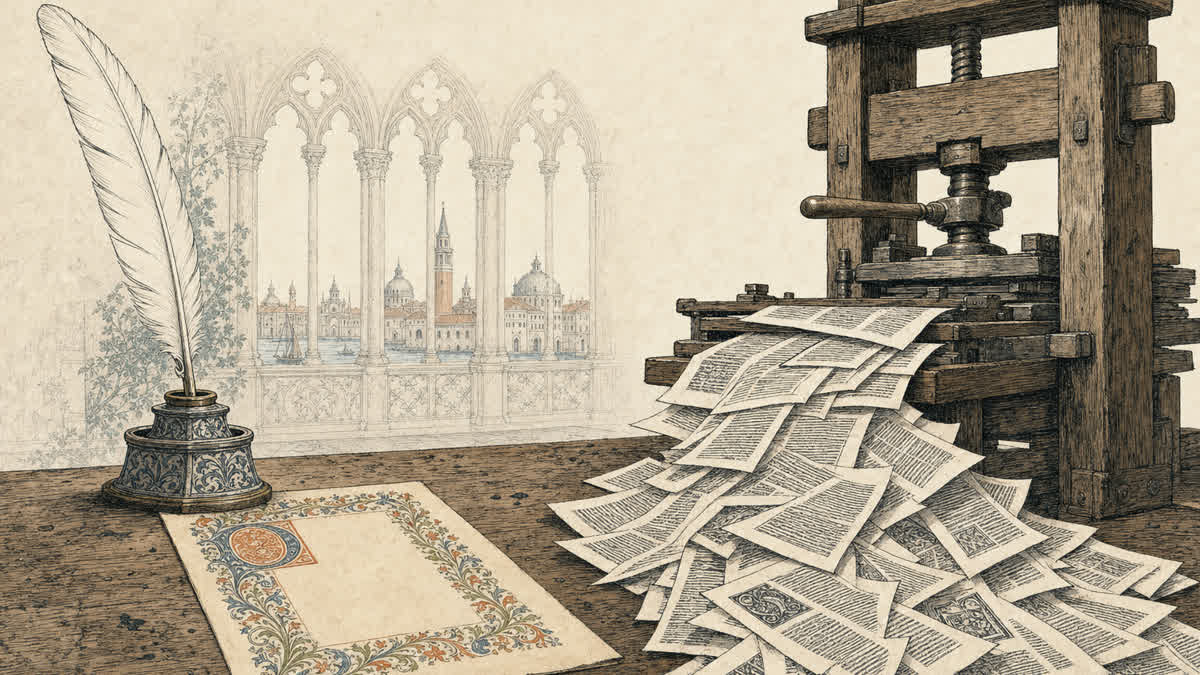
The Gutenberg Bible was probably completed in late 1455 in Mainz, in present-day Germany. By 1500, Europe had printing shops in roughly 250 places. Both complaints now made about AI—that it is too dangerous and that its output is too poor—also appeared in the early history of printing. But they did not always come from the same people, or at the same time.
People in Venice complained early on that printed books were badly made. In the 1470s, a Dominican friar and scribe named Filippo da Strada publicly attacked printing.
In August 1473, Nicolò Marcello was elected doge of Venice. Not long afterward, da Strada presented him with a handwritten Italian translation of the Legenda aurea. At the front, he added a Latin poem asking the doge to ban printing in Venice. It was more than an insult. Da Strada compared printers to counterfeiters and accused them of rushing out error-ridden or obscene books for money, corrupting the young, and taking work from scribes. The line adapted for the title of this essay comes from the poem:
Est virgo hec penna, meretrix est stampificata. — transcription
In Chartier’s translation: “The pen is a virgin, the printing press a whore.”
Quoting the line does not mean endorsing its view of women. It does, however, state da Strada’s position with unusual bluntness: handwriting stood for purity and restraint; printing for commerce and excess.
Da Strada named several specific harms. Printers, he said, worked too quickly in pursuit of profit and filled books with errors. Immoral and heretical works could escape the Church’s control. Knowledge would also lose value once it reached readers whom he considered unqualified to possess it. Roger Chartier summarizes these charges in The Practical Impact of Writing.
Two decades later, the Benedictine abbot Johannes Trithemius wrote De laude scriptorum manualium, or In Praise of Scribes. It was written in 1492 and printed in Mainz in 1494. This is often told as a joke: a man opposed to printing had his anti-printing manifesto printed.
That version misses what Trithemius was actually trying to defend. His concern was the monastic tradition of copying books as a spiritual practice. The historian Noel L. Brann points out that Trithemius was not opposed in principle; he saw printing as a way to circulate monastic learning. In Praise of Scribes asks whether monks should continue copying books. It does not ask society as a whole to abandon print.
Nor did criticism come only from people who made their living by hand. Desiderius Erasmus was deeply involved in print publishing. In 1508, he worked with Aldus Manutius in Venice on an expanded edition of the Adagiorum chiliades. In his commentary on Festina lente—“Make haste slowly”—Erasmus first praised the Aldine Press for spreading classical learning. Then he attacked printers who would rather let a good book go out with six thousand errors than pay for proofreading. He complained about swarms of new books and argued that their sheer number was harmful to scholarship. He benefited from printing and took part in it, but he criticized it all the same.
By the Reformation, print’s political and religious power was harder to miss. Printing was not the sole cause of the Reformation, of course, but Martin Luther’s career shows how quickly it could turn one person into a public figure. He was unknown in 1517. By 1520, he was the most-published author of the time. The University of Chicago Library calls him the first bestselling author in the history of the book.
Religious authorities did not simply resist printing, either. In 1454, before the Gutenberg Bible was ready for sale, Paulinus Chappe, who was selling Cyprus indulgences on the pope’s behalf, commissioned Johannes Gutenberg to print thousands of forms, by one estimate. Church institutions used print even as they tried to limit what it could carry.
There was no clean division between a pro-print camp and an anti-print camp. Da Strada cared about textual quality, religious morality, and the livelihoods of scribes. Trithemius cared about monastic practice. Luther and his supporters used print to extend their reach. Church institutions bought printed material and tried to control it. When these people called printing dangerous or shoddy, they were not all talking about the same thing.
How Authorities Tried to Control Printing
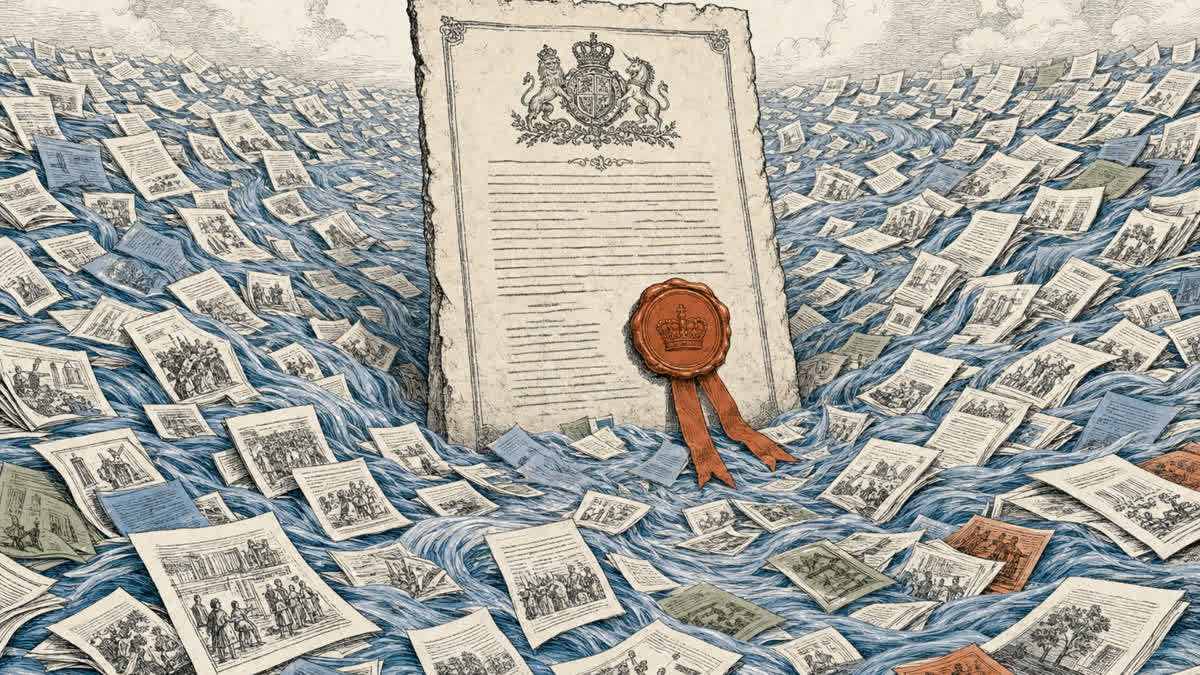
As printing expanded, European rulers, churches, and trade organizations tried bans, indexes, privileges, and licensing.
France briefly chose a blanket ban. On January 13, 1535, King Francis I ordered printing to stop throughout the kingdom and threatened unauthorized printers with death by hanging. Roughly six weeks later, the order was revised. The Parlement of Paris was to nominate twenty-four printers, from whom the king would select twelve. Only those twelve could print approved books in Paris, and only when the books were considered to serve the public good; new works were still forbidden. Until the new arrangement was in place, the ban and the threat of hanging remained in force.
The papacy used an index. The Index Librorum Prohibitorum was first issued in 1559 and revised for centuries afterward. In 1966, the Vatican announced that it no longer had legal force within the Church, while maintaining that it still carried moral weight and that Christians should remain wary of works that endangered faith or morals.
England relied on a guild and a licensing system. Under its 1557 royal charter, the Stationers’ Company held an almost complete monopoly over printing in England, although people with separate royal authorization could still print. The Printing Act of 1662—now often called the Licensing Act—created a statutory licensing regime. It operated from 1662 to 1679 and again from 1685 until 1695.
These systems lasted for very different lengths of time. France revised its blanket ban after about six weeks. England’s statutory licensing system ended in 1695. The papal index retained legal force within the Church until 1966. Calling all three simply “bans” hides what each one regulated, how it worked, and how long it survived.
The Wicked Bible also shows that authorities worried about the accuracy of a printed text, not just its subject. But the surviving court records say that the fine was later remitted. The seized books were returned to the printers, who could correct and sell them, and their license was not revoked. Later retellings dropped the remission and added claims that the books were destroyed and the printers lost their license.
One printing error gave rise to another historical error that circulated for centuries.
The Rules Printing Developed
Bans and licenses were not the only responses. Other practices emerged gradually: naming the printer; giving the place and date of publication; granting privileges; using recognizable devices; founding journals; and, later, developing more formal systems of review. Some helped readers judge where a text came from. Some protected commercial interests. Others served administration or censorship. The same practice could do more than one of these things at once.
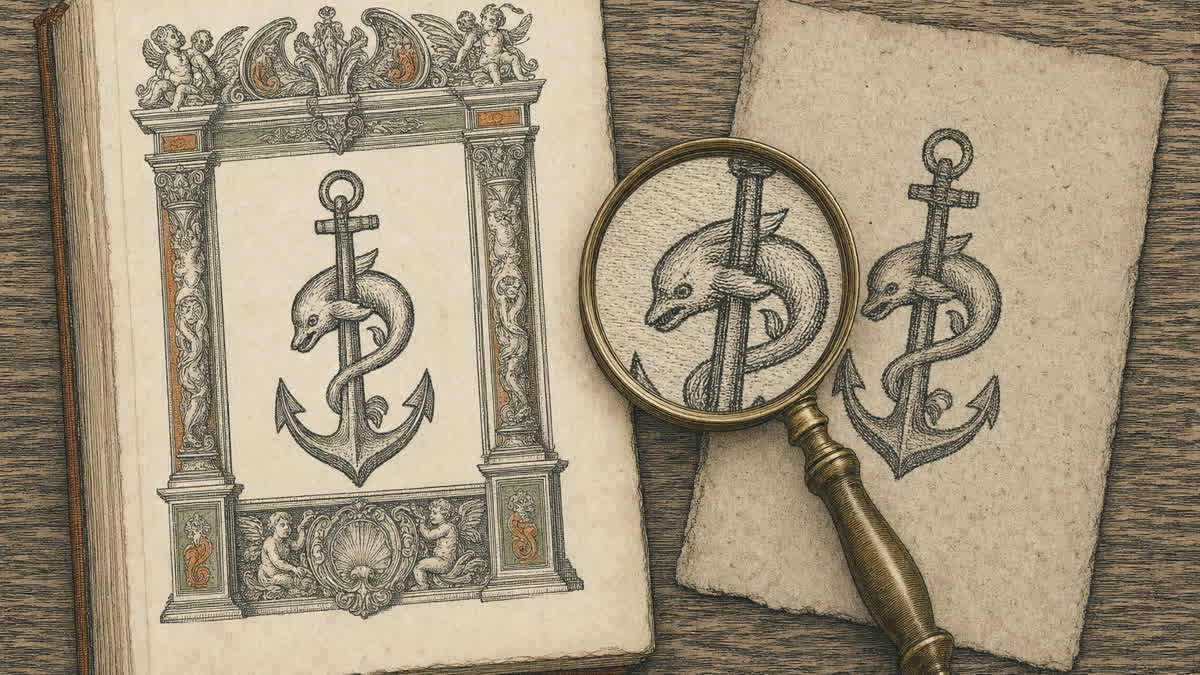
The Venetian publisher Aldus Manutius is a useful example. Beginning in 1501, his press issued pocket-size books known as enchiridia, set in italic type and devoted to Latin and Greek classics as well as Italian vernacular poetry. Cambridge University Library calls them his most successful innovation. Printers around Lyon soon began copying Aldine editions. One surviving counterfeit, probably printed in Lyon, imitates the Aldine edition of Dante from 1502 and even tries to copy the dolphin-and-anchor device.
The dolphin and anchor on an Aldine book identified it as a product of Manutius’s press. Yale Law Library describes such a printer’s device as “a trademark of sorts”: it was a marketing tool that also did some of the work of a copyright notice.
In 1503, Manutius published a warning. He listed differences between the authentic and counterfeit editions and supplied a list of errors so that buyers could spot the fakes. A device alone could not prove authenticity because counterfeiters could copy it. Buyers could still compare the device, printer, place, date, paper, type, and specific errors together.
Manutius did not invent the printer’s device. The earliest known example appeared in the 1457 Mainz Psalter, decades before his warning. The dolphin and anchor was simply one of the devices that later became famous.
The fifteenth century was not entirely without ideas resembling copyright or trademarks. Manutius held printing privileges granted by Venice. These were not automatic, generally applicable property rights, but monopolies awarded case by case by a government, limited by duration, subject, and territory. Venice had granted a printing monopoly to Johannes de Speyer as early as 1469, and in 1486 granted what is known as the first privilege issued directly to an author. The Cambridge exhibition notes that Lyon was outside Venetian jurisdiction, and therefore outside the reach of Manutius’s privileges. Counterfeit books were still printed in France, complete with an imitation dolphin and anchor.
The Statute of Anne, enacted in 1710, is commonly described as the world’s first copyright statute. Under the new law, the right to print a book no longer belonged only to members of the Stationers’ Company. Authors and their assignees could also hold the exclusive right to print and reprint a book for a fixed period. For a new, unpublished book, the first term was fourteen years. Long before that, merchants and printers had used marks to identify the source of goods and books. National systems for depositing or centrally registering trademarks came later. France introduced a deposit system in 1857; Britain’s Trade Marks Registration Act 1875 created a national register.
Marks identifying a source and limited periods of exclusivity therefore predate national trademark registration and generally applicable copyright statutes. Early privileges, however, were narrow in subject, duration, and territory, and difficult to enforce across borders.
Review developed even more slowly. Henry Oldenburg founded Philosophical Transactions in 1665, but modern peer review did not arrive with the journal. The Royal Society adopted collective selection by committee in 1752 and did not introduce systematic expert review until the 1830s. A scientific journal appeared about two centuries after the Gutenberg Bible. More systematic expert review took nearly another two centuries.
None of these systems was designed all at once, and none eliminated the underlying problems. Printer’s devices could be forged. Privileges could protect investment and control publication at the same time. Editors and reviewers could still miss errors.
What Happened to the Scribes
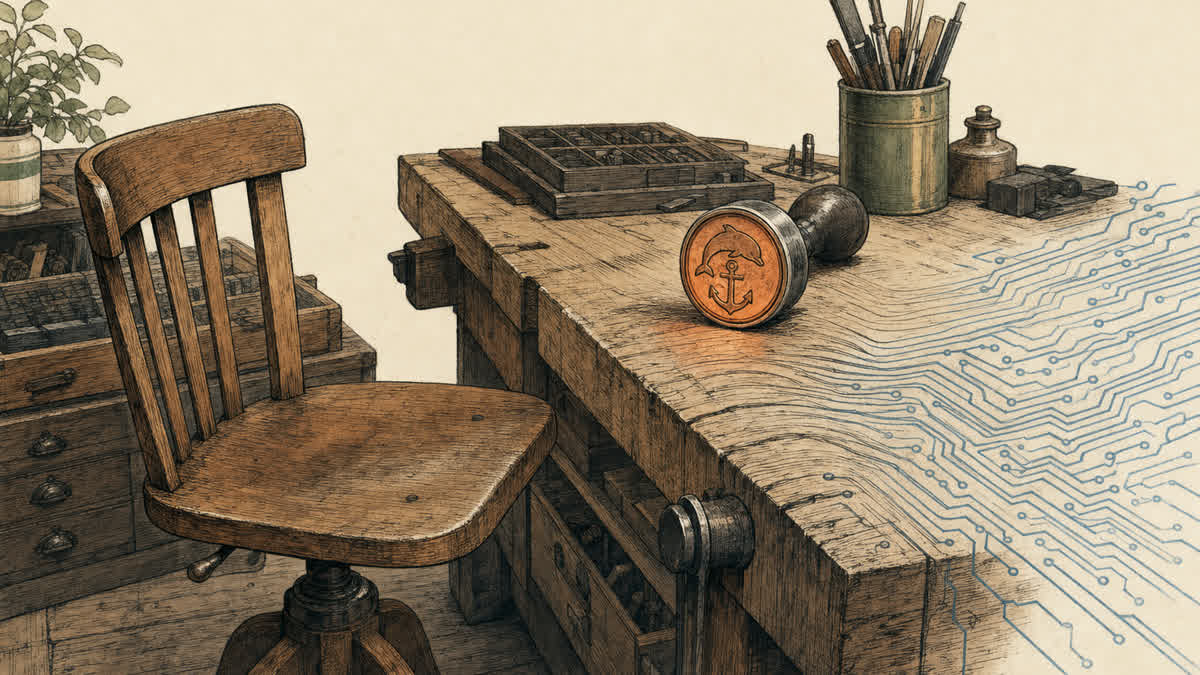
Scribes did not vanish when the press appeared. In England, according to a literary history published by Cambridge University Press, most texts continued to be “published” through handwriting and speech for many years after William Caxton opened his Westminster press in 1476. Print was better suited to longer works with a large audience. Short texts and works for specialized readers still often circulated in manuscript. As literacy increased, manuscript and print expanded together for a time. This was not a simple case of a new technology replacing an old one.
Early printed books also depended on handwork. Printers left blank spaces for initials and rubrics, which people later supplied in red or blue ink or decorated with gold. Princeton University Library notes that illuminators who had worked on manuscripts continued to find work. As long as patrons wanted brilliantly colored luxury books, these artisans could decorate pages whether the words were handwritten or printed. Woodcut initials and printed headings reduced the need for hand rubrication from the 1470s onward, but the luxury market still needed illuminators.
The evidence supports a modest claim: handwriting and print coexisted, divided up kinds of work, and changed the market around them. It does not show that scribes generally became proofreaders and typesetters. Monasteries, government offices, commercial workshops, and luxury-book markets changed in different ways from place to place. The Cambridge account also notes that monastic scriptoria in England disappeared in the late 1530s. Protestant culture later put more weight on personal writing, while private and public archives continued to grow. The history of scribes cannot be reduced to a printing press simply replacing handwriting.
Printing History Has No Ready-Made Answer
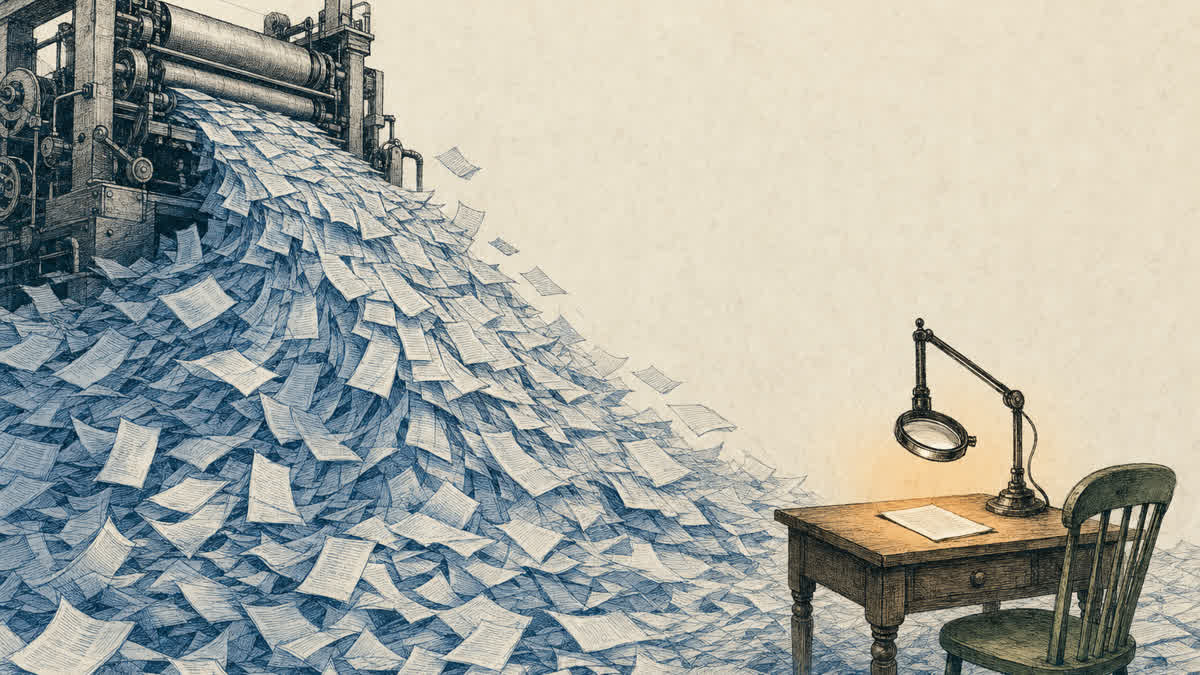
Printing and generative AI are not the same technology. A press mainly reproduces text that has already been set. A generative model produces new material in response to instructions. A fifteenth-century book still had to pass through a workshop, transportation network, and market before it reached a reader. Today, content can travel around the world almost at once. The legal systems, literacy rates, scale of distribution, and institutions controlling the channels are also very different. An analogy can help us notice a problem. It cannot give us the answer.
For Wikipedia’s volunteer editors, limiting AI-generated text is first of all a way to control the burden of review. AI can produce a great deal of prose quickly; the community has only so much time to check it. But for creators already used to working with AI, the rule does not distinguish among authors who disclose that use, cite evidence that can be checked, and accept responsibility when something goes wrong.
Platforms are not all worried about the same thing. TikTok focuses on realistic synthetic media that could mislead people. Xiaohongshu focuses on automated operation and the mass production of low-quality material. Hacker News rejects AI-generated or AI-edited text because it wants the site to remain a conversation among people. Different platforms serve different purposes and face different review conditions, so they make different rules.
Instead of asking whether AI should be supported or banned in the abstract, it may be more useful to break the question into smaller ones.
The hardest issue is how to divide responsibility. Who should spend the time checking a claim: the author, the platform, an editor, or the reader? Some material can be published first and corrected later. Other risks must be limited before publication. Where should that line be drawn? It is also unclear how much an AI label can accomplish. Citations, revision histories, and bylines may make checking easier, but such requirements can also exclude people and concentrate more power in the hands of a few gatekeepers. We cannot yet know whether rules based on how a work was produced will endure or give way to other approaches.
Printing history offers no ready-made answer, but it does show institutions changing through trial and error. France’s blanket ban lasted about six weeks; the Index Librorum Prohibitorum endured for centuries. Printer’s devices helped readers identify a source and were themselves counterfeited. Scientific journals appeared, and then nearly two more centuries passed before more systematic expert review took shape.
Da Strada’s poem was not a prophecy about AI. It records how one fifteenth-century scribe understood the new machine in front of him. Reading it now, we can at least ask which of his fears had a basis in fact and which were shaped by his own position and interests. Do the parallels appear because new technologies repeatedly create the same problems, or because people confronted by change repeatedly say the same things? Printing history cannot tell us how AI will ultimately change writing, review, and publishing.
References and Source Passages
- English Wikipedia — Original source: AI noticeboard: “Easy-to-cancel mandate”. In the discussion, an editor’s source check found that the two-step test appeared to be a requirement of the law rather than a test devised by the researchers. My disclosure included the estimate that I was “using AI to generate almost 90-95% of the new lines of code.” The same reply described the prompting, research, citation, draft review, and move into mainspace. The time-based estimate, the comparison between about one minute of prompting and ten to twenty minutes of AI runtime, and the estimate of more than 99 percent by character count were my later calculations, not statements made on the noticeboard — fetched 2026-08-20
- English Wikipedia — Original source: “Writing Articles with Large Language Models”. The guideline prohibits using LLMs to generate or rewrite article content; a footnote dates the relevant request for comment to March 2026, and the text lists exceptions including proofreading and translation — fetched 2026-08-20
- Hacker News — Original source: Hacker News Guidelines. The rule reads: “Don’t post generated text or AI-edited text. HN is for conversation between humans.” — fetched 2026-08-20
- TikTok — Original source: “AI-generated content”. TikTok requires labels on AI-generated content containing realistic images, audio, or video. The page separately describes content for which labeling is encouraged, content that may be removed, and content that is prohibited altogether — fetched 2026-08-20
- Sina Tech, reporting a Xiaohongshu announcement — Original source: Xiaohongshu issues rules for governing AI content. The announcement welcomes creators using AI to improve content quality and informational value. Sanctions for violations can include restricting distribution or banning accounts — fetched 2026-08-20
- International AI Safety Report expert advisory panel — Original source: International AI Safety Report 2026, 221 PDF pages. Cyber capabilities are discussed on PDF page 58 (report page 57, about 26 percent into the file), including systems’ ability to discover software vulnerabilities and write malicious code. Biological and chemical risks appear on PDF page 65 (report page 64, about 29 percent), where the report also emphasizes the substantial uncertainty about real-world effects — fetched 2026-08-20
- Library of Congress — Original source: “The Gutenberg Bible”. The Library dates the probable completion of printing to late 1455 in Mainz, Germany — fetched 2026-08-20
- German Museum of Books and Writing, German National Library — Original source: “Spread of printing”. The museum states that printing shops had appeared in roughly 250 places by 1500 — fetched 2026-08-20
- Ho Nga-kam, Kung Kao Po, the weekly newspaper of the Catholic Diocese of Hong Kong — Original source: “The Charism of the Dominican Order, Part I”. The Chinese article explains the variant Chinese names for the Dominicans and gives the formal Latin name, Ordo Praedicatorum (O.P.), or Order of Preachers — fetched 2026-08-20
- Giancarlo Petrella — Original source: “Domenicani contro l’arte della stampa: Non comprate quei libri!”, la Biblioteca di via Senato Milano, December 2022, 108 PDF pages. Da Strada’s identity, the recipient, and the occasion appear on PDF page 29 (journal page 27, about 27 percent into the file). The requested ban, counterfeiting comparison, charges of error and obscenity, and the line used in the title appear on PDF page 30 (journal page 28, about 28 percent). Petrella locates the poem in Biblioteca Nazionale Marciana manuscript It. I 72 and transcribes: “Est virgo hec penna, meretrix est stampificata” — fetched 2026-08-20 (the previously listed Archive.org PDF was corrupted and is not used as evidence). See also Catherine Kikuchi’s bibliographic location and variant reading, in a 226-page PDF. PDF page 24 (journal page 23, about 11 percent) identifies Marciana, Mss. Italiani, cl. I, cod. 72, n° 5054, fol. 2r, and reads “meretrix que est stampificata” — fetched 2026-08-20
- Roger Chartier — Original source: “The Practical Impact of Writing”, 12 PDF pages. The passage is on PDF page 6 (book page 123, about halfway through the file). It gives the English line “The pen is a virgin, the printing press a whore” and summarizes the profit-driven output as hastily made, faulty editions — fetched 2026-08-20
- Noel L. Brann — Original source: “A Monastic Dilemma Posed by the Invention of Printing”, Visible Language XIII.2 (1979), 18 PDF pages. PDF page 1 (journal page 150, about 6 percent) dates the work to 1492 and says its author was not hostile to printing in principle. The account of his giving the manuscript to a printer appears on PDF page 2 (journal page 151, about 11 percent); Brann says Trithemius did so to give the tract the widest possible circulation — fetched 2026-08-20
- German Digital Library — Original source: catalog record for De laude scriptorum. The imprint is listed as “Maguntinu[m] : Peter Friedberg, 1494” — fetched 2026-08-20
- John Willinsky, The Intellectual Properties of Learning: A Prehistory from Saint Jerome to John Locke, chapter 8, “Humanist Revival” — Original source: open-access final manuscript. The book was published by the University of Chicago Press in 2018. This citation uses the author’s 35-page, peer-reviewed and revised manuscript, which he notes still differs from the published text. Erasmus’s work with Manutius in 1508 appears on PDF page 12 (about 34 percent into the chapter). The introduction and praise in the Festina lente entry appear on pages 18–19; the turn to criticism appears on pages 19–20, about 51–57 percent into the file. Willinsky’s cited translation refers to a good book choked with six thousand mistakes, swarms of new books, and their number being harmful to scholarship — fetched 2026-08-20
- University of Chicago Library — Original source: “Martin Luther as print media’s first influencer”. The exhibition says that Luther went from unknown in 1517 to the most-published author in print by 1520, and also calls him the first bestselling author in book history — fetched 2026-08-20
- Princeton University Library — Original source: “The beginning of printing in Mainz”. The library says that Chappe commissioned Gutenberg to print the indulgence forms in great quantity and estimates that there were probably thousands — fetched 2026-08-20
- James K. Farge — Original source: “Early Censorship in Paris: A New Look at the Roles of the Parlement of Paris and of King Francis I”, Renaissance and Reformation 25(2) (1989), pp. 173–183, 11 PDF pages. The ban and its revision appear on PDF pages 7–8 (journal pages 179–180, about 64–73 percent into the file). The first order threatened unauthorized printing with death by hanging. The revision instructed the Parlement to nominate twenty-four printers, from whom the king would select twelve. Those selected could print only approved books in Paris that were considered to serve the public good, and could not print new works — fetched 2026-08-20
- University of Pennsylvania Libraries — Original source: “Index Librorum Prohibitorum”. The page dates the first issue to 1559, under Pope Paul IV, and notes that it continued to be revised and expanded until 1966 — fetched 2026-08-20
- Vatican Dicastery for the Doctrine of the Faith — Original source: 1966 notification concerning the Index. The notification says that the index remains morally binding but no longer has the force of ecclesiastical law — fetched 2026-08-20
- Primary Sources on Copyright — Original source: 1557 royal charter of the Stationers’ Company. The charter barred printing in England and its territories by anyone who was neither a company member nor separately licensed by the Crown; Ronan Deazley describes this as exclusive control over printing within England — fetched 2026-08-20
- Cambridge University Press — Original source: “The Stationers and the Printing Acts at the end of the seventeenth century”. The chapter summary confirms that the 1662 act expired on May 3, 1695, and explains that contemporaries called it the Printing Act, while it later became known as the Licensing Act — fetched 2026-08-20. For the licensing system and its two periods of operation, see also the Primary Sources on Copyright record for the Licensing Act of 1662, which describes licensing of the press in 1662–1679 and again in 1685–1695 — fetched 2026-08-20 (no new Archive.org snapshot was available)
- David Moseley, University of Canterbury — Original source: “Not” Funny? Humour, Embarrassment, and the “Wicked Bible”, 79 PDF pages; PDF page 2 is blank. The omission and complete erroneous sentence appear on PDF page 3 (thesis page 1, about 4 percent into the file). Henry Stevens’s use of the name “Wicked” in 1855 appears on PDF page 17. The evidence that the books were not destroyed and were returned for correction appears on PDF page 18 (thesis page 16, about 23 percent). The finding that the license was not revoked appears on PDF page 19 (thesis page 17, about 24 percent). The fine and the Greek printing house appear on PDF page 55 (thesis page 53, about 70 percent) — fetched 2026-08-20
- Cambridge University Library — Original source: “Enchiridia, counterfeits and the dolphin-and-anchor device”. The exhibition calls the pocket classics, first issued in 1501, Manutius’s most successful editorial innovation and notes their use of italic type. The live site timed out during review, so these points were checked against the complete archived page — fetched 2026-08-20
- Cambridge University Library — Original source: “Dante Commedia counterfeit device”. The counterfeit was probably printed in Lyon around 1502–1503 and even attempts to copy Aldus’s dolphin-and-anchor device. The exhibition overview explains that competitors were concentrated in Lyon, beyond Venetian territory and the reach of its printing privileges — fetched 2026-08-20
- Yale Law Library — Original source: “Printers’ devices from law books”. The library describes a printer’s device as a trademark of sorts, used for marketing and as something like a copyright notice. The page dates the earliest known example to the 1457 Mainz Psalter — fetched 2026-08-20
- Aldus Manutius, Primary Sources on Copyright — Original source: English translation and transcription of the 1503 Monitum in Lugdunenses typographos, from Bibliothèque nationale de France, BN, Ms. Gr. 3064, fol. 85. Manutius says that books from Lyon appeared under his name and full of errors, then lists differences in printer, place, date, device, paper, and type, followed by errors in particular books — fetched 2026-08-20
- Joanna Kostylo, Primary Sources on Copyright — Original source: “Commentary on Marcantonio Sabellico’s privilege”. Kostylo describes Johannes de Speyer’s 1469 grant as a printing monopoly and Sabellico’s 1486 grant as the first known privilege to an author. Such privileges were not understood as inherent rights — fetched 2026-08-20
- Ronan Deazley, Primary Sources on Copyright — Original source: “Commentary on the Statute of Anne 1710”. Deazley calls it the world’s first copyright statute and notes that ownership was open not only to members of the Stationers’ Company but also to authors. The initial term for an unpublished new book was fourteen years — fetched 2026-08-20
- UK Intellectual Property Office — Original source: “The red triangle that made history”. The article says that France introduced a deposit system in 1857 and that Britain’s 1875 act created a systematic, nationally centralized register — fetched 2026-08-20
- The Royal Society — Original source: “History of Philosophical Transactions”. The history dates the journal’s founding by Oldenburg to 1665, collective selection by a twenty-one-member committee to 1752, and more rigorous, systematic expert review to the 1830s — fetched 2026-08-20
- Cambridge University Press — Original source: “Manuscript transmission and circulation”. Limited to England, the chapter summary says that much material still circulated in manuscript and oral form for years after printing arrived, and that the new medium did not simply grow at the expense of the old. It also places the disappearance of English monastic scriptoria in the late 1530s, in the context of the Reformation — fetched 2026-08-20
- Princeton University Library — Original source: “Inside the Milberg Gallery: Illumination”. The page describes spaces left for initials and rubrics in early printed books, later filled by hand in red or blue ink or decorated with gold. Woodcut initials and printed headings reduced demand for rubrication from the 1470s, but manuscript illuminators still found work in the luxury-book market. The live site triggered Cloudflare during review, so these points were checked against the complete archived page — fetched 2026-08-20