
风投诞生之前的创业者:阿克莱特,合伙人的钱和专利授权
阿克莱特从下游客户所在的行业找来合伙人出钱,买家拒收他的纱线就自己织布,又拿一项后来被法院撤销的专利卖授权。

本文目录
TL;DR: 阿克莱特(Richard Arkwright)没有发明工厂,法院也没有承认他的机器全是他发明的。史料能证明的是另外三件事:他从第一个客户所在的行业找到合伙人;正经买家拒收他的纱线,他就自己做下游产品;他拿一份故意写得含糊的专利去卖授权。1785 年,授权生意在法庭上垮了,工厂生意没有垮。
本文属于“风投诞生之前的创业者”系列。现代风险投资一般从 1946 年成立的美国研究与发展公司(ARD)算起,这个系列看的是在那之前创业的人。每一篇回答同样几个问题:创业者面对的是什么市场,他用了哪一招,这一招放到今天叫什么,关于他的哪些流行说法经不起查证。
阿克莱特自己承认,公司亏了五年多才赚钱
1782 年,阿克莱特输掉一场专利官司之后,印了一份四页的小册子,请议会出手帮忙。这份小册子读起来很像他本人写的融资路演材料。他在里面说,拿到第一项专利之后过了五年多,机器和厂房投进去一万二千多英镑,“他本人和合伙人”才开始有利润。到写小册子的时候,他说这门生意已经雇用“五千多人”,总资本“不少于二十万英镑”。这些数字出自阿克莱特本人,目的是说服议员,应当当作创业者的自述来读,不能当作审计过的账目。
五年多没有利润,钱来自合伙人而不是基金。对关心“在机构资本出现之前怎样找到产品市场契合(PMF)”的人来说,阿克莱特值得一看,原因就在这里。
当时纺纱是瓶颈,上一个造纺纱机的人被赶出了家乡
贝恩斯(Edward Baines)在 1835 年写的棉纺织业史里,形容新机器出现之前的情形是织工“不断催逼纺工”:织工一家人纺的纬纱不够用,他得到邻居家去收纱,对方开什么价就得给什么价。纱线不愁卖,难的是供应。
阿克莱特的小册子还写出了风险。按小册子的说法,哈格里夫斯(James Hargreaves)大约在 1767 年造出一台能同时纺许多根纱的机器,结果机器被烧毁,人被赶出兰开夏。同为兰开夏人的阿克莱特于是去了诺丁汉,在 1769 年取得专利。贝恩斯补充说,阿克莱特和合伙人搬到诺丁汉,是因为担心他们的机器遭到“类似的暴行”。
市场又大又饥渴,旧势力却肯动手砸机器。
阿克莱特分三步找钱,第三位出资人来自第一个客户所在的行业
贝恩斯记下了找钱的顺序。阿克莱特生在普雷斯顿,学的是理发,贝恩斯说他自己拿不出钱来研制机器。钱分三步到位:
- 朋友。 在普雷斯顿,阿克莱特找卖酒兼做油漆的朋友斯莫利(John Smalley)帮忙。贝恩斯说斯莫利“出钱又出力”加入了阿克莱特。
- 银行。 到了诺丁汉,赖特(Wright)家的银行垫了钱,条件是分享发明的利润。机器迟迟做不成,银行就请阿克莱特另找出资人,并把他介绍给尼德(Samuel Need)。
- 产业合伙人。 尼德的合伙人是德比的斯特拉特(Jedediah Strutt),斯特拉特改良过织袜机并拿到了专利。贝恩斯说,斯特拉特看过机器之后称之为“一项了不起的发明”,随后尼德和斯特拉特都“与阿克莱特合伙”。
贝恩斯的部分细节来自斯特拉特的儿子威廉·斯特拉特(William Strutt),经由更早的一部地方志转述,所以这是隔了一层的家族说法,不是合同原件。笔者没有在公开渠道找到 1769 年或 1771 年的合伙契约原文,本文因此不写任何股份比例和出资金额。
对本系列来说,要紧的是第三位出资人的身份。尼德和斯特拉特都做袜子生意。阿克莱特在 1782 年的小册子里说,纱线最早找到的用途是织成袜子,“结果成功了”。用今天的话说,斯特拉特是战略投资人:他来自客户所在的行业,能试用产品,能判断技术,还能买下产出。这是笔者根据上述史实做的解读,史料本身没有这么说。
专利上的机器靠马拉,先有诺丁汉的工厂,后有克罗姆福德
1769 年的专利说明书于 1769 年 7 月 15 日登记。阿克莱特在说明书里画的机器,主轴由“一匹马带动”,几对罗拉以不同转速转动,先把棉条抽细,再交给锭子加捻。贝恩斯指出,阿克莱特在专利里自称“诺丁汉的钟表匠”,贝恩斯直说这是“肯定不实的描述”。
合伙人先在诺丁汉建了一座马拉的工厂。贝恩斯说马力太贵,他们于是在德比郡的克罗姆福德(Cromford)另建了一座规模大得多、靠水轮驱动的工厂,这种纺纱机因此得名“水力纺纱机”(water frame)。贝恩斯引用工程师肯尼迪(John Kennedy)的话,说克罗姆福德第一座工厂建于“1771 年”。联合国教科文组织为德文特河谷工厂群(Derwent Valley Mills)世界遗产写的介绍给出同一个年份,还多写了一步:阿克莱特1771 年在克罗姆福德建了水力纺纱厂,1776–77 年又建了一座更大的。
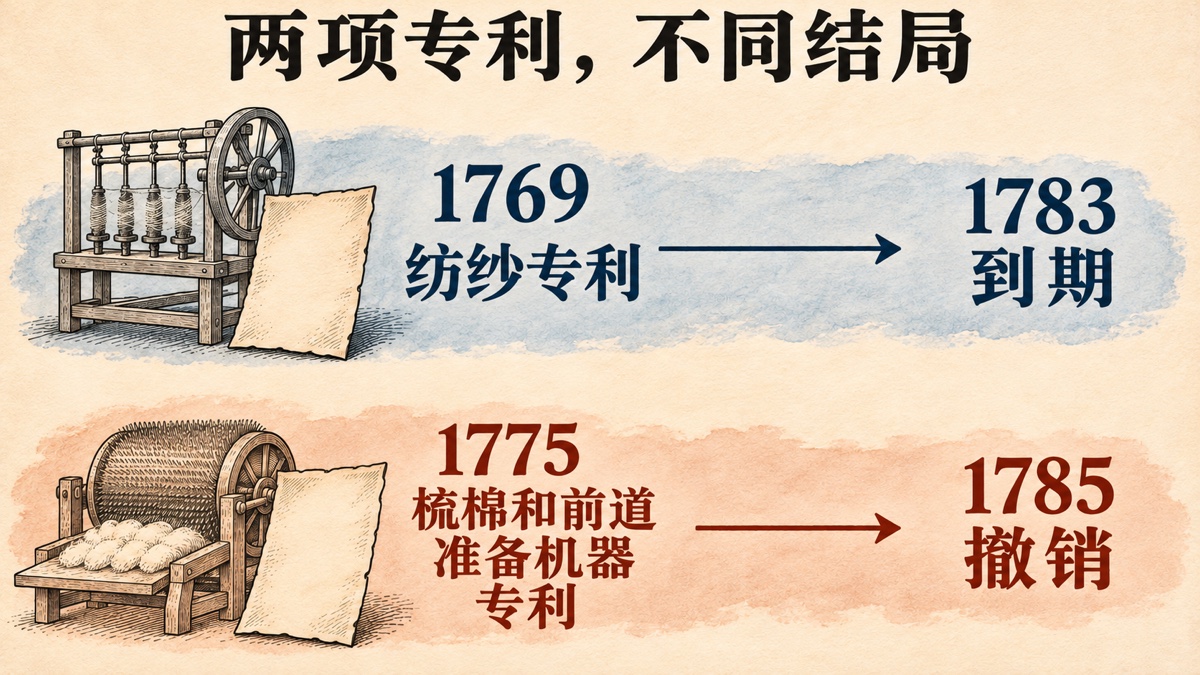
此后阿克莱特又拿到第二项专利,时间是 1775 年 12 月,内容是梳棉和前道准备机器。这个细节后面会用到:法院撤销的是 1775 年这一项,不是 1769 年那一项。
买家拒收纱线,合伙人就自己造出需求
1782 年的小册子讲了一段市场推广的经历,做新型零部件的创业者读来都会觉得眼熟。纱线质量很好,但合伙人“很难让公众用上它”,卖不掉的存货越积越多。他们一步一步应对:
- 先把纱线织成袜子,这正是合伙人自己的本行。
- 再请兰开夏的厂商把纱线织成白棉布(calico),厂商“断然拒绝”。
- 于是他们自己织白棉布。
- 接着税务官员认定这批布属于白棉布,要在每码 3 便士的常规税之外再收每码 3 便士,尽管布是英格兰本地织的,印花的白棉布更是禁止出售。合伙人向税务专员申诉未果,最后找到议会,“顶着兰开夏厂商的强烈反对”争取到了豁免。
用今天的话说,这是渠道拒收逼出来的纵向一体化。一个行业不想要你的零部件,你就自己当这个零部件的客户,再去改那条让成品卖不动的税规。今天讲“全栈创业”的故事,往往漏掉游说这一步。
阿克莱特出售授权,还入股被授权的工厂
纱线的需求一旦超过阿克莱特和合伙人自己的产能,按小册子的说法,阿克莱特就把“许多专利机器”卖给了德比、莱斯特、诺丁汉、伍斯特、斯塔福德、约克、赫特福德和兰开夏各郡的“大批创业者”。他估计这些买家因此投入了“至少六万英镑”。
贝恩斯从外部描述了同一门生意。阿克莱特登广告公开出让专利使用权,“每个锭子收一笔钱”,“有几家新建的工厂他还入了股”。贝恩斯又说,阿克莱特从授权里赚了钱,“但从他自己几家工厂的利润里赚得多得多”。
笔者读过的两份史料都没有写每个锭子收多少钱,本文因此不给数字。
放到今天,这是“授权加入股”的模式:出售技术使用权,按产能收持续费用,有时用一部分费用换股份。一些特许经营和平台合作也是这个结构。授权收入押在一项很脆弱的资产上,就是专利本身。
阿克莱特故意把专利写得难以照抄,专利也正是因此丢的
当时和现在一样,专利法要求说明书写到别人在专利到期后能照着造出机器的程度。阿克莱特在小册子里承认,1775 年那项专利的说明书,他“有意”没有写全,理由是怕外国人仿造;他还说自己“一贯的规矩”是不许外国人进厂参观。
贝恩斯转述了庭审证词:替阿克莱特起草说明书正式部分的人作证说,阿克莱特交代他,要让文本“看起来像一份说明书,但在情理允许的范围内写得越含糊越好”。
诉讼经过如下,依据是贝恩斯的书和 1785 年的庭审记录:
- 1781 年。 阿克莱特对未获授权的使用者提起九起诉讼,只有告莫当特上校(Colonel Mordaunt)的一起开了庭。陪审团以说明书含糊为由判阿克莱特败诉。
- 1782 年。 阿克莱特印发小册子,请议会“确认、连接并合并两份专利证书”。贝恩斯指出,1769 年的专利将于 1783 年到期,1775 年的专利到 1789 年底才到期,所以阿克莱特等于要求把第一台机器的专利再延长八年。贝恩斯说阿克莱特后来放弃了这次申请。
- 1785 年 2 月。 在民事诉讼法院(Court of Common Pleas),阿克莱特2 月 17 日就第二项专利的侵权诉讼胜诉。
- 1785 年 6 月。 兰开夏的纺纱商申请到一份撤销令状(scire facias),要求撤销 1775 年的专利。案件于 1785 年 6 月 25 日在威斯敏斯特大厅由布勒法官(Justice Buller)审理。王室一方的律师提出四条理由:专利妨害公众利益;机器不是新发明;机器不是阿克莱特发明的;说明书没有公开发明。庭审记录的结尾写道:“陪审团毫不犹豫,作出了有利于王室的裁决”。
- 1785 年 11 月。 阿克莱特申请重审,曼斯菲尔德勋爵(Lord Mansfield)驳回了申请;11 月 14 日,王座法院判决撤销这份专利证书。
笔者有两点看法,都属于解读。第一,保护生意不被抄袭的保密做法,恰恰毁掉了法律上的资产:阿克莱特想对同一台机器既保有商业秘密又享有专利,两者不可兼得。第二,专利没了,公司还在。贝恩斯写道,1785 年之后阿克莱特“照样一帆风顺”,而且“有好几年,棉纱的价格由他来定,其他纺纱商都跟着他的价格走”。真正持久的优势是那几座运转中的工厂。
几种流行说法经不起史料核对
“1785 年,阿克莱特的水力纺纱机专利被撤销。” 不准确。1785 年的撤销令状针对的是“1775 年 12 月 16 日授予”的专利,也就是梳棉和前道准备机器那一项。1769 年的纺纱专利在 1783 年已经到期。
“阿克莱特发明了水力纺纱机。” 发明权在 1785 年的庭审上吵过,至今没有定论。做筘的工匠海斯(Thomas Highs,庭审记录拼作“Hayes”)作证说,他当面对阿克莱特说“他拿走了我的发明”,中间人是钟表匠约翰·凯(John Kay)。凯作证说他1767 年在沃灵顿(Warrington)认识了阿克莱特。阿克莱特的律师则攻击两人的可信度。陪审团作的是概括裁决,没有说明采纳了王室的哪一条理由,所以这份裁决并不等于认定海斯是发明人。贝恩斯权衡了双方的说法,指出能证明凯替海斯造过机器的证人只有凯一人,凯又和阿克莱特闹翻过,海斯本人直到 1785 年才公开主张发明权。贝恩斯还提出另一种可能:阿克莱特不懂机械,雇了钟表匠来造他自己构想的装置。贝恩斯本人的结论是,这些机器“虽是别人发明,却靠他的收尾之功才得以完善”。这是 1835 年一位史家的判断,不是定论。
“约翰·凯帮阿克莱特造了机器。” 这段历史里有两个约翰·凯,很容易搞混。和阿克莱特共事、1785 年出庭作证的凯,是沃灵顿的钟表匠。发明飞梭的约翰·凯是兰开夏伯里(Bury)人,贝恩斯把飞梭的年份定在 1738 年。笔者读到的史料里,没有任何内容把飞梭的凯和水力纺纱机联系在一起。
“克罗姆福德是世界上第一座工厂。” 贝恩斯自己就说,阿克莱特“并非工厂制度的首创者”,并举出隆贝(Thomas Lombe)在德比德文特河边建的丝绸厂,贝恩斯把年份定在 1719 年。联合国教科文组织的措辞更窄,也更站得住:德文特河谷见证了“工厂制度的诞生”,“现代工厂起源于克罗姆福德的工厂”。“第一座工厂”应当理解为“水力棉纺第一次成体系的地方”,而不是任何意义上的第一座工厂。
授权费和合伙股份。 阿克莱特每个锭子收多少授权费,1769 年和 1771 年的合伙关系里各人占多少股份,笔者都没有找到公开的一手出处。一些现代的概述给出了数字,本文一概不用。
今天的创业者可以从渠道、投资人和护城河三方面借鉴
以下是笔者对史料的解读,写给做开发者工具、域名和其他基础设施的创业者。这类产品往往是别人产品里的一个组成部分。
- 零部件再好,也可能没人买。 阿克莱特的纱线比手纺纱好,兰开夏的织布商照样拒收。如果你的用户是开发者或注册商,用你的产品就得改他们的工作流程,那就要预先想好对方说“不”的时候怎么办,想好下游哪一块你可以自己来做。
- 最好的早期投资人,可能就在第一个客户所在的行业。 斯特拉特本来就做袜子,所以看得懂这台机器。懂使用场景的投资人,能压低 PMF 之前最大的风险:做出没人用的东西。
- 公开和保密只能选一个。 阿克莱特既想要专利保护,又想让机器保密,法院把后者当成了前者的缺陷。放到软件团队身上,就是许可证或标准号称开放,真正的实现却藏着不放。合作伙伴看得出来,法院也看得出来。
- 授权收入的强弱取决于背后的权利。 如果授权生意建立在一项法院、注册局或平台随时可以收回的资产上,那就是在押注这项资产。阿克莱特扛过了专利被撤,是因为他自己的工厂本身就赚钱。
- 游说也可能是 PMF 的一部分。 税务裁定让阿克莱特的成品布失去竞争力,直到议会改了规矩才解决。当一条规则决定了产品能不能卖,改这条规则也是创业者的分内事。
参考资料
一手史料是 1782 年的小册子《阿克莱特公司的申辩》(The Case)和 1785 年的庭审记录。贝恩斯 1835 年的书属于二手史学著作;正文里只靠贝恩斯一家的地方,都已注明。引用 18 世纪印刷品时,长 s(“ſ”)改写为 s,措辞不改。互联网档案馆(Internet Archive)的扫描书不支持文字片段定位,相关链接打开的是书内搜索或页码。本文没能为来源新建 Wayback Machine 快照,只有联合国教科文组织的页面有现成快照。引文保留英文原文,便于核对。
一手史料
- Richard Arkwright and Co., The Case of Mr. Richard Arkwright and Co. in Relation to Mr. Arkwright’s Invention of an Engine for Spinning Cotton, &c. into Yarn (伦敦,1782 年),共 4 页。 互联网档案馆扫描本(Eighteenth Century Collections Online)。 抓取于 2026-11-11。引用段落:
- 第 1 页: “his Engines were burnt and destroyed, and himself driven out of Lancashire”.
- 第 1 页: “he retired to Nottingham, and obtained a Patent in the Year 1769”.
- 第 2 页: “he procured a Patent for these also, in December 1775”.
- 第 2 页: “upwards of Five Years had elapsed after obtaining his First Patent, and more than 12,000l. had been expended in Machinery and Buildings”.
- 第 2 页: “Their first Trial was, in weaving it into Stockings, which succeeded; they then endeavoured to prevail on the Manufacturers in Lancashire to weave it into Callicoes, but they absolutely refused.”
- 第 2 页: “the Officers of Excise refusing to let them pass at the usual Duty of 3d. per Yard, insisting on the additional Duty of 3d. per Yard, as being Callicoes”.
- 第 2 页: “Mr. Arkwright sold to Numbers of Adventurers … many of his Patent Machines. Upon a moderate Computation, the Money expended in consequence of such Grants amounts to at least 60,000l.”
- 第 2 页: “he therefore, purposely, in Prevention of that Evil … omitted to give so full and particular a Description of his Inventions”.
- 第 3 页: “a Business that already employs upwards of Five Thousand Persons, and a Capital, on the whole, of not less than 200,000l.”
- 第 3 页: “to confirm, connect and consolidate, the Two Letters Patent”.
- The Trial of a Cause Instituted by Richard Pepper Arden, Esq; His Majesty’s Attorney General, by Writ of Scire Facias, to Repeal a Patent Granted on the Sixteenth of December 1775, to Mr. Richard Arkwright (伦敦:Hughes and Walsh,1785 年)。 互联网档案馆扫描本(Eighteenth Century Collections Online)。 抓取于 2026-11-11。引用段落:
- 扉页: “to repeal a Patent granted on the Sixteenth of December 1775”.
- 开庭记录: “At Westminster-Hall, 25th of June 1785. Mr. Justice Buller came into Court”.
- 海斯(Highs)的证词: “I began to tell him he had got my invention, I told him, I had shewn the model of it to John Kay”.
- 约翰·凯的证词: 被问到在哪里遇到阿克莱特,凯答 “At Warrington”,年份是 1767 年。
- 法官总结之后: “The Jury, without a minute’s hesitation, brought in their verdict FOR THE CROWN”.
- 1785 年 11 月 10 日的重审动议: “On the 10th of November 1785, the Court of King’s Bench was moved … for a Rule, to shew cause why a new Trial should not be granted”; Lord Mansfield: “There is not a colour for it”; the report continues “The rule was not granted” and “Afterwards on the 14th of November 178[5], the Court of King’s Bench gave Judgment to CANCEL the Letters Patent.”
二手资料
- Edward Baines, Jun., History of the Cotton Manufacture in Great Britain (伦敦:Fisher, Fisher, and Jackson,1835 年)。 互联网档案馆扫描本。 抓取于 2026-11-11。引用段落:
- 第 116 页: “In the year 1738, Mr. John Kay, a native of Bury, in Lancashire … suggested a mode of throwing the shuttle”.
- 第 115 页: “The weaver was continually pressing upon the spinner.”
- 第 145 页: “He never publicly laid claim to the invention till 1785 … No witness but Kay speaks to his having made such a machine. No document attests it. … Kay, the only witness besides Highs himself, had quarrelled with and quitted Arkwright”.
- 第 149 页,关于海斯的发明权主张:“those who disbelieve it may adopt the conjecture, that Arkwright, not being a practical mechanic, engaged the clockmaker to construct the apparatus he had himself contrived.”
- 第 148 页: “He was born at Preston on the 23d of December, 1732, of poor parents … He was brought up to the trade of a barber”.
- 第 150 页: “Being altogether destitute of pecuniary means for prosecuting his invention, Arkwright repaired to his native place, Preston, and applied to a friend, Mr. John Smalley … he joined Arkwright with heart and purse.”
- 第 151 页: “Arkwright and Smalley, fearing similar outrages directed against their machine, went also to Nottingham … Messrs. Wright, bankers, who made advances on condition of sharing in the profits … both Mr. Need and Mr. Strutt entered into partnership with Arkwright.” 脚注:“Some of the circumstances connected with Arkwright’s settling at Nottingham, were communicated by the late Mr. William Strutt … to the editor of the Beauties of England and Wales.”
- 第 151–152 页: “In the specification, which was enrolled on the 15th of July in that year”; “A, the Cogg Wheel and Shaft, which receive their motion from a horse.”
- 第 153 页: “Richard Arkwright, of Nottingham, clockmaker”; “they built another mill on a much larger scale at Cromford, in Derbyshire, which was turned by a water wheel, and from this circumstance the spinning machine was called the water-frame.”
- 第 185 页: “yet he did not absolutely originate it. Mills for the throwing of silk had existed in England … from the time of Sir Thomas Lombe, who, in 1719, erected a mill on the river Derwent, at Derby”.
- 第 186 页,引用肯尼迪:“Mr. Arkwright’s first mill was built (in 1771) at Cromford”.
- 第 187 页: “He offered the use of his patents by public advertisements, and gave many permission to use them on receiving a certain sum for each spindle. In several cases he took shares in the mills erected”; “he instituted nine actions in the year 1781; only one of which, that against Colonel Mordaunt, came to trial.”
- 第 188 页: “he meant it to appear to operate as a specification, but to be as obscure as the nature of the case could possibly admit.”
- 第 191 页: “His first patent, obtained in 1769, would expire in 1783 … and the second patent, obtained in 1775, would not expire till the end of the year 1789”; “tried in the court of Common Pleas on the 17th of February”.
- 第 191–192 页: the Lancashire spinners “applied for and obtained from the lord chancellor a writ of scire facias”; “Mr. Bearcroft, the counsel for the crown, opposed the validity of the patent on four grounds”.
- 第 193 页: “those most useful machines, which, though invented by others, owed their perfection to his finishing hand”; “For several years he fixed the price of cotton twist, all other spinners conforming to his prices.”
- UNESCO World Heritage Centre, Derwent Valley Mills,2001 年列入名录。 抓取于 2026-11-11(链接指向现有最近的快照,2026-10-31)。引用段落:
- 遗产介绍: “it was not until Richard Arkwright constructed a water-powered spinning mill at Cromford in 1771, and a second, larger mill in 1776-77 that the ‘Arkwright System’ was truly established”; “The modern factory owes its origins to the mills at Cromford”.
- 标准 (ii): “The Derwent Valley saw the birth of the factory system”.