
Founders Before Venture Capital: George Eastman Sold the Darkroom, Not Just the Camera
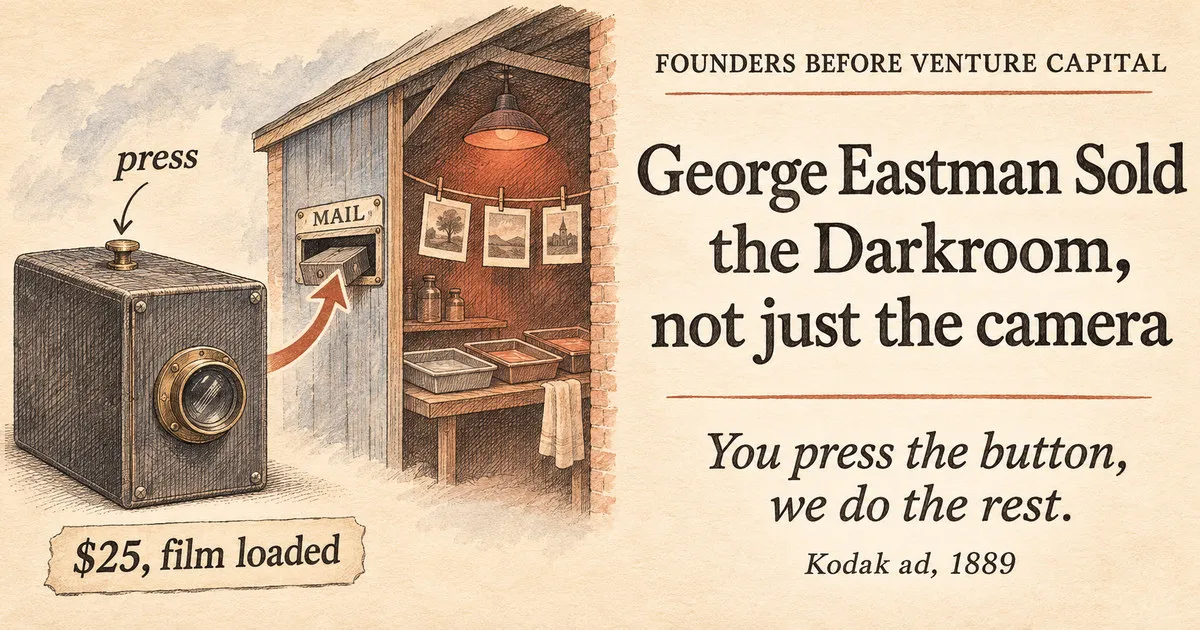
In 1888 George Eastman sold a $25 camera that went back to his factory for developing. The camera was the front end; the product was the service behind it.

On this page
The Kodak Camera. “You press the button, we do the rest.”
That is the top of a small 1889 magazine advertisement now held by the George Eastman Museum. Under the slogan, the ad promises that “Anybody can take good photographs with the Kodak,” offers a free primer, and closes with one line of terms: “Price, $25.00. Loaded for 100 pictures.” The advertiser was the Eastman Dry Plate and Film Co. of Rochester, New York.
This post is part of a series on founders who built companies before modern venture capital existed. The question for each one is the same: who, working without a VC fund, behaved most like a startup founder of today? George Eastman is a strong candidate. He sold a result, and he kept the hard part of the work inside his own factory.
Photography in the 1870s Was a Craft, Not a Consumer Product
Eastman did not start as a photographer. According to the George Eastman Museum, he left school at 14 to support his mother and sisters and later worked as a junior clerk at the Rochester Savings Bank. When he was 23, a colleague suggested that he take a camera on a vacation. He bought the equipment, never made the trip, and became absorbed in photography anyway. The museum says that the “weight, awkwardness, and cost” of the equipment pushed him to look for something better.
He spent three years experimenting with gelatin emulsions in his mother’s kitchen. His U.S. Patent No. 226,503 was granted on April 13, 1880. It covers a machine for coating glass plates, and it states that with his process plates “are covered with a perfectly uniform coating of gelatine emulsion.” The problem he attacked first was manufacturing, not photography: how to make many identical dry plates.
Money came from a local businessman, not from a fund. The museum records that in 1881, “with the financial backing of Rochester businessman Henry Strong,” Eastman formed the Eastman Dry Plate Company. Kodak’s own corporate history dates the partnership to January 1, 1881 and says that Strong invested after the dry-plate work had already shown results. The company was reincorporated as the Eastman Dry Plate and Film Company in 1884 and became Eastman Kodak Company in 1892.
Kodak’s history also tells a story about the early years that founders today will recognize. When dry plates went bad in dealers’ hands, Eastman recalled them and replaced them. The company quotes him: “Making good on those plates took our last dollar.” This account comes from the company and I have not found an independent contemporary record of the recall, so I treat it as Kodak’s version of its own history.
The 1888 Kodak Moved the Hard Work Behind a Mail Slot
Eastman filed for a camera patent on March 30, 1888. U.S. Patent No. 388,850 was granted on September 4, 1888. The specification describes a rectangular box with the lens and shutter at the front and a roll holder that closes the rear end.
The Smithsonian’s National Museum of American History holds an Original Kodak, serial number 540, and its catalog entry describes the business model clearly. The camera sold for $25, loaded with film for 100 exposures, with a leather case. When the roll was finished, the owner sent the whole camera back to the factory. Developing and printing cost $10, and the camera came back reloaded, together with the negatives and mounted prints. The same entry notes that 1888 advertisements also let an amateur “finish his own pictures,” with spare rolls sold for $2.
Put the pieces together and the product looks like this:
| What the customer did | What the company did |
|---|---|
| Pointed the box and pressed a button | Coated the film and loaded the camera |
| Mailed the camera to Rochester | Developed, printed, and mounted the pictures |
| Received prints and a reloaded camera | Kept the chemistry, the darkroom, and the know-how |
The slogan describes the same split. Kodak’s corporate history says that Eastman coined “you press the button, we do the rest” and that the phrase became well known within a year. The first part is the company’s claim. The second part has independent support: the George Eastman Museum holds a scrapbook of press clippings, donated by Kodak, in which newspapers and magazines play with the slogan. One item is a newspaper cartoon from January 1891. Another is an April 1891 advertisement for a doorbell that borrowed the line as “You press the button, I do the rest.”
Eastman Picked a Name That Could Not Be Copied
The word “Kodak” was a made-up word, and Eastman explained his reasons in letters. The best collection of those letters that I could find is a pamphlet that Eastman Kodak Company published, titled “How Kodak Got Its Name.” Because the pamphlet is the company’s own account, I cite only the passages where it quotes Eastman directly.
- In a letter of September 15, 1888, Eastman wrote that there is “a commercial value in having a peculiar name; it cannot be imitated or counterfeited.”
- In a letter of December 15, 1906, he called the word “a purely arbitrary combination of letters” and listed his requirements for a trademark: it must be short, incapable of being misspelled, distinctive, and acceptable under foreign trademark laws.
- In a 1920 interview with System magazine, as the pamphlet quotes it, he said: “I devised the name myself … The letter ‘K’ had been a favorite with me.”
His criteria were legal and commercial. A name that means nothing in any language is easy to register in many countries and hard for a competitor to imitate.
The Brownie Put the Same Service Within Reach of a Child
Twelve years later the company went down-market. An Eastman Kodak advertisement from 1900, held by the George Eastman Museum, announces in large type “Brownie Cameras $1.00” and adds that they can be “Operated by any School Boy or Girl.” The price list at the bottom of the ad offers a six-exposure transparent-film cartridge for 15 cents and a Brownie developing and printing outfit for 75 cents.
So the 1888 Kodak was $25 and the 1900 Brownie was $1. The price comparison is from the two primary sources. What the comparison does not tell us is the margin on each product. I did not find a primary source for Kodak’s cost on the Brownie or for its film margins, so I do not claim that the camera was sold at a loss.
In Startup Terms, Eastman Built a Full-Stack Product
The rest of this section is my interpretation, not a sourced fact.
- He sold the outcome, not the tool. A customer of the 1888 Kodak bought pictures. The camera was the interface. The darkroom, which was the hard and specialized part, stayed with the company. Today we call this a managed service or a full-stack product.
- He reduced the job to one action. The 1889 ad says “Anybody can take good photographs.” The pitch was about who could take photographs. This is the same move as a developer tool that turns a week of setup into one command.
- He built a recurring relationship. Every finished roll brought the customer back to Rochester, either for the $10 service or for a $2 spare roll. That is a consumables business, and it gave the company repeat contact with each customer.
- He went down-market once the system worked. The Brownie arrived after the film, the processing, and the distribution already existed. The cheaper camera fed a system that was already running.
- He treated the name as an asset. His 1906 list of requirements still works as a checklist for naming a product or choosing a domain name: short, hard to misspell, distinctive, and registrable in more than one country.
Kodak’s corporate history says that Eastman built the business on four principles: a focus on the customer, mass production at low cost, worldwide distribution, and extensive advertising. That list is the company’s later summary, not a document from 1888, but it matches what the primary sources show.
Some Popular Claims About Eastman Do Not Hold Up
Several stories about Eastman and Kodak circulate widely. Here is what I found when I checked them.
- “Kodak” imitates the click of a shutter. Eastman’s own explanations, quoted in the company pamphlet, describe the word as arbitrary and chosen for legal reasons. I found no statement by Eastman that connects the name to a sound.
- The “K” comes from his mother’s maiden name. His mother was Maria Kilbourn Eastman, according to the George Eastman Museum. But in the quotations I found, Eastman says only that K was a favorite letter. He does not mention his mother. I found no reliable source for the link.
- Eastman invented flexible film by himself. Kodak says that Eastman announced film in rolls in 1883, but that early film used a paper support. Transparent celluloid film had a rival claimant. Hannibal Goodwin filed a patent application on May 2, 1887, received U.S. Patent No. 610,861 in 1898, and in 1913 a federal district court held the patent valid and found that Eastman Kodak’s film infringed it. The history of flexible film is a priority dispute between inventors.
- Kodak sold Brownies at a loss to sell film. This is a common summary of the “razor and blades” model. I did not find a primary source that gives Kodak’s cost for the Brownie, so I mark this claim as unverified.
- Eastman wrote the slogan himself. This comes from Kodak’s own history. I found no independent document from 1888 that names the author, so I treat it as the company’s attribution.
Strong Was an Angel Investor, Not a Venture Fund
Henry Strong is the closest thing to an investor in this story, and he was a local businessman who put money into a young Rochester company after it showed early results. That is closer to a modern angel than to a venture fund. Eastman relied less on outside capital than on a product design that kept the difficult part of photography inside his company and charged for it each time a customer finished a roll.
For anyone building a developer tool, a hosting product, or a naming product today, the 1888 Kodak asks a useful question: what is your darkroom? It is the part of the job that your customers cannot or will not do, and that you can do better at scale. The button is the interface. The darkroom is the business.
References
- Eastman Dry Plate and Film Company, Advertisement for the Kodak camera, 1889, George Eastman Museum, gift of Eastman Kodak Company — Original source: Google Arts & Culture record. The scan shows the headline “The Kodak Camera,” the slogan “You press the button, we do the rest.”, the line “Anybody can take good photographs with the Kodak. Send for the Primer, free.”, and the terms “Price, $25.00. Loaded for 100 pictures.” — fetched 2026-11-11 (no archive snapshot available)
- George Eastman Museum — Original source: “About George Eastman”. The page covers his birth in 1854, his mother Maria Kilbourn Eastman, his work as a junior clerk at the Rochester Savings Bank, three years of experiments with gelatin emulsions, the 1880 dry-plate coating machine, the 1881 company formed with Henry Strong’s backing, and the 1884 and 1892 reincorporations — fetched 2026-11-11
- George Eastman — Original source: U.S. Patent No. 226,503, “Method and Apparatus for Coating Plates for Use in Photography”, dated April 13, 1880, application filed September 9, 1879. Supporting passage: “By my improved process plates are covered with a perfectly uniform coating of gelatine emulsion” — fetched 2026-11-11
- George Eastman — Original source: U.S. Patent No. 388,850, “Camera”, dated September 4, 1888, application filed March 30, 1888. The specification opens “Be it known that I, GEORGE EASTMAN, of Rochester, in the county of Monroe and State of New York” — fetched 2026-11-11
- Smithsonian Institution, National Museum of American History — Original source: “Original Kodak Camera, Serial No. 540”, ID PG.000169. The entry gives the $25 price with film and a leather case, the 100-exposure roll, the $10 charge for developing and printing, the return of the reloaded camera with negatives and mounted prints, and the $2 spare rolls mentioned in 1888 advertisements. The site blocked a scripted fetch, so I read it in a browser — fetched 2026-11-11
- Eastman Kodak Company (company’s own account) — Original source: “George Eastman”, corporate history page. Supporting passages: “Success of the dry plate venture so impressed businessman Henry A. Strong, that he invested some money in the infant concern.” and “On January 1, 1881, Eastman and Strong formed a partnership called the Eastman Dry Plate Company.” — fetched 2026-11-11
- Eastman Kodak Company (company’s own account) — Original source: “George Eastman”, section “Customer Focus.” The page says that dry plates went bad in dealers’ hands, that Eastman recalled and replaced them, and quotes him without a date or source — fetched 2026-11-11
- Eastman Kodak Company (company’s own account) — Original source: “George Eastman”, section on advertising. The page says that Eastman coined the slogan and that within a year it became a well-known phrase. An earlier section says: “In 1883, Eastman startled the trade with the announcement of film in rolls” and describes his first approach as coating the emulsion on paper — fetched 2026-11-11
- Eastman Kodak Company (company’s own account) — Original source: “George Eastman”, list of “four basic principles”: “a focus on the customer,” “mass production at low cost,” “worldwide distribution,” and “extensive advertising” — fetched 2026-11-11
- George Eastman Museum — Original source: “Newspaper cartoon alluding to Kodak’s slogan ‘You press the button, we do the rest’”, January 1891, object 2003.1267.0243, gift of Eastman Kodak Company, 2003. Catalog record only; I did not read the cartoon’s text — fetched 2026-11-11 (no archive snapshot available)
- George Eastman Museum — Original source: “Magazine advertisement for the Eureka Automatic Door Bell featuring slogan ‘You press the button, I do the rest’”, April 1891, object 2003.1267.0205, gift of Eastman Kodak Company, 2003. Catalog record — fetched 2026-11-11 (no archive snapshot available)
- Eastman Kodak Company (company’s own account), How Kodak Got Its Name, undated pamphlet — Original source: PDF hosted by mcnygenealogy.com, 3 PDF pages, scanned images without a text layer. PDF page 2 quotes Eastman’s 1920 statement to Samuel Crowther of System magazine: “I devised the name myself … The letter ‘K’ had been a favorite with me—it seems a strong, incisive sort of letter.” PDF page 3 quotes his letter to C. W. Hunt of September 15, 1888 (“There is, you know, a commercial value in having a peculiar name; it cannot be imitated or counterfeited.”) and his letter to John M. Manley of December 15, 1906 (“a purely arbitrary combination of letters, not derived in whole or part from any existing word”). I did not find the original System article or the original letters — fetched 2026-11-11
- Eastman Kodak Company, Kodak advertisement for the Brownie Camera, 1900, George Eastman Museum, object 2003.1269.0137, gift of Eastman Kodak Company, 2003 — Original source: museum catalog record. The scan shows “Eastman Kodak Co.’s Brownie Cameras $1.00,” “Operated by any School Boy or Girl,” and a price list: Brownie camera $1.00, transparent-film cartridge of 6 exposures $.15, paper-film cartridge of 6 exposures $.10, Brownie developing and printing outfit $.75. I read the price list from the museum’s 500-pixel preview image — fetched 2026-11-11 (no archive snapshot available)
- Goodwin Film & Camera Co. v. Eastman Kodak Co., 207 F. 351 (W.D.N.Y. Aug. 14, 1913), Judge Hazel — Original source: opinion text on hallapproved.com, a secondary host of the case text. The opinion concerns Goodwin’s Patent No. 610,861, applied for on May 2, 1887 and granted on September 13, 1898, and concludes that “the determination of the controversy is in favor of the validity of the patent,” with claims 1, 6, 8, 10, and 12 infringed. I did not verify the later appeal or any settlement amount — fetched 2026-11-11 (no archive snapshot available)