
Henry Ford Failed Twice Before Ford Motor Company
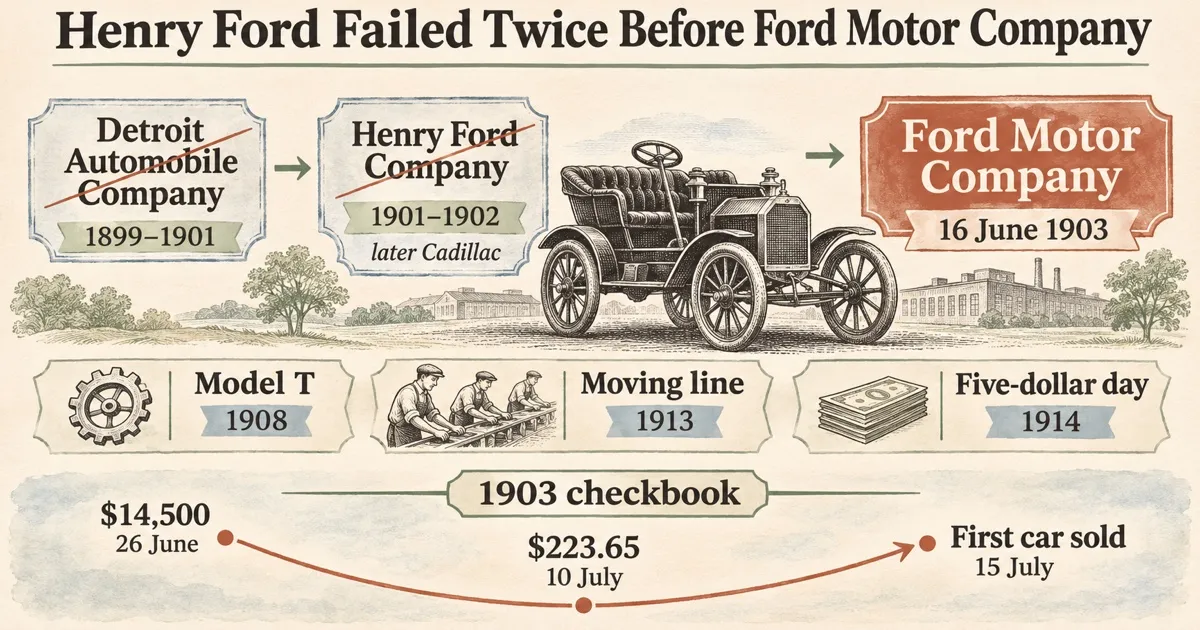
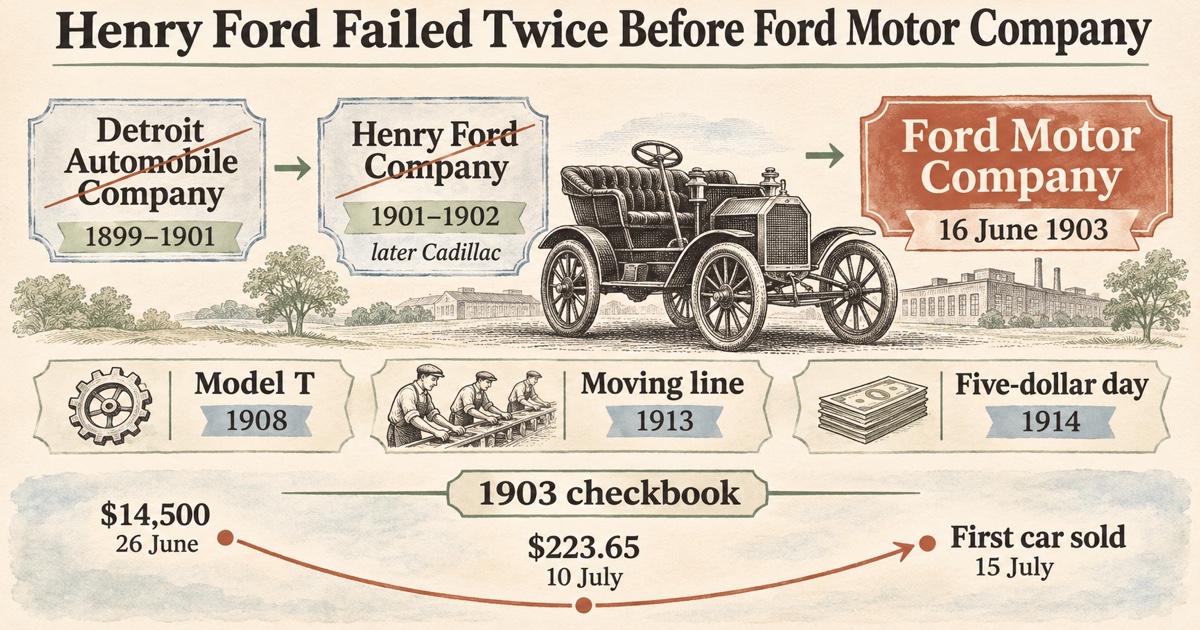
Before venture capital existed, Henry Ford lost two car companies within three years, then built a third with a coal dealer, a machine shop that supplied the parts and also bought in, and a checking account that nearly hit zero.

On this page
This post is part of a series on founders who worked before venture capital firms existed. Each post asks one question: which of their moves looks most like what a startup founder does today?
Henry Ford is the obvious name, and the usual story starts with the Model T. This post starts earlier, with the two companies that failed. It covers 1899 to 1914 only. It is not a full biography. One part of Ford’s later record needs a plain statement here: from May 1920 his newspaper, the Dearborn Independent, ran an antisemitic campaign. Ford later issued public apologies during a libel suit that was settled on 16 July 1927.
I checked each fact against a source that I could open, and most of the sources are primary. The two main ones are The Henry Ford museum’s own archive pages and Ford’s 1922 memoir My Life and Work, written with Samuel Crowther. The memoir is a primary source for what Ford wanted people to believe. It is not a reliable source for dates, and a later section shows why.
Ford’s first company built cars to order and closed within eighteen months
In 1899 Ford was chief engineer at the Edison Illuminating Company in Detroit. He left that job on 15 August 1899 to become superintendent of a new firm, the Detroit Automobile Company. The company had been formed in July 1899. Its letterhead lists Clarence A. Black as president and Ford as Mechanical Superintendent. Ford was an employee with a title, not the person in charge.
The company made a delivery truck first. The museum says that it built no more than 20 trucks and cars and that the company lasted no more than eighteen months. The museum’s pages give two dates for the end. One page says it went out of business in January 1901. An older museum chronology says it went out of business in November 1900. I could not resolve the difference.
Two decades later, Ford described the problem as one of control. In his account the investors wanted to make to order and to get the largest price possible for each car, and the firm was not a vehicle for realizing my ideas. That is Ford’s view, written after he won. It is still a useful clue. The first company sold a small number of expensive custom vehicles, and the person who designed them had no authority over what to build.
A race win bought Ford a second company, and the investors pushed him out
Ford did not get a second company by showing customers. He got it by winning a race. On 10 October 1901, at the Grosse Pointe track near Detroit, Ford drove his “Sweepstakes” car against Alexander Winton, who was then one of the best-known car makers in the country. After Winton’s car developed mechanical problems, Ford won. The museum says that the victory and resulting publicity encouraged financiers to back Ford’s second firm.
The Henry Ford Company was incorporated on 30 November 1901. A letter from Ford to his friend Milton Bryant, dated 6 January 1902 and written on the new company’s letterhead, shows where Ford’s attention went. He wrote: “My Company will kick about me following racing but they will get the advertising and I expect to make $ where I cant make (cents) at manufacturing.”
The investors did kick. The museum says Ford’s racing put him at odds with the investors of the Henry Ford Company. The chronology says he left on 10 March 1902. The investors kept the factory. The company changed its name to Cadillac under the guidance of Henry Leland. So Ford’s second company did become a successful car maker. It did so without him.
Ford’s memoir rewrites these three years
Ford’s memoir is the source of many popular stories about him, so it is worth checking against the documents above. Three details do not match.
First, the memoir says the Detroit Automobile Company later became the Cadillac Company. The museum’s records show that the Henry Ford Company, his second firm, became Cadillac. The memoir also puts his March 1902 departure inside the story of the first company, so two companies become one.
Second, the memoir says I never thought anything of racing. The 1902 letter to Bryant says that Ford expected racing to pay better than manufacturing.
Third, the memoir says that after his “999” racer won, a week after the race I formed the Ford Motor Company. The museum chronology places the 999’s win over Winton in 1902 and the incorporation of Ford Motor Company on 16 June 1903. The gap was months, not a week.
None of these errors changes the outline. Ford failed twice and then succeeded. But they show how a founder’s own story gets smoother with time: two failures become one, and a gap of months becomes a week.
The third company was funded by a coal dealer, and its supplier became a stockholder
Ford’s third partner was Alexander Malcomson, a Detroit coal merchant. Malcomson financed some of Ford’s early ventures, including the 999 racer, and in 1902 signed a partnership with Ford under the name Ford & Malcomson.
When Ford Motor Company was formed, the museum’s record of the Articles of Association of 16 June 1903 lists twelve stockholders and 1,000 shares:
| Stockholder | Shares | Who they were, according to The Henry Ford |
|---|---|---|
| Henry Ford | 255 | The engineer |
| Alexander Malcomson | 255 | Coal merchant |
| John S. Gray | 105 | Malcomson’s uncle, president of the German-American Bank |
| John F. Dodge | 50 | Machine shop owner, supplier |
| Horace E. Dodge | 50 | Machine shop owner, supplier |
| Albert Strelow | 50 | Contractor who rented Ford and Malcomson a shop |
| Vernon Fry | 50 | Malcomson’s cousin |
| Charles H. Bennett | 50 | President of Daisy Air Rifle |
| John Anderson | 50 | Malcomson’s lawyer |
| Horace Rackham | 50 | Anderson’s law partner |
| James Couzens | 25 | Clerk in Malcomson’s office |
| Charles Woodall | 10 | Malcomson’s bookkeeper |
Source: The Henry Ford, stockholder research guide. The 1919 Michigan Supreme Court opinion in Dodge v. Ford Motor Co. says that Couzens subscribed for 50 shares. The museum says part of his 25 shares represented his sister, Rosetta Couzens’, investment of $100. I give the museum’s figure in the table and note the difference.
This list has no professional investors. It has a merchant, his relatives, his employees, his lawyer, his landlord, a local manufacturer, and two suppliers. John and Horace Dodge ran a machine shop that Ford contracted to supply chassis, transmissions, and axles in early 1903. They became stockholders in the company that was their customer. Popular accounts give exact terms for the Dodge contract, such as the number of chassis and the price per unit. I did not find a primary source for those terms, so I left them out.
The amount of cash is not clear. The articles of association, as the 1919 court opinion quotes them, fix the capital stock at $150,000 and say that $100,000 was subscribed and paid in, $49,000 in cash and $51,000 in other property. Ford’s memoir says that the total amount subscribed in cash was about twenty-eight thousand dollars. I give both figures. I do not know which one describes the money that actually arrived.
The company’s first checkbook shows how thin the money was. The account started with $14,500 on June 26, 1903. It sank to $223.65 by July 10 after 60 checks. On 15 July, the company sold its first car for $850, and the balance grew after that.
The Model T was one product with a falling price
Ford began building the Model T on 1 October 1908. In the 1908–1909 season the company still sold other models, but in Ford’s account the Model T swept them right out. The company sold 10,607 cars that season, and the touring car cost $850.
Then Ford cut the product line. In 1909 he announced one morning, without any previous warning, that the company would build only the Model T. In the same passage he wrote the line that people still quote: “Any customer can have a car painted any colour that he wants so long as it is black.” The source of that sentence is Ford’s own book, so it is not a misattribution. But it is a 1922 memory of a 1909 remark, not a record made in 1909.
Ford also said how he set prices. He based them on an estimate of what the largest possible number of people will want to pay, not on demand or on competitors. His own table shows the result for the touring car:
| Season | Touring car price | Cars produced |
|---|---|---|
| 1909–10 | $950 | 18,664 |
| 1910–11 | $780 | 34,528 |
| 1911–12 | $690 | 78,440 |
| 1912–13 | $600 | 168,220 |
| 1913–14 | $550 | 248,307 |
| 1914–15 | $490 | 308,213 |
| 1915–16 | $440 | 533,921 |
| 1916–17 | $360 | 785,432 |
Source: My Life and Work, chapter X. These are Ford’s figures, published by Ford.
The moving line and the five-dollar day solved a production problem and then a labour problem
The moving assembly line started small. The museum chronology says that Ford’s first assembly line, producing magneto generators, begins operating on April 1, 1913. Ford’s own figures for that first line: one worker used to assemble a flywheel magneto in about 20 minutes. Split into 29 operations on a moving line, the time fell to 13 minutes 10 seconds, and later to five minutes. For the chassis, the best stationary time was 12 hours 28 minutes. A rope-and-windlass trial cut it to 5 hours 50 minutes, and the raised line of early 1914 cut down the labour time per chassis to one hour thirty-three minutes.
The new work was faster, and workers did not stay. Two pages from The Henry Ford give the 1913 labour turnover rate as 370 percent and 380 percent.
On 5 January 1914, Henry Ford and James Couzens, by then vice president, announced that the company would pay five dollars a day. The museum gives the old rate as $2.30 a day on one page and $2.34 for a nine-hour day on another. The new pay was five dollars for an eight-hour day. It was not a plain raise. The museum calls it a profit sharing plan, and Ford called it a kind of profit-sharing plan in which workers had to meet “certain conditions” to get the full amount. The museum says Ford acted probably in response to the urging of James Couzens, the former clerk from Malcomson’s office.
The 1919 lawsuit shows the founder–investor conflict in plain words
Ford soon wanted control. He wrote that he owned 25 1/2 per cent at the start and thought that a minority stake would work, but “I very shortly found I had to have control.” Malcomson sold his 255 shares to Ford in 1906.
The Dodge brothers kept their shares, and in 1916 they sued. In the court record Ford is quoted as saying: “My ambition is to employ still more men … To do this, we are putting the greatest share of our profits back into the business.” The Michigan Supreme Court answered in 1919: “A business corporation is organized and carried on primarily for the profit of the stockholders.” The two suppliers who became stockholders in 1903 had become the minority shareholders who forced the dividend question.
”A faster horse” is not a Ford quote
The best-known Ford line about customers is this one: “If I had asked my customers what they wanted they would have said a faster horse.” The Henry Ford says the line has never been satisfactorily traced to Henry Ford and that it only begins to appear in the early 21st century. Quote Investigator has not yet located compelling evidence that Henry Ford is responsible. The earliest Ford-linked version it found is from a 1999 issue of The Cruise Industry News Quarterly, in which a speaker imagined that if Ford had asked people, they’d probably tell him what they really wanted was a faster horse.
The quote is usually cited to argue that asking customers is useless. The documented record is more mixed. Ford’s first company built what its investors could sell at the highest price, and it failed. For the Model T, Ford set prices by what the largest number of people could pay, and sales rose as the price fell. He refused to add models, but he did not ignore what buyers could afford.
In today’s terms, Ford’s years from 1899 to 1914 look like a familiar startup path
This section is my interpretation, not a sourced claim.
- The Detroit Automobile Company looks like a company that started selling before it had a product people wanted. It built custom work at high prices. The person who built the product had no say in what the product was.
- The 1901 race was a demo. It did not prove the car was good for customers. It proved that Ford could build something that worked in public, and that was enough for investors.
- The Henry Ford Company was a founder–investor mismatch. The investors wanted a car business. The founder wanted to race. The investors kept the company.
- Ford Motor Company’s first round was an angel round from one merchant’s network, plus a supplier who became an owner: the Dodge brothers supplied the parts and held 10 per cent of the shares. The checkbook from June to July 1903 is a runway chart.
- The Model T was a narrow product with a price set by the size of the market Ford wanted, not by cost-plus. Each price cut came with more volume.
- The five-dollar day was a retention fix after a process change made the work worse for the people who did it.
For people who build developer tools or sell domain names today, two points carry over. A demo can raise money, but it does not tell you who will pay. And the people who supply your parts, your infrastructure, or your first distribution can become owners, with interests that later diverge from yours.
What the records do not settle
- The exact end date of the Detroit Automobile Company: November 1900 or January 1901.
- How much cash Ford Motor Company actually received in 1903: the articles say $49,000; Ford said about $28,000; the first bank deposit was $14,500.
- The terms of the 1903 Dodge contract, and whether the Dodge brothers paid for their shares in cash or in parts. I found no primary source that I could open.
- The date on which the Henry Ford Company took the Cadillac name.
References
- The Henry Ford — Henry Ford chronology, entries for 1899, 1900, 1901, 1902, 1903, 1908, 1913 and 1914. Supporting passages: “Henry Ford Company, his second car company, is incorporated on November 30”; “Leaves Henry Ford Company (later becomes Cadillac) on March 10”; “Ford Motor Company is incorporated on June 16”. The original page at thehenryford.org/exhibits/hf/Chronology.asp is offline; this link is a 2015 copy hosted by San Diego State University — fetched 2026-11-11; Wayback copy of the original, 2016-02-25
- The Henry Ford — Letterhead of the Detroit Automobile Company, 1899-1901, object ID P.D.354.A, artifact overview — fetched 2026-11-11; archived 2026-07-18
- The Henry Ford — Detroit Automobile Company Delivery Truck outside Factory, 1899-1900, object ID 84.1.1660.928, artifact overview — fetched 2026-11-11; archived 2026-07-16
- The Henry Ford — Henry Ford: Henry Ford’s Failures, expert set compiled in 2013; items “Henry Ford and Ed (Spider) Huff Driving the Ford Sweepstakes Racer at Grosse Pointe, Michigan, October 10, 1901” and “Ford Motor Company Checkbook, 1903” — fetched 2026-11-11; archived 2026-07-15
- The Henry Ford — Letter from Henry Ford to Milton Bryant Concerning Auto Racing, 1902, object ID 64.167.1.408, dated 6 January 1902; transcription and artifact overview — fetched 2026-11-11; archived 2026-07-16
- The Henry Ford, Benson Ford Research Center — Research Guide: Ford Motor Company Stockholders and Stock, 1903-1956, section “The Original Stockholders” and the stock-sale timeline — fetched 2026-11-11; archived 2026-10-17
- Michigan Supreme Court — Dodge v. Ford Motor Co., 204 Mich. 459 (1919), statement of facts on the articles of association, via Harvard Law School’s Caselaw Access Project. Supporting passage: “the capital stock is fixed at the sum of $150,000 … $49,000 in cash and $51,000 in other property” — fetched 2026-11-11; archived 2026-11-07
- Same opinion — list of subscribers to the articles. Supporting passage: “James Couzens, who each subscribed for 50 shares” — fetched 2026-11-11
- Same opinion — Ford’s statement as quoted in the bill of complaint — fetched 2026-11-11
- Same opinion — the court on the purpose of a business corporation — fetched 2026-11-11
- Henry Ford with Samuel Crowther — My Life and Work (1922), chapter II, “What I Learned About Business”, Project Gutenberg eBook #7213. Supporting passages: “to make to order and to get the largest price possible for each car”; “In March, 1902, I resigned”; “The Detroit Automobile Company later became the Cadillac Company” — fetched 2026-11-11; archived 2026-09-06
- Same book, chapter II — on racing — fetched 2026-11-11
- Same book, chapter III, “Starting the Real Business” — the 999 race and the formation of the company — fetched 2026-11-11
- Same book, chapter III — capitalization and cash subscribed. Supporting passages: “of this I owned 25 1/2 per cent”; “The total amount subscribed in cash was about twenty-eight thousand dollars” — fetched 2026-11-11
- Same book, chapter III — on control — fetched 2026-11-11
- Same book, chapter IV, “The Secret of Manufacturing and Serving” — Model T sales in 1908–1909. Supporting passage: “We sold 10,607 cars … The price for the touring car was $850” — fetched 2026-11-11
- Same book, chapter IV — the single-model announcement — fetched 2026-11-11
- Same book, chapter V, “Getting into Production” — the first moving lines. Supporting passages: “cut down the assembly time to thirteen minutes, ten seconds”; “cut down the labour time per chassis to one hour thirty-three minutes” — fetched 2026-11-11
- Same book, chapter VIII, “Wages” — the 1914 plan — fetched 2026-11-11
- Same book, chapter X, “How Cheaply Can Things Be Made?” — pricing policy and the price-and-production table — fetched 2026-11-11
- Matt Anderson, The Henry Ford — Ford’s Five-Dollar Day, 3 January 2014 — fetched 2026-11-11; archived 2026-10-17
- The Henry Ford — Crowd of Applicants outside Highland Park Plant after Five Dollar Day Announcement, January 1914, artifact overview — fetched 2026-11-11; archived 2026-07-17
- Rebecca Bizonet, The Henry Ford — Henry Ford’s Quotations, 12 March 2013 — fetched 2026-11-11; archived 2026-07-15
- Quote Investigator — My Customers Would Have Asked For a Faster Horse, 28 July 2011, updated 6 March 2025 — fetched 2026-11-11; no archive snapshot found
- Anti-Defamation League — The International Jew: 1920s Antisemitism Revived Online. Supporting passages: “The Dearborn Independent first attacked Jews in its May 22, 1920 issue”; “Ford issued public statements and apologies to individuals and Jews as a group”; “On July 16, 1927, an out-of-court settlement of the Sapiro suit was announced” — fetched 2026-11-11; archived 2024-08-30