
Founders Before Venture Capital: Hewlett and Packard Started a Company Before They Chose a Product
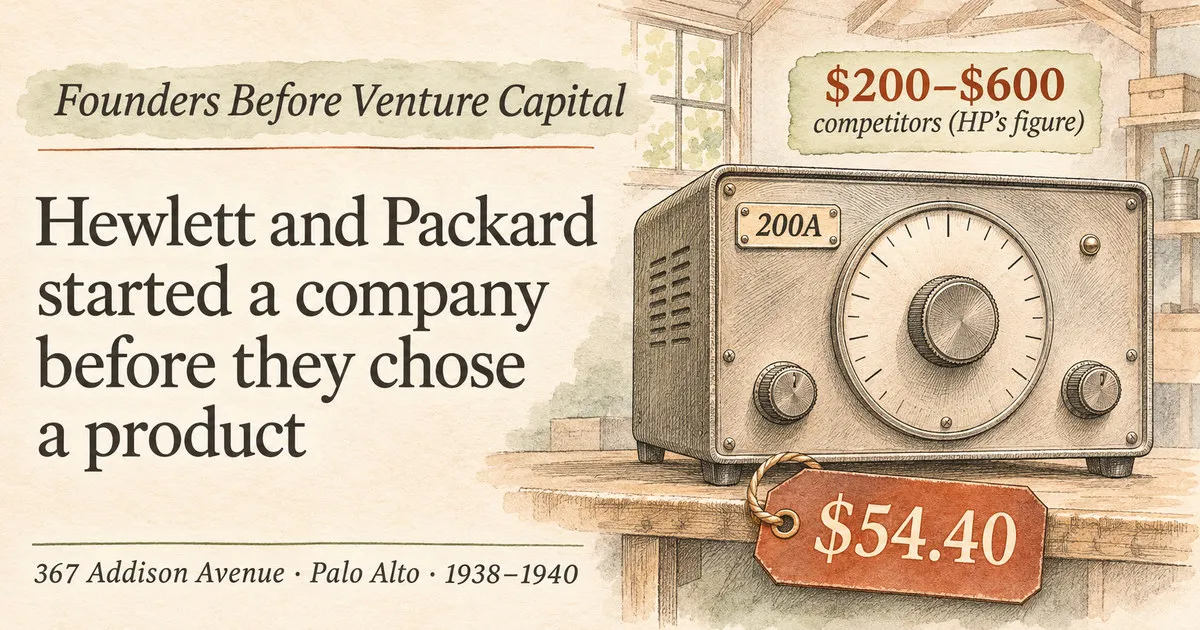
In 1937 Bill Hewlett and Dave Packard postponed the question of what to make. By 1939 they sold a $54.40 audio oscillator from a Palo Alto garage, paid for by $538, a spouse's salary and customer orders.

On this page
On August 23, 1937, Bill Hewlett and Dave Packard held their first formal business meeting. The minutes say that the company would design and manufacture electronics, but “the question of what to manufacture was postponed.” The proposed name was “The Engineering Service Company.”
This post is part of a series about founders who worked before modern venture capital, which is usually dated from the founding of ARD in 1946. Their story looks a lot like a startup story today: two engineers, a professor who pushed them, a garage, and a first product that sold to other engineers.
Most of what we know about the garage years comes from the company itself. The Hewlett-Packard Company Archives, hp.com and hpe.com are corporate sources, and Packard’s book The HP Way is a founder’s memoir. I did not read The HP Way for this post. Where a claim rests only on a company source, I say so. The independent documents I used are a 1939 journal paper, a 1939 magazine advertisement, a patent, and the 2007 National Register of Historic Places nomination for the property.
The market was laboratory instruments that cost hundreds of dollars
An audio oscillator generates one pure tone at a time. Engineers used it to test amplifiers, telephones, radios and recording equipment. In the late 1930s, the common laboratory instrument for this job was the beat-frequency oscillator.
Hewlett worked on a different design at Stanford. HPE’s gallery page says the 200A began as the subject of Hewlett’s master’s thesis and used a light bulb in a Wien bridge circuit to control the output without distortion. In October 1939, Fred Terman, Hewlett and two other Stanford authors published a paper in the Proceedings of the I.R.E. about negative feedback in laboratory equipment. The summary makes the market argument in one sentence: resistance-capacitance oscillators “represent a simple and inexpensive substitute for beat-frequency oscillators, and have comparable performance.”
Hewlett filed a patent for a “variable frequency oscillation generator” on July 11, 1939, and it was granted on January 6, 1942. HP’s museum page says that Hewlett assigned the patent to the partnership of William R. Hewlett and David Packard.
HP’s own figures describe the price gap. HP’s museum page says that the 200A sold for $54.40, and that similar equipment from competitors cost between $200 and $600. I did not find an independent 1939 price list for the competing instruments, so the $200 to $600 range is HP’s claim.
Their move was a cheap tool for engineers, built in a rented garage
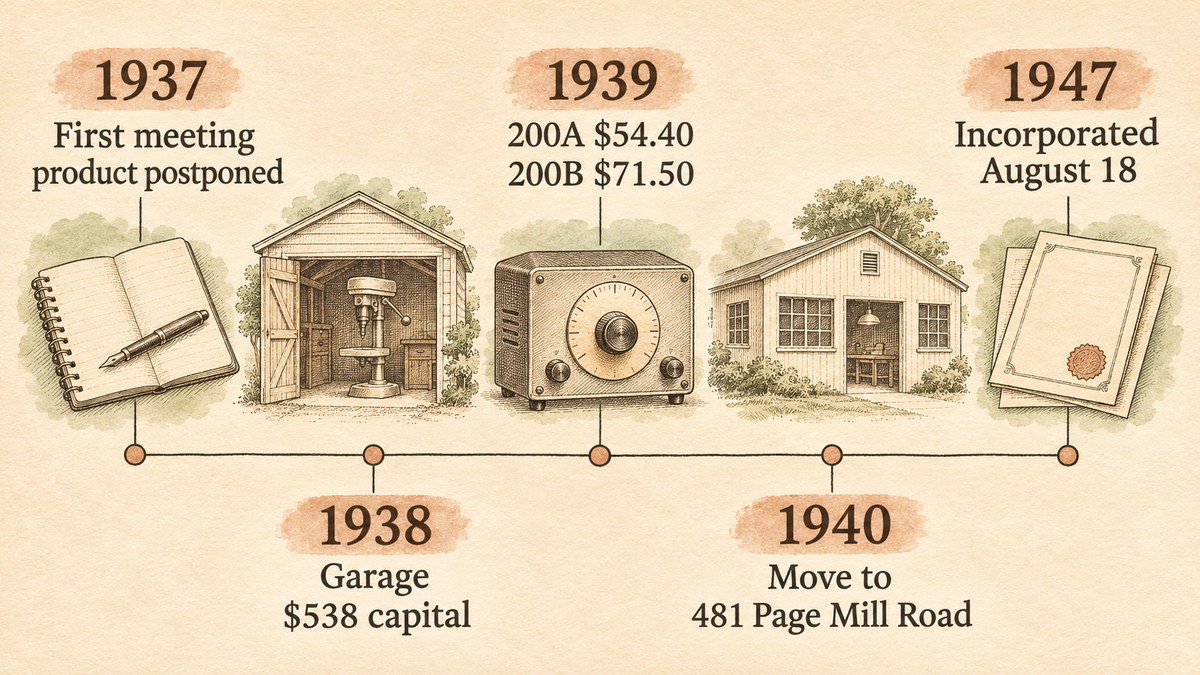
Terman did more than teach. HP’s garage timeline says that in the summer of 1938 Terman arranged a Stanford fellowship for Packard, and that Packard took a leave of absence from General Electric to “make a run for it” with Hewlett. Hewlett chose 367 Addison Avenue in Palo Alto because it had a garage that the two men could work in. The Packards moved into the ground-floor flat in September 1938, and Hewlett moved into a shed behind the house.
The capital was small. HP’s garage timeline says that they began part-time work with $538 in working capital, made up of cash and a used Sears Craftsman drill press. HP’s 1930s timeline gives the same amount but calls the tool a used Sears-Roebuck drill press. The $538 was not an investment from anyone else. It was the founders’ cash and equipment.
The garage did not start with one product. The National Register nomination quotes a 1984 book: the two men “devised a variety of electrical gadgets and did odd job work that Professor Terman helped them find.” The same document lists a diathermy machine for the Palo Alto Hospital, a drive for a telescope on Mount Hamilton, a bowling-alley foul-line indicator and a weight-reducing machine. The HP archives show the foul-line indicator, an automatic toilet flusher and an electric weight-loss machine as projects from the search for a market niche. The nomination also says that Lucile Packard provided a regular income from her job in the Stanford Registrar’s Office and kept the company’s books in the evenings.
The oscillator then became the product. HP’s 1930s timeline says that Packard named it the 200A “because we thought the name would make us look like we’d been around for awhile.” An archived HPE page says that the founders chose $54.40 not because of cost calculations but because the number reminded them of the 1844 slogan “54-40 or Fight!” That explanation is company lore. I did not find a 1939 document that explains the price.
The famous customer came next. Walt Disney Studios wanted changes to the 200A, and the result was the Model 200B. Disney ordered eight of them and used them to test channels, recording equipment and speakers for the theaters that showed Fantasia in 1940. An archived HPE page gives the price as $71.50 each. An independent document agrees with that price. HP’s first magazine advertisement, in the November 1939 issue of Electronics, offered the “Model 200B” for “$71.50 net FOB Palo Alto” and printed the return address as 367 Addison Avenue.
On January 1, 1939, they formalized the partnership and chose the company name with a coin toss. HP’s 1930s timeline gives the result of the first year as revenue of $5,369 and 2 employees. The National Register nomination adds $1,563 in profit and approximately 200 oscillators built at the property from the fall of 1938 to the fall of 1939. In 1940 the company moved to a rented building at 481 Page Mill Road. HP was incorporated on August 18, 1947, eight years after the coin toss.
Today we would call this a bootstrapped, customer-funded university spinout
This section is my interpretation, not a sourced fact.
In today’s terms, Hewlett and Packard did four things that founders still copy.
- They turned research into a product. The oscillator came out of Stanford work under Terman, and the same idea appeared in a journal paper and in a patent. Today we would call this a university spinout, although I found no source that says Stanford held a stake.
- They used price as the wedge. The 1939 paper sold the idea as an inexpensive substitute with comparable performance. HP’s own numbers put the 200A at a fraction of the competitors’ prices. That is the classic disruptive entry: equal on the specification that matters, much cheaper on the invoice.
- They let customers pay for development. None of the sources I read mention an outside investor in the garage years. The money in those sources is the $538, Lucile Packard’s salary, odd-job income and orders such as Disney’s.
- They turned a custom request into a catalog product. The 200B started as changes for one customer. By November 1939 it was the lead product in their first magazine advertisement. Today we would say that a design partner shaped version two.
The garage years also show what product-market fit looked like before the phrase existed. The founders tried gadgets for a hospital, a bowling alley and an observatory. Those projects paid but did not repeat. The oscillator repeated: engineers in many places had the same need, and the same instrument met it.
Several popular claims do not survive a check of the sources
“Disney bought the first HP oscillators.” HP calls the Disney order the company’s first big sale, not its first sale, and the instrument was the modified 200B. The date is also unclear. The HPE gallery says it was a 1938 sale, the HP archives date the item ca. 1939, and the first advertisement for the 200B appeared in November 1939.
“Packard won the coin toss.” The HP timelines that I read say only that the name was decided with a coin toss. Retellings disagree about who won. I did not find a primary source that names the winner, so I leave it out.
“The oscillator was Packard’s thesis.” The National Register nomination says the variable frequency oscillator was a master’s thesis project of Packard’s. The patent names William R. Hewlett as the inventor, and HPE describes the 200A as the subject of Hewlett’s master’s thesis. The nomination is wrong on this point. It also gives the address once as “376 Addison”, which is a typo for 367.
“They showed the oscillator in Portland in November 1938.” The National Register nomination says that in November 1938 they took a working model to an Institute of Radio Engineers conference in Portland. The 1939 paper says it was presented at the Pacific Coast Convention in Portland on August 11, 1938. I could not reconcile the two dates, and I treat the November date as unconfirmed.
“The garage is where Silicon Valley was born.” That phrase is a commemoration, not a finding. California registered the garage as Landmark No. 976 on August 13, 1987, and the official description calls it “the birthplace of the world’s first high-technology region.” HP’s timeline gives August 7, 1987 for the registration and May 19, 1989 for the plaque dedication. In 2018, IEEE dedicated a milestone called “Birthplace of Silicon Valley, 1956” at the former Shockley Semiconductor Laboratory site in Mountain View. The name “Silicon Valley” first appeared in print in Electronic News on January 11, 1971, more than thirty years after HP left the garage.
“The $538 was seed money.” HP describes it as working capital that included a drill press. It was not a round from investors, and HP’s two timelines do not agree on the brand of the drill press.
Founders who build tools for builders can still use this playbook
An audio oscillator in 1939 was a developer tool. Its customers were engineers who built other products. HP’s first advertisement sold the 200B on specifications: frequency range, distortion, output and price. Three lessons carry over.
- Publish the idea where your customers read. The Proceedings of the I.R.E. and Electronics were where HP’s customers looked for tools. The paper explained why the design worked, and the advertisement gave the price and the address.
- Name the product for the buyer’s trust. The founders first proposed a generic service name, then used their own surnames, and called the first model “200A” to look established. A name is a signal to the customer before the customer tests anything. This applies to model numbers, company names and domain names alike.
- Keep the custom work if it repeats. The Disney changes became the 200B, and the 200B became the advertised product. A request from one customer is worth building into the catalog when the next customer needs the same thing.
References
All sources were fetched on 2026-11-11. The archive links point to the most recent existing Wayback Machine snapshot that I found, and the date in each archive link is the snapshot date.
- Hewlett-Packard Company Archives (corporate source) — “Creating a Company”, item dated August 23, 1937. Supporting passage: “the two men agreed that their mission would involve designing and manufacturing electronics, but ‘the question of what to manufacture was postponed.’” — fetched 2026-11-11; archived 2026-04-18
- Hewlett Packard Enterprise (corporate source) — Innovation Gallery: Model 200A audio oscillator. The live URL now redirects to a timeline page without this text, so read the archived copy. Supporting passages: “The Model 200A began as the subject of Bill Hewlett’s master’s thesis at Stanford University”; “priced the 200A at $54.40 not because of cost calculations but because it reminded them of ‘54.40’ or Fight!’” — fetched 2026-11-11; archived 2025-12-09
- F. E. Terman, R. R. Buss, W. R. Hewlett and F. C. Cahill — “Some Applications of Negative Feedback with Particular Reference to Laboratory Equipment,” Proceedings of the I.R.E., October 1939, pp. 649–655, scan hosted by the HP Memory Project. Summary on p. 649: “Such resistance-capacitance oscillators represent a simple and inexpensive substitute for beat-frequency oscillators, and have comparable performance.” Footnote on p. 649: “Presented, Thirteenth Annual Convention, New York, N. Y., June 16, 1938, and Pacific Coast Convention, Portland, Ore., August 11, 1938.” — fetched 2026-11-11; archived 2023-10-23
- Google Patents — US 2,268,872, “Variable frequency oscillation generator,” William R. Hewlett. Application US283301A filed 1939-07-11; granted 1942-01-06. — fetched 2026-11-11; archived 2025-12-13
- HP (corporate source) — Virtual museum: HP 200A history. Supporting passages: “It sold for $54.40. Similar equipment built by competitors cost between $200 and $600”; “The company’s first big sale was an order of eight model 200B audio oscillators to the Walt Disney Company”; the patent was assigned “to Hewlett-Packard Company of Palo Alto, California a co-partnership consisting of William R. Hewlett and David Packard.” — fetched 2026-11-11; archived 2026-07-15
- HP (corporate source) — HP Garage Timeline, entries for 1938, 1939, 1940, 1987 and 1989. Supporting passages: “Fred Terman arranges a Stanford fellowship for Dave”; “specifically chooses 367 Addison Avenue because it has a garage that the two of them can work in”; “The $538 consists of cash and a used Sears Craftsman drill press”; “January 1, Bill and Dave formalize their partnership. They decide the company’s name with a coin toss”; “Having outgrown the garage, Hewlett-Packard moves to a rented building at 481 Page Mill Road”; “1987, August 7 Garage is granted California State Landmark status as California Registered Landmark No. 976”; “1989, May 19 Garage is dedicated as a state historic landmark.” — fetched 2026-11-11; archived 2026-11-01
- HP (corporate source) — HP timeline — 1930s. Supporting passages: “The $538 consists of cash and a used Sears-Roebuck drill press”; “The HP Model 200A is so named ‘because we thought the name would make us look like we’d been around for awhile,’ says Dave later”; “HP creates its second product—the Model 200B audio oscillator—and Disney orders eight of them”; “Revenue: $5369. Employees: 2.” — fetched 2026-11-11; archived 2026-10-30
- National Park Service — National Register of Historic Places Registration Form: Hewlett-Packard House and Garage, NRIS 07000307, Section 8, continuation pages 6–9. The form cites the HP archives, Packard’s The HP Way and Rogers and Larsen’s Silicon Valley Fever (1984), so it is partly a secondary source. Supporting passages (p. 7): “odd job work that Professor Terman helped them find”; “Lucile Packard provided a regular income from her job in the Registrar’s Office at Stanford University”; “a variable frequency oscillator (a master’s thesis project of Packard’s)”; “In November 1938, they built a working model of an audio oscillator and took it to Portland, Oregon, to an Institute of Radio Engineers conference.” (p. 8): “approximately 200 audio oscillators”; “revenues of $5369 and had made $1563 in profit.” (p. 9): “the house and garage at 376 Addison in 1938.” — fetched 2026-11-11; archived 2025-09-18
- Hewlett-Packard Company Archives (corporate source) — “Freelancing in Their Spare Time”. Supporting passage: “Among the devices they pursued were an automatic toilet flusher, an electric weight-loss machine and this device, an electric foul-line indicator they developed for a local bowling alley.” — fetched 2026-11-11; archived 2026-06-14
- Hewlett Packard Enterprise (corporate source) — Innovation Gallery: Model 200B Audio Oscillator. The live URL now redirects, so read the archived copy. Supporting passages: “A 1938 sale to Disney of eight oscillators required enough modifications in the original design for the result to be the Model 200B”; “Disney ordered eight of the Model 200B at $71.50 each.” — fetched 2026-11-11; archived 2026-07-10
- Hewlett-Packard Company Archives (corporate source) — “A Fantastic First Ad”. Supporting passage: “Hewlett-Packard’s first magazine ad appeared in the November 1939 issue of Electronics, showcasing the Model 200B audio oscillator.” — fetched 2026-11-11; archived 2026-06-15
- Electronics, vol. 12, no. 11, November 1939 — Hewlett-Packard Co. advertisement “Resistance Tuned Audio Oscillators”, printed page 95, PDF page 97, scan hosted by World Radio History. Ad text: “MODEL 200B … $71.50 net FOB Palo Alto … HEWLETT-PACKARD CO. 367 ADDISON AVENUE PALO ALTO, CALIFORNIA.” — fetched 2026-11-11; archived 2026-02-03
- Hewlett-Packard Company Archives (corporate source) — “A Deal with Disney: HP 200B Oscillator”, item dated ca. 1939. Supporting passage: “Disney ordered eight of them for use in the audio production of Fantasia, most famously in the installation of Fantasound.” — fetched 2026-11-11; archived 2026-07-27
- Hewlett Packard Enterprise (corporate source) — Growth and innovation timeline, entry “1947–HP incorporates.” Supporting passage: “HP is incorporated on August 18. Dave is named president, Bill vice president.” — fetched 2026-11-11 in a browser; no archive snapshot recorded
- California Office of Historic Preservation — California Historical Landmark No. 976, “Birthplace of Silicon Valley”. Supporting passages: “This garage is the birthplace of the world’s first high-technology region, ‘Silicon Valley.’”; “Registration Date: 8/13/1987.” — fetched 2026-11-11; archived 2026-08-01
- Engineering and Technology History Wiki (IEEE) — Milestones: Birthplace of Silicon Valley, 1956. Dedicated 2018/08/15. Citation: “At this location, 391 San Antonio Road, the Shockley Semiconductor Laboratory manufactured the first silicon devices in what became known as Silicon Valley.” — fetched 2026-11-11; archived 2026-09-16
- Computer History Museum, David A. Laws — “Silicon Valley Turns 50”. Cover image caption: “First use of the name ‘Silicon Valley’ in print. Electronic News, January 11, 1971 page 1.” — fetched 2026-11-11; archived 2026-06-09
Further reading
- California Office of Historic Preservation — Hewlett-Packard House and Garage, National Register listing dated 4/20/2007. — fetched 2026-11-11; archived 2026-06-15
- Hewlett-Packard Company Archives (corporate source) — “The Father of Silicon Valley”, on Fred Terman’s role. — fetched 2026-11-11; archived 2026-04-18
- David Packard, The HP Way (HarperBusiness, 1995). Founder’s memoir; not read for this post.