
Founders Before VC: Gardiner Hubbard, Alexander Graham Bell, and the Telephone You Could Only Rent
In 1877 the telephone's backers chose to lease every instrument instead of selling it. What the surviving documents show about that decision, and which famous Western Union stories do not hold up.

On this page
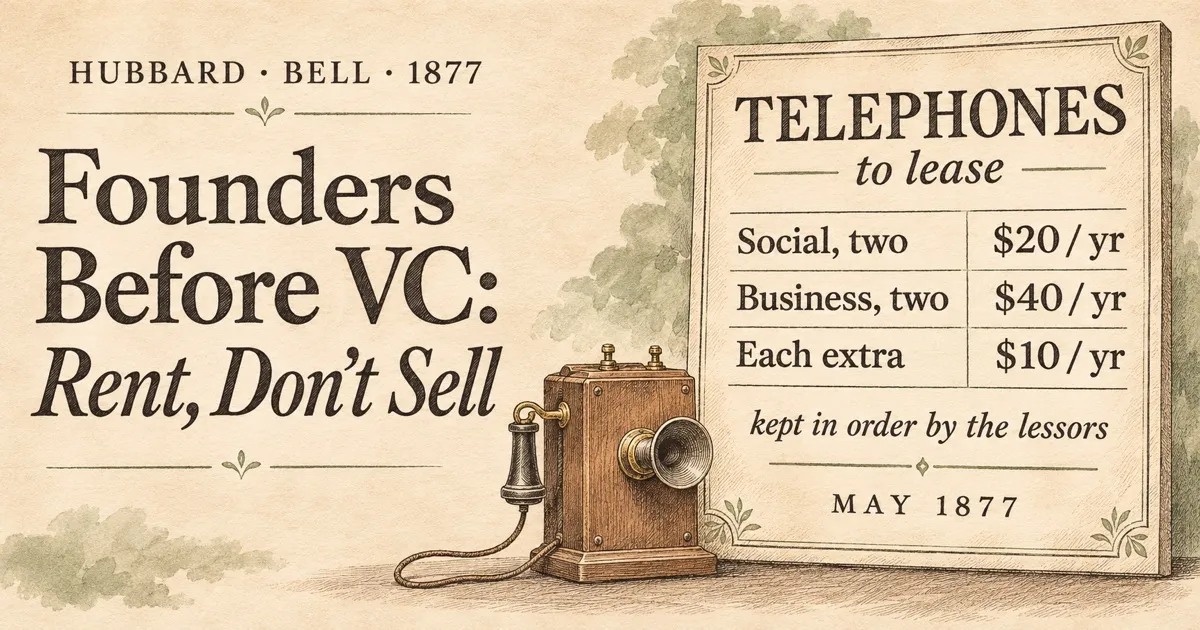
In May 1877 a one-page circular went out under the name of Gardiner G. Hubbard, a Cambridge lawyer. It offered a new instrument that carried speech over a wire, and it did not offer to sell one. The terms were $20 a year to lease two telephones for social use and $40 a year for business use, payable every six months in advance. The owners would keep the instruments in working order, and an extra telephone on the same line cost another $10 a year.
This series asks a narrow question: before modern venture capital, which the series dates from the founding of ARD in 1946, who worked most like today’s startup founders? The telephone is an obvious candidate, but the famous version of the story gives most of the credit to the inventor’s genius and a rival’s blindness. The surviving papers point somewhere else. They show a business decision made early, written down in a price list, and defended against pressure to take quick cash.
The telephone began as a side project of a telegraph venture
Bell did not start out with backers for the telephone. In February 1875 Bell, Hubbard and Thomas Sanders signed a written agreement forming the “Bell Patent Association” to promote Bell’s work in the telegraph field. Bell’s main project then was a multiple telegraph that would send several messages over one wire. Thomas Watson, the machinist who built Bell’s apparatus, later recalled that Hubbard and Sanders, as Bell’s financial backers, were insisting that Bell should finish the harmonic telegraph first and leave “air castles like the telephone” for later.
The incentive was clear. Telegraphy was the large, proven market, and Western Union dominated it. In 1879 Hubbard described his rival to his own stockholders as a company with a capital of over $40,000,000, “controlling the best electric talent in the country”. A better telegraph had an obvious buyer. A device that carried the human voice had none yet.
Bell filed his telephone patent application on February 14, 1876. U.S. Patent 174,465 was issued on March 7, 1876, under the title “Improvement in Telegraphy”. Its fifth claim covered “the method of, and apparatus for, transmitting vocal or other sounds telegraphically”. On June 25, 1876, Bell showed the telephone to the judges of the Centennial Exhibition in Philadelphia.
The partners were also linked by family. Hubbard was president of a Boston school for deaf children, and his daughter Mabel had been deaf since the age of five. Bell had met Hubbard at that school in 1872 and later taught Mabel as a private pupil. In 1877, the same year he formed the Bell Telephone Company, Bell married Mabel Hubbard. Hubbard was therefore the inventor’s partner, organizer and father-in-law at once.
Sanders put in most of the money. Herbert Casson’s 1910 history says Sanders, whose business was cutting out soles for shoe manufacturers, advanced nine-tenths of the money spent on the telephone from 1874 to 1878. Michael Wolff, writing in IEEE Spectrum in 1976 and relying on Robert Bruce’s biography of Bell, says that by March 1878 Sanders had sunk almost his whole fortune of $110,000 into the venture. Both are secondary accounts, and the figures are theirs.
Hubbard chose to rent the instrument instead of selling it
The circular of May 1877 is the clearest record of the business model. It argued that the telephone beat the telegraph for local business because no skilled operator was required, speech was faster than Morse code, and the instrument needed no battery. Then it set out the lease terms quoted above and ended: “Parties leasing the Telephones incur no expense beyond the annual rental and the repair of the line wire.” The same circular was reprinted in Popular Science Monthly in 1906, so the text does not depend on a single later copy.
The choice was not obvious inside the family. Wolff writes that Mrs. Hubbard seems to have pushed for the outright sale of telephones, while her husband preferred leasing. Wolff quotes Watson’s later memoir: “Some of the ladies deeply interested in the immediate outcome were strenuously advocating at this critical juncture making and selling the telephones at once in the largest possible quantities—imperfect as they were.” Selling would have brought cash immediately to a group that badly needed it. Leasing meant the company paid for the instruments now and collected rent slowly.
In my reading, the lease kept three things with the patent holders. First, the instrument stayed company property, so a customer could not resell it. Second, the company could replace instruments as the technology improved. Third, rent came every year. Hubbard’s 1879 report to the stockholders, a manuscript in the Library of Congress, shows where this led. By then the company had about 12,000 telephones outstanding at a net rental of about $5.00 a year, and Hubbard expected the average net rental to rise. This article checked that sentence against the manuscript image, not only against the transcription.
Hubbard also used other people’s capital to spread the network. He gave local agents exclusive territories. Watson recalls that Fred Gower held an exclusive right Mr. Hubbard had granted him for renting telephones all over New England, and later traded it away for lecture rights. By 1879 the growth came through “district companies”, local firms that charged customers a monthly fee for service. Hubbard’s report describes agents who were stimulated by a large commission and who made the telephone their main business. Hubbard explained why speed mattered: “the Co. that first occupies the field in any city must hold it against any new comer”.
Western Union entered the telephone business with a transmitter developed by Edison, and the Bell company sued Western Union for infringing the Bell patents. On November 10, 1879, the two companies signed an agreement under which Western Union admitted the validity of the Bell patents and retired from the telephone field. In return, the Bell company agreed to pay Western Union 20 percent of its royalties from telephone rentals for 17 years. By the end of 1880 there were 47,900 Bell telephones in the United States, according to the chronology that AT&T printed with Watson’s address.
Today’s founders would call it hardware as a service with franchised distribution
In today’s terms, the model has three parts. This section is my interpretation, not a claim from the sources.
- Recurring revenue instead of one-time sales. The 1877 circular is a subscription price list. The customer paid for working service, maintenance included, and the company kept ownership of the hardware. Today we call this hardware as a service.
- Control of the installed base. Because every instrument stayed company property, the company kept a relationship with every user. A buyer of an outright telephone could have resold it. A renter could not.
- Distribution paid for by partners. Exclusive local agents and district companies built the lines and found customers with their own money in return for a commission. That is close to a franchise or a channel-partner program. Hubbard’s “first occupies the field” sentence is an early statement of land-grab thinking: the first network in a city tends to keep it.
What Hubbard did not have was outside risk capital. The money came from Sanders, from Hubbard’s own family, and from agents who invested in their own territories. That is the main reason this story belongs in a series about founders before venture capital. The financing was personal, and the business model had to fund its own growth.
Several famous stories about Western Union do not survive checking
The Western Union “toy” memo is a later fabrication
A memo often quoted in business books has a Western Union committee reject the telephone: “This idea is idiotic on the face of it,” and the device is “hardly more than a toy”. Wolff printed the text in 1976 and wrote that the report “is suspect on several counts”. It is addressed to Chauncey Depew as president of Western Union, but Depew was never its president and joined its board only in 1881. It is unsigned and apparently not on company stationery. A 2015 article on the comic site Wondermark reports that the text first appeared in a 1968 IEEE publication by Richard C. Levine, who later told the historian Phil Lapsley that he had put it together from two similar but not identical versions. That account of Levine’s letter is secondhand, and I could not open Lapsley’s original blog posts. The conclusion does not depend on it: no source this article found shows the memo existing in 1876.
The $100,000 offer rests mainly on Bell’s side of the story
The story that Hubbard offered all the Bell patents to Western Union for $100,000 has a specific source. In an address delivered on October 17, 1913, Watson said the president of Western Union had refused, somewhat contemptuously, Mr. Hubbard’s offer to sell all the Bell patents for “the exorbitant sum of $100,000”. Watson added that two years later Western Union would gladly have paid $25,000,000. That figure is Watson’s claim, not a documented offer.
Wolff searched for other evidence in 1976 and found almost none. Bruce placed the offer in late 1876 or the winter of 1876–77 but found no mention of it in Bell’s private correspondence. Two scholars who examined Western Union’s “President’s Letter Books” for that period found no mention either, and none has been found in Hubbard’s surviving letters to Bell. Wolff concluded that the only evidence it even occurred was Watson’s 1913 recollection. Casson’s 1910 history supplies the famous line in which Orton asks, “What use could this company make of an electrical toy?”, but Casson gives no source for the quotation.
A third account points in a different direction. In his 1924 memoir, Chauncey Depew wrote that in 1876 Hubbard offered him a one-sixth interest for ten thousand dollars. Depew says he asked William Orton, the actual president of Western Union, who told him there was nothing in the scheme “except as a toy”. Depew dropped the investment. This is a recollection written almost fifty years later, and it has its own errors: Depew quotes Hubbard calling Bell “my son-in-law” in 1876, although the marriage took place in 1877.
So the strongest honest statement is this: Bell’s associates later remembered an offer, and Depew remembered a smaller one. No contemporary document found so far confirms the $100,000 figure.
Orton’s personal dislike of Hubbard is also weaker than the legend
Popular versions often explain the refusal by saying Orton hated Hubbard, who had opposed Western Union in Congress and in the courts. The historian David Hochfelder traced that explanation to two ultimate sources, a Watson letter of December 1877 and a claim by George Prescott, and noted that Hubbard’s papers show the two men on friendly terms, even dining together. Hochfelder also cites a January 1878 letter in which Hubbard himself doubted “if any instrument of value can be made under [Bell’s] patents of 1876”. If the patent holder had doubts about the 1876 patents, a cautious telegraph company may have had reasons other than blindness.
The shoe-machinery inspiration for leasing is not established
A common modern claim says Hubbard copied the lease model from Gordon McKay’s shoe-sewing machines, which were leased to factories for royalties. The English Wikipedia article on McKay says the legal arrangements were partially handled by Gardiner Greene Hubbard, citing a 1926 book, Pioneering the Telephone in Canada, at page 17. I could not open that book, and I found no document in which Hubbard or his partners name McKay as the model for telephone leasing. The parallel is real: both businesses leased patented machines. The causal link is unverified, so this article does not rely on it.
The lesson for founders is to decide early what the customer actually buys
This section is my interpretation.
Hubbard’s 1877 circular sold a working service, not a box. That choice decided how the company made money, who owned the hardware, and how fast outside agents could expand the network. It was made when the product was crude, cash was scarce, and, by Wolff’s account, a member of the founder’s family wanted to sell instruments immediately.
For a founder building developer tools, the question is the same: is the customer buying a binary, a hosted service, or a guarantee that something keeps working? For a business built on domain names, the question is whether customers want to own a name outright or want a name that stays configured, renewed and protected. In both cases the answer sets the pricing, the support burden, and the defensibility of the business.
The other lesson concerns the stories founders repeat. The “Western Union said it was a toy” anecdote is useful because it flatters the outsider. Its documentary basis is a forged memo, a 1913 recollection by an interested party, an unsourced line in a 1910 popular history, and a 1924 memoir. The record that survives in Hubbard’s own hand is less dramatic and more useful: a price list, a commission structure, and a plan to occupy each city first.
References
- Thomas A. Watson, The Birth and Babyhood of the Telephone, address to the Third Annual Convention of the Telephone Pioneers of America, Chicago, October 17, 1913; AT&T Information Department edition, Project Gutenberg eBook #54506. The section after “Financial Problems” reprints Hubbard’s circular signed “Cambridge, Mass., May, 1877,” including the three advantages, the $20 / $40 lease terms, the $10 extra-instrument rental, and “Parties leasing the Telephones incur no expense beyond the annual rental and the repair of the line wire.” Primary source (participant memoir reprinting a period document). — fetched 2026-11-11 (no archive snapshot available; saving a new one was not possible from this session)
- Watson, The Birth and Babyhood of the Telephone, passage on the 1874–75 harmonic telegraph: Hubbard and Sanders “were insisting that the wisest thing for Bell to do was to perfect the harmonic telegraph.” — fetched 2026-11-11
- Watson, The Birth and Babyhood of the Telephone, section “Financial Problems”: “the President of the Western Union Telegraph Company had refused, somewhat contemptuously, Mr. Hubbard’s offer to sell him all the Bell patents for the exorbitant sum of $100,000 … Two years later the Western Union would gladly have bought those patents for $25,000,000.” — fetched 2026-11-11
- Watson, The Birth and Babyhood of the Telephone, section “The ‘Gower-Bell’ Telephone”: Gower “gave up an exclusive right Mr. Hubbard had granted him for renting telephones all over New England.” — fetched 2026-11-11
- Watson, The Birth and Babyhood of the Telephone: “The Western Union people had discovered that the telephone was not such a toy as they had thought … and Edison evolved for them his carbon-button transmitter,” and later, “our little David of a corporation sued that big Goliath, the Western Union Company, for infringing the Bell patents.” — fetched 2026-11-11
- “Early Chronology of the Telephone,” appended to Watson, The Birth and Babyhood of the Telephone, AT&T edition. Entry for 1875, February 27: “Written agreement between Bell, Sanders, and Hubbard forming ‘Bell Patent Association’ to promote inventor’s work in telegraph field.” The chronology was compiled by AT&T, not spoken by Watson; it lists events up to 1921. — fetched 2026-11-11
- Same chronology, entry for 1876, June 25: “Bell exhibits his Telephone to the Judges of the Centennial Exhibition at Philadelphia.” The same chronology gives July 9, 1877: “‘Bell Telephone Co., Gardiner G. Hubbard, Trustee,’ the first telephone organization, formed.” — fetched 2026-11-11
- Same chronology, entry for 1880, December 31: “47,900 Bell telephones in the United States.” — fetched 2026-11-11
- Alexander Graham Bell, U.S. Patent 174,465, “Improvement in Telegraphy”, application filed February 14, 1876, issued March 7, 1876; claim 5. Google Patents. Primary source. — fetched 2026-11-11
- Gardiner Greene Hubbard, “Report from Gardiner Greene Hubbard to Stockholders and Directors of the Bell Telephone Company, 1879,” manuscript, Library of Congress, Alexander Graham Bell Family Papers, item magbell.27100114. The Library of Congress site blocked automated reading during this check, so the text was read from a transcription with page images published by Telephone Archive. Manuscript p. 8 (PDF p. 8; transcription PDF p. 19): “We have now outstanding about 12,000 telephones at a net rental of about $5.00 a year.” Checked against the manuscript image. Primary source. — fetched 2026-11-11; LOC item page archived 2025-01-21; transcription archived 2026-10-06
- Same report, transcription PDF p. 19: “We have accomplished these results in spite of the determined opposition of the Western Union with its capital of over $40,000,000. & controlling the best electric talent in the country … for the Co. that first occupies the field in any city must hold it against any new comer.” Read from the transcription; not checked against the manuscript image. — fetched 2026-11-11
- Same report, transcription PDF p. 21: “Our agents have been stimulated by a large com. and have made this their sole or chief business.” Read from the transcription. — fetched 2026-11-11
- Fred De Land, “Notes on the Development of Telephone Service II,” Popular Science Monthly, vol. 69, December 1906, Wikisource transcription. Reprints the May 1877 circular with the same lease terms. — fetched 2026-11-11
- Library of Congress, “Inventor and Scientist,” Alexander Graham Bell Papers, articles and essays: “In 1877, he formed the Bell Telephone Company, and in the same year married Mabel Hubbard.” — fetched 2026-11-11 (read from the archive copy; the live page blocks automated reading)
- Michael F. Wolff, “The marriage that almost was,” IEEE Spectrum, February 1976, p. 42 (PDF p. 2): Hubbard was the school’s president; Mabel “had been deaf since the age of five”; Bell met Hubbard “at the deaf children’s school in 1872” and “took on Mabel Hubbard as a private pupil.” Secondary source. — fetched 2026-11-11
- Wolff, “The marriage that almost was”, p. 46 (PDF p. 6): “Most of the money for the fledgling Bell enterprise was coming from the merchant Thomas Sanders, who, by March 1878, would have sunk almost his whole fortune of $110000 into the venture.” Secondary source. — fetched 2026-11-11
- Wolff, “The marriage that almost was”, p. 46 (PDF p. 6): “Mrs. Hubbard seems to have been pushing—the outright sale of the telephones rather than the leasing of them, which her husband preferred,” followed by Watson’s quotation about “making and selling the telephones at once.” Wolff does not give the page of Watson’s memoir. Secondary source. — fetched 2026-11-11
- Wolff, “The marriage that almost was”, p. 46 (PDF p. 6): “there seems to be almost no evidence of it … the only evidence that it even occurred is the following gleeful recollection, in 1913, by Watson.” Also reports Bruce’s dating and the search of Western Union’s “President’s Letter Books.” Secondary source. — fetched 2026-11-11
- Wolff, “The marriage that almost was”, p. 47 (PDF p. 7): full text of the “November 15, 1876” memo, followed by “Unfortunately, this report is suspect on several counts. First, it is misaddressed. Chauncey Depew was never president of Western Union Telegraph (he became a member of the board of directors in 1881). Second, it is unsigned and the original was apparently not on corporate stationery.” — fetched 2026-11-11
- Wolff, “The marriage that almost was”, p. 51 (PDF p. 11): the agreement of November 10, 1879, “by which Western Union admitted the validity of the Bell patents, agreed to retire from the telephone field,” with the Bell company paying “20 percent of all royalties received from telephone rentals over the next 17 years.” Secondary source. — fetched 2026-11-11
- “True Stuff: Alexander Graham Bell vs. Western Union,” Wondermark, October 9, 2015: reports that the memo first appeared in Richard C. Levine’s “Chairman’s Statement” in a 1968 IEEE journal, and quotes Levine’s 2011 letter to Phil Lapsley. Secondary source; Lapsley’s original posts were not reachable during this check. This post dates Watson’s recollection to 1915; the address itself is dated October 17, 1913. — fetched 2026-11-11
- Herbert N. Casson, The History of the Telephone (1910), chapter II, Project Gutenberg eBook #819: Sanders’s business “was that of cutting out soles for shoe manufacturers”; “from 1874 to 1878, he had advanced nine-tenths of the money that was spent on the telephone.” Secondary source without footnotes. — fetched 2026-11-11
- Casson, The History of the Telephone, chapter II: “In one moment of discouragement they had offered the telephone to President Orton, of the Western Union, for $100,000; and Orton had refused it. ‘What use,’ he asked pleasantly, ‘could this company make of an electrical toy?’” No source given. — fetched 2026-11-11
- Chauncey M. Depew, My Memories of Eighty Years (1924), chapter XXII, “Journalists and Financiers,” Project Gutenberg eBook #2045: Hubbard said, “We need ten thousand dollars, and I will give you one-sixth interest for that amount of money”; Orton replied, “There is nothing in this patent whatever, nor is there anything in the scheme itself, except as a toy.” Primary source (memoir). — fetched 2026-11-11
- David Hochfelder, “Constructing an Industrial Divide: Western Union, AT&T, and the Federal Government, 1876–1971,” Business History Review 76, no. 4 (2002): 705–732, note 6 (the article text is paywalled; the notes are public): “The notion that Orton’s dislike for Hubbard led him to reject his offer apparently has two ultimate sources … However, Hubbard’s papers show that he and Orton were on friendly terms.” Secondary source citing the Hubbard Family Papers. — fetched 2026-11-11
- Hochfelder, same article, note 7: “Hubbard later admitted that he ‘doubt[ed] if any instrument of value can be made under [Bell’s] patents of 1876,’” citing Hubbard to Cornelius Roosevelt, January 21, 1878, Box 7, Hubbard Family Papers. — fetched 2026-11-11
- Wikipedia, “Gordon McKay”, section “Life”: “The legal arrangements were partially handled by Gardiner Greene Hubbard,” citing William Patten et al., Pioneering the Telephone in Canada (1926), p. 17. Unverified: the cited book could not be opened during this check. — fetched 2026-11-11