
Internet Archaeology of a “Mozart Masterpiece”
A piece billed as Mozart's teenage “Small Town Carnival” left no trace of any orchestra ever playing it. I traced it back to its earliest uploader: a widower on Douyin with more than 2,000 AI-made songs.

Today on YouTube I stumbled on a piece of music titled “Mozart: Small Town Carnival” (《小镇狂欢曲》). I loved it. It is light and bright, with a vivid kind of energy, and after a few listens the melody would not leave my head. So, naturally, I went looking for the full version, and for a real symphony orchestra playing it.
The video’s description was thorough. It said the piece was Mozart’s Divertimento in D major, K. 136, written at 16 in his hometown of Salzburg. The odd thing is that each of those facts, taken on its own, is basically true: Mozart did write K. 136 in Salzburg in 1772, when he was about 16.
But when I went and listened to the real K. 136, it was not this piece at all.
Then things got stranger.
I searched every platform for this “Small Town Carnival.” It was clearly already popular: plenty of videos on Douyin and YouTube use the music, and it sounds like a complete orchestral work. By any normal logic, if a symphonic piece had been properly composed, arranged and performed, and then became this popular, I should be able to find something: a live performance, a studio recording, an album release, a composer credit, maybe even a score.
Across every platform, I found almost nothing.
No video of an orchestra playing it, no classical recording that matched the melody, and no clear, credible original release.
That started to bother me: how can a piece that sounds like a full orchestra, and that has spread this widely, leave no trace of anyone ever playing it?
Eventually, a creator I follow, @野子伐木累, posted a video about the piece. He offered a very interesting verdict:
“This was probably poked out of an AI.”
That one line tied all the anomalies together.
If this was never a work played by an orchestra, but an “orchestral recording” generated directly by AI, then the missing performance videos, the missing orchestra, the missing score, even the missing original release, all suddenly made sense.
So, with ChatGPT’s help, I started a small piece of internet archaeology, following the upload dates on different platforms back in time.
I ended up at one of the earliest uploaders I could find: the Douyin account “黄鹤楼” (Huanghelou, “Yellow Crane Tower”; Douyin ID 97567489577). On July 6, 2026, he posted a track called “D大调小镇狂欢曲” (“Small Town Carnival in D Major”). It was the exact melody I had first heard.
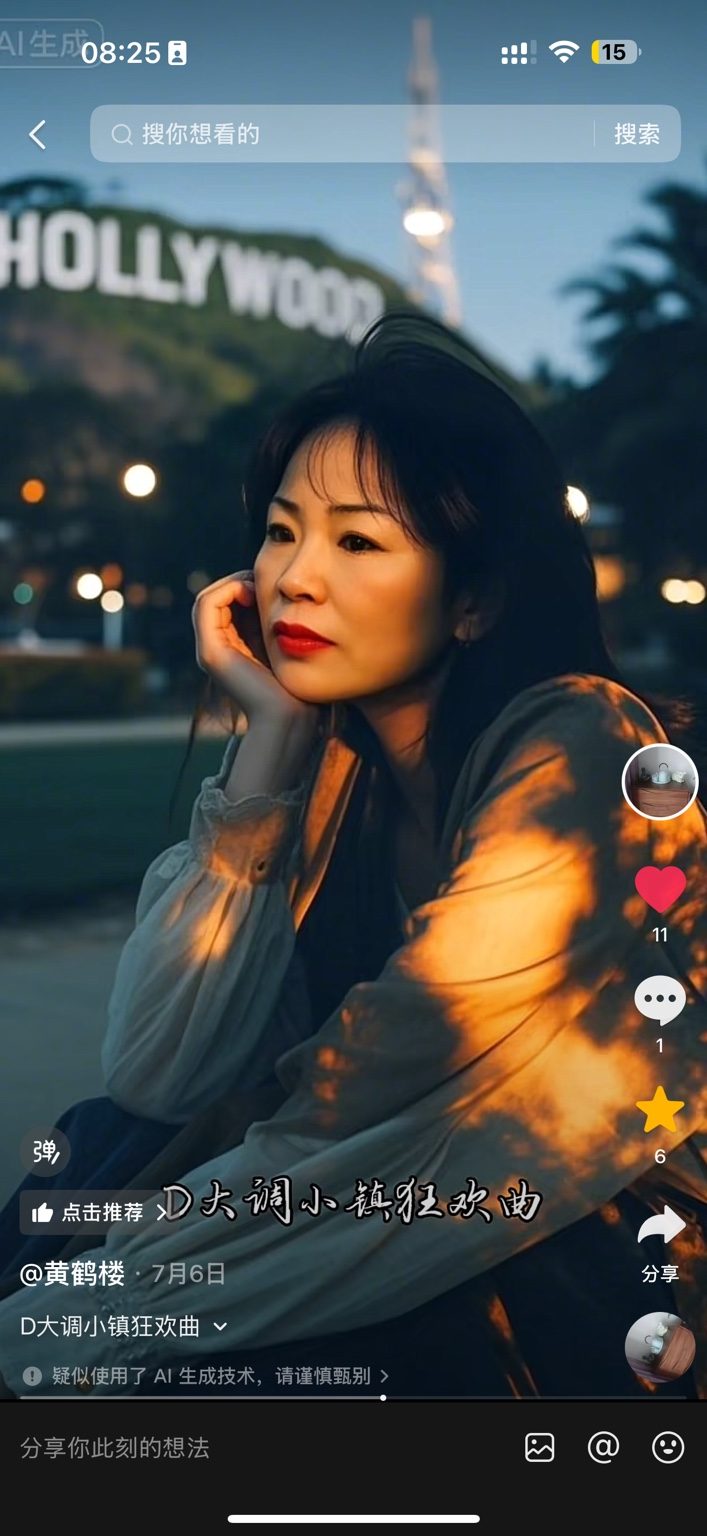
Scrolling further through his profile, the story became more interesting than “who wrote this tune.”
Huanghelou has posted more than 2,000 works. Especially around July 6, he posted track after track in a similar style, each with a different melody. It looks a lot like one person intensely exploring a musical style during that stretch: generating, trying, then moving on to the next one.
And the video itself carries an AI-generated label.
So my guess is that “Small Town Carnival” is probably one piece that happened to come out of his burst of AI music experiments at the time. Of course, these public traces alone cannot prove he is the original creator, but the clues so far are fascinating.
As I kept scrolling, I noticed something else.
Many of his music covers show the same woman again and again. In a number of posts and captions, he says she is his wife, who died a few years ago.
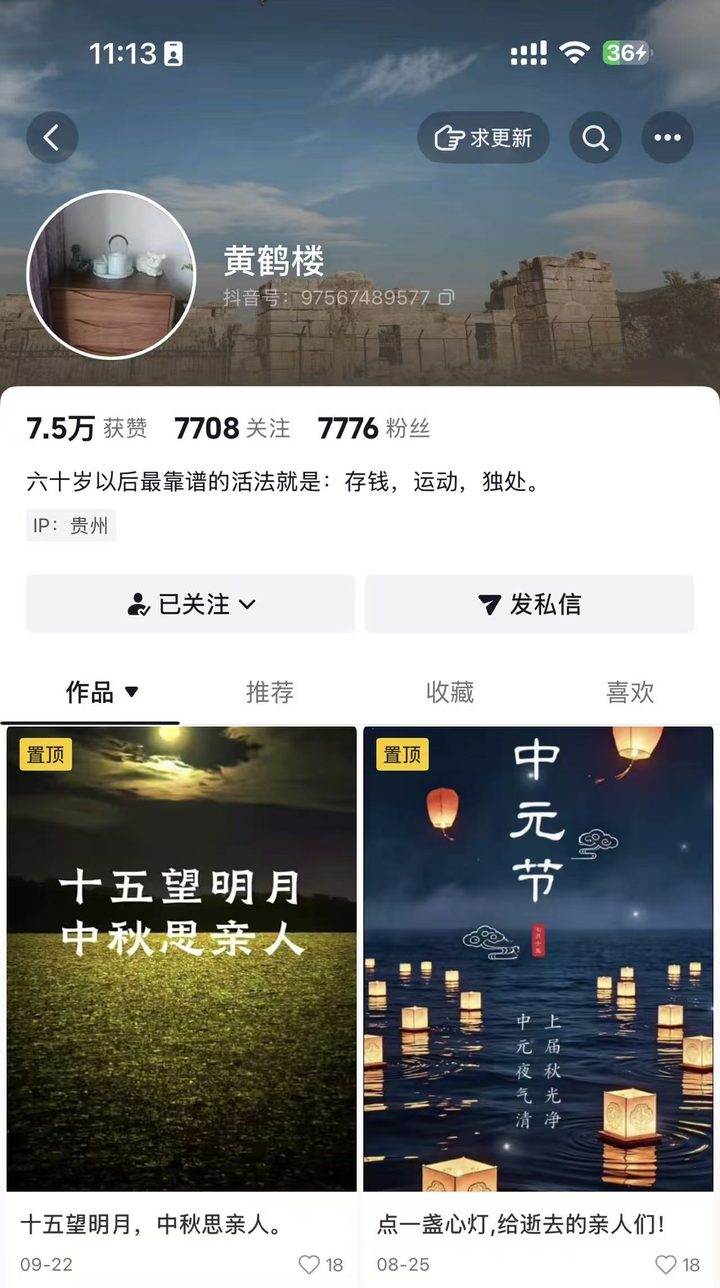
At that point I realised that the detective work, “Is this AI music?” and “Who is the real author?”, was no longer the part that moved me most.
I could not help forming a guess. Perhaps after his wife died, he missed her terribly and went through deep loneliness and hardship. Then AI music tools came along, and he began making music, one piece after another. Perhaps the music was not only for other people to hear, but also a way to keep himself company: to turn longing, feelings and imagination he could not put into words into one melody after another.
Of course, I do not know what his real life is like. This is only a guess, drawn from the traces left by more than two thousand works.
But it made me think about the positive meaning of AI creation for people from a different angle.
When we talk about AI music or AI art, we often ask:
“Does this count as real creation?”
“Will AI replace artists?”
“Does AI-generated work have any artistic value?”
These questions are usually asked from the point of view of professional creators.
From an ordinary person’s point of view, things may look completely different.
In the past, someone who could not compose, however strong their feelings, would find it very hard to turn those feelings into a complete piece of music. A piece like “Small Town Carnival,” which sounds like a full orchestra, used to mean composing, orchestration, a score, and a group of real musicians.
Now one person sitting at a computer can turn a vague feeling in their head into an “orchestra.”
Someone who cannot compose can still express longing through music.
Someone who cannot paint can still create a picture for a person who is gone.
Someone with no audience can still make what is inside them real.
Here, AI is not necessarily “replacing an artist.”
It may also be handing someone who was never an artist a tool for expression they never had before.
There is one more contrast in this story that struck me.
At around 9 a.m. on September 25, 2026, I looked at Huanghelou’s July 6 post of “Small Town Carnival in D Major.” It had only about 10 likes.
Yet the videos that later reposted the music, set it to new footage, renamed it, and even gave it a backstory about “Mozart writing it at 16 in Salzburg” had collected thousands, even tens of thousands of likes.
At first I thought I was just chasing a fun internet mix-up:
A piece of music that was probably born in the AI era of 2026 somehow picked up more than two hundred years of history as it spread.
But by the end of the chase, I cared much less about the “fake Mozart” story.
I would rather remember a different picture:
A man, perhaps missing his late wife and keeping himself company with AI and music, made a melody I love in a corner of the internet with only ten likes.
Then the melody left him.
It has no orchestra and no concert hall, and perhaps no group of people has ever sat down together to play it. But it still found its way into the ears of thousands upon thousands of people.
If the music once kept its creator company and helped him heal, then after leaving him it seems to have started keeping other people company too, including me, who heard it by chance today and then spent a long time looking for it.
That is probably the biggest lesson this small piece of internet archaeology gave me:
The meaning of AI may not only be that machines gain the ability to create.
It may also be that many people who never had the skill or the tools to create can, for the first time, express themselves.